


 Ver en contexto
 Enviar
 Compartir
 Detalles

 Descargar
 Similares
 Radiografía
 Presentación de diapositivas
Primavera -

 Ver más
Giclée / Impresión de arte
Impresiones giclée o en lienzo de calidad de museo con producción rápida y opciones de acabado flexibles. ( Comprar pintura hecha a mano Comprar imagen)




P118B $10

P118H $10

P118W $10

P438Z $10

P508JH $12

P508YH $12

P805H $10

P805Z $10

P919BZ $10

P919G $10

P919XJ $10

P959ZH $10

P968JZ $12

W106C $8

W218G $10

W218JH $8

W218Y $10

W307PJ $10

W316G $10

W316PJ $8

W316Y $10

W398PJ $8

W4111J $10

W500HY $15

W500JH $15

W692G $12

W849H $8

W940BG $15

W953PJ $8




Elija entre nuestros tamaños predefinidos que respetan las proporciones originales de la obra.

Puede introducir sus propias dimensiones para adaptarse a un marco o espacio específico. Si el tamaño seleccionado no coincide con las proporciones de la imagen original, recortaremos la obra de arte o extenderemos la imagen con un borde con efecto espejo o de color sólido. Se enviará una maqueta digital para su aprobación antes de que comience la producción.
Tenga en cuenta que la vista previa en pantalla no refleja el recorte o la extensión real. Solo la maqueta mostrará con precisión la composición final.
Aunque existen tamaños personalizados, recomendamos seleccionar una dimensión de la lista predefinida para preservar las proporciones originales.
Envío a todo el mundo () en 2 semanas en lugar de las 4/5 semanas estándar. (6 septiembre)

Envío exprés gratuito a todo el mundo

Lienzo de lino de alta calidad

Seguro de envío total

Garantía de reembolso de impuestos aduaneros

Garantía de fidelidad cromática exacta

Política de devolución de 100 días (solo por defectos)

Garantía de devolución del 100% del dinero

Descuento por cantidad
 La opción de vidrio solo está disponible en tamaños inferiores a 110 cm.

Primavera -
Giclée / Impresión de arte
Dimensiones de la reproducción
-


Precio total final
$ 62
Sandro Botticelli’s *Primavera*: A Renaissance Reverie
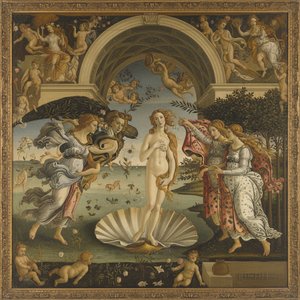
Sandro Botticelli's *Primavera*, painted circa 1482, stands as one of the most enchanting and enduring images of the Italian Renaissance. More than simply a depiction of a woodland scene, it is a complex tapestry woven with allegorical symbolism, reflecting the intellectual currents and humanist ideals that defined Florence during the reign of Lorenzo de' Medici. The painting’s immediate impact lies in its ethereal beauty – a dreamlike vision populated by exquisitely rendered figures amidst a vibrant, almost impossibly lush, natural setting. Botticelli’s masterful handling of line and color creates an atmosphere of serene contemplation, inviting viewers to lose themselves within this carefully constructed world.
- Subject Matter: The scene portrays a gathering of mythological figures – Venus, Mars, Mercury, Zephyrus, and Flora – amidst a grove of trees. While the precise narrative remains debated by scholars, it is widely believed to be an allegorical representation of springtime, love, and fertility, drawing upon classical mythology and humanist interpretations.
- Style & Technique: Botticelli’s style in *Primavera* exemplifies the Florentine Early Renaissance. Characterized by elongated figures, graceful poses, and a delicate attention to detail, it departs from the more rigid conventions of earlier Gothic art. The painting is executed with tempera on wood panel, a technique favored by Botticelli that allows for precise lines and subtle gradations of color.
A Symphony of Symbolism
*Primavera* is saturated with symbolic meaning, reflecting the intellectual climate of Florence at the time. Venus, often identified as the goddess of love and beauty, occupies a central position, her presence radiating an aura of grace and serenity. Mars, representing war and strength, stands in contrast to Venus’s gentleness, suggesting the inherent tension between opposing forces. Mercury, the messenger god, embodies intellect and communication, while Zephyrus, the west wind, is depicted as blowing Flora, goddess of spring and flowers, into bloom. The apple tree itself – a recurring motif in Renaissance art – symbolizes immortality and the renewal of life. The knife held by one figure has been interpreted as representing the act of hunting or preparation for food, adding another layer to the painting's complex symbolism.
- Venus’s Role: As the central figure, Venus embodies not just earthly love but also divine grace and spiritual perfection.
- The Grove as a Microcosm: The forest setting represents the ideal state of nature – a harmonious balance between humanity and the natural world.
Historical Context & Legacy
Painted for the Medici family, *Primavera* reflects the humanist revival that was transforming Florence in the late 15th century. The rediscovery of classical antiquity fueled a renewed interest in mythology and allegory, providing artists with new subjects and intellectual frameworks. Botticelli’s work, along with works by other Florentine masters like Leonardo da Vinci and Michelangelo, helped to establish Florence as the cultural center of Europe. *Primavera* quickly gained renown, becoming one of the most celebrated paintings of the Renaissance and inspiring countless artists throughout history. Its influence can be seen in subsequent depictions of spring and fertility, solidifying its place as a cornerstone of Western art.
Note:** This reproduction is created using high-resolution digital printing on premium canvas with archival inks, ensuring exceptional color accuracy and longevity.*Obras relacionadas


Biografía del artista
vida temprana y formación
Sandro Botticelli, nacido Alessandro di Mariano di Vanni Filipepi alrededor de 1445, fue una figura clave en el Renacimiento temprano de la pintura italiana. Inicialmente eclipsado post mortem, la obra de Botticelli fue revitalizada a finales del siglo XIX por los pre-rafaelitas, lo que llevó a una reevaluación de sus contribuciones artísticas. Botticelli nació en Florencia, Italia, y vivió toda su vida en el mismo barrio. Su familia, incluyendo a su padre Mariano di Vanni d'Amadeo Filipepi, estuvo involucrada en diversas profesiones, lo que les permitió entrar en contacto con artistas. Giorgio Vasari informó que Botticelli fue inicialmente entrenado como joyero.Estilo artístico y obras notables
La obra de Botticelli se caracteriza por una elegante linealidad, que conecta el gótico tardío italiano con el Renacimiento temprano. Sus obras más famosas, El nacimiento de Venus y Primavera, se exhiben en la Galería Uffizi en Florencia, que alberga una importante colección de su arte. * El nacimiento de Venus (ver en ArtsDot) * Primavera (explorar el arte de Sandro Botticelli en ArtsDot) * La natividad mística (Galería Nacional, Londres), fechada en 1501, es la única obra de Botticelli con una fecha clara.Legado e influencia
El estilo de Botticelli evolucionó hacia un enfoque más personal en la década de 1490, divergente de sus contemporáneos como Leonardo da Vinci y el estilo del Alto Renacimiento emergente. Su obra ha sido reconocida como una contribución significativa al movimiento artístico del Renacimiento italiano. * El movimiento artístico del Renacimiento italiano * Sandro Botticelli en Wikipedia- Artistas notables del Renacimiento italiano incluyen a Sandro Botticelli, Leonardo da Vinci, Miguel Ángel y Tiziano.
- La Galería Uffizi de Florencia alberga una importante colección de arte de Botticelli.
- La obra de Botticelli ha sido reconocida como una figura clave en el Renacimiento temprano de la pintura italiana.

Sandro Botticelli
1445 - 1510 , Italia
Datos clave
- Artistas Que Influyeron:
- Fra Angelico
- Paolo Uccello
- Estilo Artístico: Renacimiento Temprano
- Fecha De Muerte: 1510
- Fecha De Nacimiento: c. 1445
- Influenciado A Artistas: ['Pre-Rafaelitas']
- Lugar De Nacimiento: Florencia, Italia
- Nacionalidad: Italiana
- Nombre Completo: Sandro Botticelli
- Obras Notables:
- El Nacimiento de Venus
- Primavera
- Natividad Mística
Artículos relacionados
Botticelli: Las 25 Obras Maestras del Renacimiento para Decorar con Arte y Elegancia
Descubre las 25 obras maestras de Sandro Botticelli, el genio del Renacimiento italiano. Explora 'El Nacimiento de Venus', 'Primavera' y más: historia, técnica y belleza clásica. Encuentra reproducciones de arte exclusivas en ArtsDot.com.

Los 10 Maestros del Renacimiento Temprano: Arte que Transformó el Mundo |
Descubre los 10 maestros del Renacimiento Temprano: Botticelli, Leonardo da Vinci y más. Explora la historia, técnica y belleza de obras icónicas italianas. Reproducciones de arte exclusivas en .

Giclée Prints: Archival Quality & Aesthetic Nuances for the Discerning Collector
Explore the world of giclée prints with ArtsDot. Learn about archival quality, aesthetic nuances & investment potential. Expert guidance for discerning art collectors seeking museum-quality reproductions and lasting value.

Echoes of Time: Exploring the Enduring Appeal & Historical Context of Vintage Art Prints
Explore the captivating world of vintage art prints! Discover their history, collecting tips & enduring appeal. Expert insights on chromolithography and building a legacy collection with ArtsDot.

Los 25 Tesoros del Uffizi: Arte Renacentista para tu Hogar | ArtsDot
Descubre los 25 tesoros del Uffizi en Florencia: Botticelli, Leonardo da Vinci y más. Explora la historia, el arte renacentista y encuentra reproducciones de alta calidad para tu hogar. ¡Inspírate con ArtsDot.com!


