


La imagen se ajusta a sus preferencias: , .
Descripción del objeto
Explore Raphael Kirchner’s 1909 illustration of a romantic kiss – Art Nouveau influence, teal accents & bold lines. A captivating glimpse into early graphic design.
Biografía del artista
Descubre a Rafael Kirchner (1875-1917), artista austriaco del Art Nouveau conocido por sus ilustraciones y el popular 'Kirchner Girl'. Influencia japonesa y legado artístico inolvidable.
 Ver más
Reproducción al óleo hecha a mano
Óleo sobre lienzo pintado a mano en el tamaño y marco de su elección, realizado por encargo por nuestros artistas. ( Cambiar a impresiones Cambiar a imagen digital)
Order your in four simple steps
Tómese su tiempo. Puede cambiar cualquier respuesta; el precio en su carrito de compra se actualizará según cada elección.
1 Paso uno de cuatro
¿Qué tamaño desea?
Estos tamaños mantienen las proporciones de la pintura original. El dibujo muestra su elección en una pared, sobre un sofá de dos metros.
O introduce tus propias medidas
Elija entre nuestros tamaños predefinidos que respetan las proporciones originales de la obra.

Indique el ancho y el alto que necesite para adaptarse a su marco o pared. Al tratarse de una obra pintada a mano, si requiere un tamaño con una proporción distinta, el artista puede pintar un poco más alrededor de la imagen o recortarla ligeramente; usted elige. Le enviaremos una maqueta digital para su aprobación antes de comenzar la pintura. La imagen que se muestra en esta página no refleja el resultado real; solo la maqueta lo hace.
2 Paso dos de cuatro
¿Cómo desea recibirlo: enrollado, estirado o enmarcado?
Los precios que aparecen a continuación corresponden al tamaño seleccionado en el primer paso.
Elige el acabado de los bordes del lienzo
Elige tu marco

Blanco €1

Bordes difuminados €1

Continuación de imagen €1

P118B €10

P118H €10

P118W €10

P438Z €10

P508JH €12

P508YH €12

P805H €10

P805Z €10

P919BZ €10

P919G €10

P919XJ €10

P959ZH €10

P968JZ €12

W106C €8

W218G €10

W218JH €8

W218Y €10

W307PJ €10

W316G €10

W316PJ €8

W316Y €10

W398PJ €8

W4111J €10

W500HY €15

W500JH €15

W692G €12

W849H €8

W940BG €15

W953PJ €8

H24-GOLD €30

H24-SILVER €30

H36-GOLD €45

H36-SILVER €45
Con marco
Moldura: . Dimensiones totales con marco: .
3 Paso tres de cuatro
¿Desea realizar algún cambio en la pintura?
La mayoría de las personas responden que no. Debido a que cada pintura se realiza a mano, nuestro artista también puede adaptarla para usted.
Tras realizar el pedido, el equipo de ArtsDot.com enviará un correo electrónico al cliente para solicitar instrucciones y proporcionar una vista previa del boceto
4 Paso cuatro de cuatro
Algunas opciones de acabado
Todos ellos son opcionales. Las respuestas ya seleccionadas no tienen ningún coste adicional.
¿Quién lo pinta?
Envío a todo el mundo () en 3-4 semanas en lugar de las 5 semanas estándar. (17 noviembre). Sin comprometer la calidad.
¿Una placa de identificación, como en un museo?
Detalles de la placa de bronce grabada
This elegant plaque features the artist's name and the title of the artwork, finely engraved for a timeless presentation.
It is made from bronze with a refined, elegant finish. The text is precisely laser-engraved for a sharp and permanent result. Measuring 9x2 cm, the plaque is compact yet easy to read. It's built to be durable and scratch-resistant, offering a professional, museum-quality look. Mounting is simple thanks to the included adhesive backing.
Detalles de la placa de acrílico transparente
The plaque includes essential engraved details such as the artist's name, the title of the artwork, the date it was created, the type of media used-like oil on canvas or watercolor-a brief description of the piece, and a QR code that links to the complete artwork information.
It is crafted from clear acrylic, offering a sleek, modern appearance. The text is UV-engraved in black to ensure strong visual contrast. With a size of 10x15 cm, it ensures optimal readability. It comes equipped with two metal hooks for secure wall mounting. The plaque is designed to be weather-resistant, making it suitable for various environments, and it includes interactive features that work seamlessly with smartphone scanning.
Detalles de la placa de acrílico negro
This elegant plaque includes engraved information such as the artist's name, the title of the artwork, the date it was created, the type of media used (like oil on canvas or watercolor), a short description of the artwork, and a QR code for quick access to more information.
The plaque itself is made from refined black acrylic with a premium finish. The text is laser-engraved in white for high contrast and readability. Its size is 10x15 cm, designed to be easy to read. It comes with two metal hooks for professional mounting. The design is sleek and fits any interior style. It is also weather-resistant and durable, with built-in digital integration for mobile compatibility.
¿Un barniz protector?
¿Para cuándo lo necesita?
✓ Revisar y pedir
Su pintura, tal como la solicitó

Unknown
Técnica de reproducción
Dimensiones de la reproducción
-

Selección de artistas premium
Mayor nivel de detalle, delicadeza y tiempo de producción adicional
-

Enmarcado de reproducción
-
-
Para obras de arte o reproducciones que midan más de 105 cm (aproximadamente 41 pulgadas) en cualquiera de sus lados, el marco se enviará como un kit desmontado. Este método garantiza una entrega segura y evita daños durante el transporte.
Se requiere montaje profesional: este no es un producto para hacer usted mismo (DIY).
El kit debe ser ensamblado y el lienzo tensado por un enmarcador profesional con experiencia, utilizando cola para madera (no incluida), una tenaza para tensar lienzos y sargentos para mantener los bastidores alineados mientras la cola se seca. Un montaje incorrecto o una tensión desigual del lienzo pueden dañar la obra de arte de forma permanente y no están cubiertos por nuestra garantía.
 Para obras de arte o reproducciones que midan más de 105 cm (aproximadamente 41 pulgadas) en cualquiera de sus lados, el marco se enviará como un kit desmontado. Este método garantiza una entrega segura y evita daños durante el transporte.
Se incluyen todos los listones de madera maciza, cortados con precisión según las medidas.
Se ensambla con los tornillos incluidos, además de cola para madera para las uniones de las esquinas, la cual no se incluye y debe ser proporcionada por su enmarcador.
Se requieren herramientas profesionales que no están incluidas: un alicate para tensar lienzos (tensor) y abrazaderas para mantener los bastidores alineados mientras se seca el pegamento.
Importante:
Las uniones de las esquinas requieren cola para madera, los listones deben sujetarse con prensas hasta que la cola esté completamente seca, y para tensar el lienzo en el bastidor ensamblado se requiere una pinza para tensar lienzos. Ninguno de estos elementos está incluido en el kit. Por favor, contacte con un profesional del enmarcado con experiencia antes de realizar un pedido de este tamaño.

Cartela
-
-

Barniz protector
Barniz brillante (realza los colores y protege contra la luz y la humedad)
-

Personalizar mi obra
Ejemplos de lo que se puede personalizar: sustituir el rostro por una foto del cliente; añadir una mascota (por ejemplo, cambiar un gato por un perro); incluir un mensaje oculto en el fondo; cambiar el paisaje o los elementos del fondo.
-

Envío urgente
Envío a todo el mundo () en 3 o 4 semanas, en lugar de las 5 semanas habituales. (17 noviembre). Sin comprometer la calidad.
-
Envío urgente
Envío internacional () en 5 semanas. (24 noviembre).
Incluido
Precio total final
€ 257
La opción de vidrio solo está disponible en tamaños inferiores a 110 cm.
Incluido en cada pedido
- Envío exprés gratuito a todo el mundo
- Lienzo de lino de alta calidad
- Seguro de envío total
- Garantía de reembolso de aranceles aduaneros
- Garantía de fidelidad cromática exacta
- Política de devolución de 100 días (solo por defectos)
- Garantía de devolución del 100% del dinero
- Descuento por cantidad


 Ver en contexto
 Enviar
 Compartir
 Detalles
 Guía
Guía

 Descargar
 Similares
 Radiografía
 Presentación de diapositivas
 Preguntas y respuestas
 Estadísticas
Obras relacionadas


Rafael Kirchner
1875 - 1917, Austria
Biografía del artista
Un visionario vienés: La vida y el arte de Raphael Kirchner
Raphael Kirchner, nacido en Viena en 1875, emergió como una figura trascendental durante los años crepusculares del movimiento Art Nouveau, dejando tras de sí un legado cautivador de ilustraciones elegantes y retratos evocadores. Su vida, aunque trágicamente truncada en 1917, abarcó un período de inmensos cambios artísticos, siendo testigo de la transición desde los ornamentados florecimientos de la Secesión de Viena hacia el floreciente mundo del arte pin-up temprano. La trayectoria de Kirchner comenzó con una formación académica en la Academia de Bellas Artes de Viena, lo que le proporcionó una base sólida en técnicas tradicionales que más tarde infundiría con su sensibilidad única. Sin embargo, fue su traslado a París alrededor de 1900 lo que verdaderamente encendió su desarrollo artístico. La vibrante atmósfera de la capital francesa, impregnada de la estética Art Nouveau y una pujante sociedad de cafés, resultó ser un terreno fértil para el talento de Kirchner. Rápidamente encontró trabajo ilustrando para revistas prominentes como La Vie Parisienne, perfeccionando su habilidad para capturar la belleza femenina y las tendencias de la moda.El encanto de la «Kirchner Girl» y las influencias orientales
La firma artística de Kirchner se convirtió en sinónimo de un tipo particular de mujer: la «Kirchner Girl». Estas figuras, a menudo representadas en entornos lujosos o adornadas con joyas exquisitas, emanaban un aire de sofisticada sensualidad. No eran abiertamente provocativas, pero poseían un erotismo sutil que cautivaba al público y presagiaba la estética pin-up venidera. Su maestría residía en su capacidad para combinar la precisión técnica con una cualidad onírica, creando imágenes que eran a la vez seductoras y etéreas. Un aspecto definitorio de la obra de Kirchner fue su fascinación por el arte japonés, particularmente por los grabados xilografías ukiyo-e. Esta influencia es sorprendentemente evidente en su célebre serie «Geisha», una colección de más de 40.000 postales que alcanzó una popularidad fenomenal. Estas imágenes no eran meras reproducciones de motivos japoneses; eran fusiones innovadoras del Art Nouveau occidental y la estética oriental, demostrando la capacidad de Kirchner para sintetizar diversas tradiciones artísticas. La serie «Geisha» se erige como un testimonio del intercambio intercultural que ocurría a principios de siglo, reflejando una creciente fascinación por el exótico Oriente dentro de la sociedad europea.De París a Nueva York: Una carrera transatlántica
El estallido de la Primera Guerra Mundial alteró drásticamente la trayectoria de Kirchner. En 1914, tomó la trascendental decisión de trasladarse a los Estados Unidos, estableciéndose en la ciudad de Nueva York. Este movimiento resultó crucial, permitiéndole continuar con sus aspiraciones artísticas mientras navegaba por un mundo sumido en el conflicto. Se integró rápidamente en la escena artística estadounidense, colaborando con otros artistas y asegurando encargos para diseños teatrales. Notablemente, Kirchner creó diseños de vestuario y paneles decorativos para el Century Theatre, demostrando su versatilidad más allá de la ilustración. Su trabajo para el teatro consolidó aún más su reputación e introdujo a la «Kirchner Girl» ante una audiencia estadounidense ávida de escapismo durante la guerra. Aunque su estancia en Nueva York fue relativamente breve —falleció en 1917 a la edad de 42 años—, marcó un capítulo significativo en su carrera, demostrando su adaptabilidad y su atractivo perdurable.Legado e influencia duradera
El impacto de Raphael Kirchner en la cultura visual se extiende mucho más allá de su vida. Su labor pionera al fusionar el Art Nouveau con la estética japonesa allanó el camino para nuevas expresiones artísticas. Es reconocido como un precursor clave del arte pin-up que floreció durante la Segunda Guerra Mundial, influyendo en artistas como Alberto Vargas, quien reconoció abiertamente la inspiración que le brindó Kirchner. El atractivo perdurable de su serie «Geisha» y otras ilustraciones reside en su elegancia atemporal y su belleza cautivadora. Su capacidad para capturar el espíritu de una era —un período marcado tanto por la innovación artística como por el cambio social— continúa resonando en los espectadores de hoy. La obra de Kirchner sirve como un recordatorio del poder del arte para trascender las fronteras culturales y evocar emociones duraderas, consolidando su lugar como una figura significativa en la historia de la ilustración y el Art Nouveau. Sus imágenes permanecen como símbolos potentes de una época pasada, susurrando relatos de belleza, sofisticación y el encanto de lo exótico.
Artículos relacionados

Las 25 obras maestras de Ernst Ludwig Kirchner: El alma del Expresionismo Alemán
Explora las 25 obras de Ernst Ludwig Kirchner y el alma del expresionismo alemán. ¡Descubre toda la colección en ArtsDot.com!

Raphael Kirchner: A Poetic Vision of Belle Époque Society Through Art Nouveau Lithography
Explore the captivating world of Raphael Kirchner, a master of Art Nouveau illustration during the Belle Époque. Discover his iconic 'Kirchner Girls,' pioneering pin-up art & lasting influence.
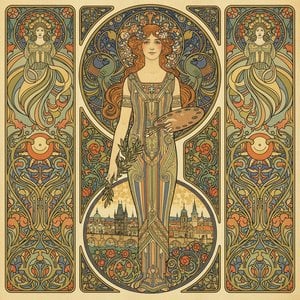
Alphonse Mucha: A Comprehensive Exploration of Art Nouveau's Master of Decorative Symbolism
Explore the life & art of Alphonse Mucha, master of Art Nouveau! Discover his iconic posters, stunning illustrations, and the monumental Slav Epic. A comprehensive guide for collectors & enthusiasts.