


The picture follows your choices: , .
Descripción del objeto
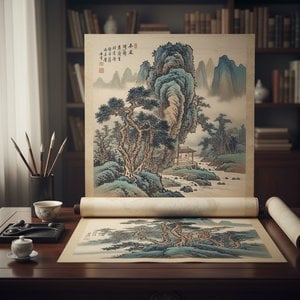
Experience Qiu Ying's 'The Sixteen Luohans,' a stunning 16th-century Chinese handscroll showcasing masterful gongbi brushwork & intricate detail of Buddhist figures.
 Ver más
Biografía del artista
Qiu Ying (1494-1552): Pintor de la dinastía Ming famoso por sus paisajes exquisitos, figuras y flores al estilo gongbi. Uno de los Cuatro Maestros del arte chino.
Reproducción al óleo hecha a mano
Óleo sobre lienzo pintado a mano en el tamaño y marco de su elección, realizado por encargo por nuestros artistas. ( Cambiar a impresiones Cambiar a imagen digital)
More about this painting
 Ver en contexto
 Enviar
 Compartir
 Detalles
 Guía
Guía

 Descargar
 Similares
 Radiografía
 Presentación de diapositivas
 Q&A
Q&A Estadísticas
Order your painting in four simple steps
Take your time. You can change any answer; the price in your order card follows each choice.
1 Step one of four
Which size would you like?
These sizes keep the proportions of the original painting. The drawing shows your choice on a wall, above a two-metre sofa.
Or give your own measurements
Elija entre nuestros tamaños predefinidos que respetan las proporciones originales de la obra.

Indique el ancho y el alto que necesite para adaptarse a su marco o pared. Al tratarse de una obra pintada a mano, si requiere un tamaño con una proporción distinta, el artista puede pintar un poco más alrededor de la imagen o recortarla ligeramente; usted elige. Le enviaremos una maqueta digital para su aprobación antes de comenzar la pintura. La imagen que se muestra en esta página no refleja el resultado real; solo la maqueta lo hace.
2 Step two of four
How should it be prepared: rolled, stretched or framed?
The prices below are for the size you chose in step one.
Choose the edges of the stretched canvas
Choose your frame

White €1

Blurside €1

Extended €1

P118B €10

P118H €10

P118W €10

P438Z €10

P508JH €12

P508YH €12

P805H €10

P805Z €10

P919BZ €10

P919G €10

P919XJ €10

P959ZH €10

P968JZ €12

W106C €8

W218G €10

W218JH €8

W218Y €10

W307PJ €10

W316G €10

W316PJ €8

W316Y €10

W398PJ €8

W4111J €10

W500HY €15

W500JH €15

W692G €12

W849H €8

W940BG €15

W953PJ €8

H24-GOLD €30

H24-SILVER €30

H36-GOLD €45

H36-SILVER €45
Con marco
Moulding: . Overall size with the frame: .
3 Step three of four
Would you like anything changed in the painting?
Most people answer no. Because each painting is made by hand, our artist can also adapt it for you.
After order, ArtsDot.com team will email client for instructions and provide a mockup preview
4 Step four of four
A few finishing options
All of them are optional. The answers already selected cost nothing extra.
Who paints it?
Envío a todo el mundo () en 3-4 semanas en lugar de las 5 semanas estándar. (2 noviembre). Sin comprometer la calidad.
A nameplate, as in a museum?
Detalles de la placa de bronce grabada
This elegant plaque features the artist's name and the title of the artwork, finely engraved for a timeless presentation.
It is made from bronze with a refined, elegant finish. The text is precisely laser-engraved for a sharp and permanent result. Measuring 9x2 cm, the plaque is compact yet easy to read. It's built to be durable and scratch-resistant, offering a professional, museum-quality look. Mounting is simple thanks to the included adhesive backing.
Detalles de la placa de acrílico transparente
The plaque includes essential engraved details such as the artist's name, the title of the artwork, the date it was created, the type of media used-like oil on canvas or watercolor-a brief description of the piece, and a QR code that links to the complete artwork information.
It is crafted from clear acrylic, offering a sleek, modern appearance. The text is UV-engraved in black to ensure strong visual contrast. With a size of 10x15 cm, it ensures optimal readability. It comes equipped with two metal hooks for secure wall mounting. The plaque is designed to be weather-resistant, making it suitable for various environments, and it includes interactive features that work seamlessly with smartphone scanning.
Detalles de la placa de acrílico negro
This elegant plaque includes engraved information such as the artist's name, the title of the artwork, the date it was created, the type of media used (like oil on canvas or watercolor), a short description of the artwork, and a QR code for quick access to more information.
The plaque itself is made from refined black acrylic with a premium finish. The text is laser-engraved in white for high contrast and readability. Its size is 10x15 cm, designed to be easy to read. It comes with two metal hooks for professional mounting. The design is sleek and fits any interior style. It is also weather-resistant and durable, with built-in digital integration for mobile compatibility.
A protective varnish?
When do you need it?
✓ Check and order
Your painting, as you ordered it

Handscroll
Técnica de reproducción
Dimensiones de la reproducción
-

Selección de artistas premium
Mayor nivel de detalle, delicadeza y tiempo de producción adicional
-

Enmarcado de reproducción
-
-
Para obras de arte o reproducciones que midan más de 105 cm (aproximadamente 41 pulgadas) en cualquiera de sus lados, el marco se enviará como un kit desmontado. Este método garantiza una entrega segura y evita daños durante el transporte.
Se requiere montaje profesional: este no es un producto para hacer usted mismo (DIY).
El kit debe ser ensamblado y el lienzo tensado por un enmarcador profesional con experiencia, utilizando cola para madera (no incluida), una tenaza para tensar lienzos y sargentos para mantener los bastidores alineados mientras la cola se seca. Un montaje incorrecto o una tensión desigual del lienzo pueden dañar la obra de arte de forma permanente y no están cubiertos por nuestra garantía.
 Para obras de arte o reproducciones que midan más de 105 cm (aproximadamente 41 pulgadas) en cualquiera de sus lados, el marco se enviará como un kit desmontado. Este método garantiza una entrega segura y evita daños durante el transporte.
Se incluyen todos los listones de madera maciza, cortados con precisión según las medidas.
Se ensambla con los tornillos incluidos, además de cola para madera para las uniones de las esquinas, la cual no se incluye y debe ser proporcionada por su enmarcador.
Se requieren herramientas profesionales que no están incluidas: un alicate para tensar lienzos (tensor) y abrazaderas para mantener los bastidores alineados mientras se seca el pegamento.
Importante:
Las uniones de las esquinas requieren cola para madera, los listones deben sujetarse con prensas hasta que la cola esté completamente seca, y para tensar el lienzo en el bastidor ensamblado se requiere una pinza para tensar lienzos. Ninguno de estos elementos está incluido en el kit. Por favor, contacte con un profesional del enmarcado con experiencia antes de realizar un pedido de este tamaño.

Cartela
-
-

Barniz protector
Barniz brillante (realza los colores y protege contra la luz y la humedad)
-

Personalizar mi obra
Ejemplos de lo que se puede personalizar: sustituir el rostro por una foto del cliente; añadir una mascota (por ejemplo, cambiar un gato por un perro); incluir un mensaje oculto en el fondo; cambiar el paisaje o los elementos del fondo.
-

Envío urgente
Envío a todo el mundo () en 3 o 4 semanas, en lugar de las 5 semanas habituales. (2 noviembre). Sin comprometer la calidad.
-
Envío urgente
Envío internacional () en 5 semanas. (9 noviembre).
Incluido
Precio total final
€ 234
La opción de vidrio solo está disponible en tamaños inferiores a 110 cm.
Included with every order
- Envío exprés gratuito a todo el mundo
- Lienzo de lino de alta calidad
- Seguro de envío total
- Garantía de reembolso de aranceles aduaneros
- Garantía de fidelidad cromática exacta
- Política de devolución de 100 días (solo por defectos)
- Garantía de devolución del 100% del dinero
- Descuento por cantidad


Qiu Ying’s “Up the River During Qingming”: A Masterpiece of Ming Dynasty Serenity
“Up the River During Qingming,” painted by Qiu Ying during the mid-16th century, is more than just a landscape; it's a carefully constructed meditation on harmony, leisure, and the enduring beauty of nature. Attributed to one of China’s Four Masters of the Ming Dynasty – alongside Shen Zhou, Tang Yin, and Wen Zhengming – this exquisite handscroll offers a rare glimpse into the refined aesthetic sensibilities of Suzhou during that era. The work, currently residing in the collection of the National Gallery of Canada, invites viewers into a tranquil scene brimming with subtle symbolism and masterful brushwork.
Qiu Ying’s artistic journey was remarkably unconventional for his time. Rather than pursuing formal training within established art circles, he began as a lacquer artisan, honing his skills in meticulous detail – a foundation that profoundly influenced the precision and control evident throughout “Up the River During Qingming.” This early experience instilled in him an unparalleled understanding of line and color, qualities he would later translate into his celebrated landscape paintings. His apprenticeship with Zhou Chen in Suzhou further solidified his technical abilities, exposing him to the techniques of the Wu School, known for its emphasis on ink washes and a more expressive approach to nature.
A Symphony of Detail: Technique and Style
The painting’s remarkable quality stems from Qiu Ying's mastery of the gongbi technique – a highly detailed, realistic style that was favored by court painters. Each element—from the meticulously rendered bamboo stalks to the delicate folds of the pavilions—is executed with painstaking precision, creating an illusion of incredible depth and texture. Notice the subtle gradations of color achieved through layering washes of ink and pigment; this creates a luminous quality that brings the scene to life. The composition is carefully balanced, drawing the eye across the landscape in a deliberate and engaging manner. The artist’s use of loose brushwork, particularly in depicting the distant mountains and flowing river, contrasts beautifully with the tightly controlled detail of the foreground elements, demonstrating Qiu Ying's versatility and his ability to seamlessly blend different artistic approaches.
Symbolism Woven into the Landscape
“Up the River During Qingming” is rich in symbolic meaning. The scene depicts a scholar leisurely enjoying a day by the river, surrounded by carefully arranged pavilions and gardens. This imagery reflects the Confucian ideals of scholarly pursuits, contemplation, and harmony with nature – values highly esteemed during the Ming Dynasty. The presence of the tavern and the farmer gathering water vegetables adds a touch of everyday life to the scene, reminding us that even amidst beauty and tranquility, human activity continues. The bamboo grove, a recurring motif in Chinese art, symbolizes resilience, integrity, and longevity—qualities admired in virtuous individuals. The distant mountains represent permanence and stability, while the flowing river embodies fluidity and change.
A Window into Ming Dynasty Culture
Beyond its aesthetic beauty, “Up the River During Qingming” offers a valuable insight into Ming Dynasty culture. It reflects the importance of gardens as spaces for contemplation, artistic expression, and social interaction. The lavish furnishings within the pavilions—including the exquisite celadon vase—demonstrate the wealth and sophistication of the era’s elite. The painting also reveals the influence of philosophical ideas, particularly those associated with Zhou Dunyi, whose “On the Love for the Lotus” inspired the scene's composition and symbolism. Qiu Ying’s ability to seamlessly integrate these diverse elements into a cohesive and harmonious whole is a testament to his artistic skill and cultural awareness.
Collecting a Legacy: Reproduction and Inspiration
Reproductions of “Up the River During Qingming” capture only a fraction of the painting's original impact. The subtle nuances of color, texture, and brushwork are difficult to replicate fully, but high-quality reproductions offer an accessible way to appreciate Qiu Ying’s artistry. This work serves as a powerful reminder of the enduring appeal of Chinese landscape painting—a genre that continues to inspire artists and captivate viewers with its beauty, symbolism, and profound sense of serenity.
Preguntas y respuestas
¿Qué elementos de la obra de Qiu Ying se encuentran en "Handscroll"?
"Handscroll" comparte con otras obras de Qiu Ying su estilo Gongbi Landscape y sus temas recurrentes: song dynasty landscape influence, ming dynasty artistic tradition, buddhist themes, spiritual journey, erotic literature, social commentary, master’s signature, legacy work.
¿Qué paleta de colores utiliza "Handscroll"?
"Handscroll" de Qiu Ying utiliza una paleta de colores Earthy. Esta gama de tonos define el carácter cromático general de la obra.
¿Qué tamaño de impresión de "Handscroll" de Qiu Ying se adapta mejor a la habitación recomendada?
La combinación recomendada para "Handscroll" de Qiu Ying: una impresión de Medium en un/a Living Room.
Obras relacionadas


Qiu Ying
1494 - 1552, China
Biografía del artista
Qiu Ying: Vida y Legado
Primeros Años y Educación
Nacido en 1494 en Taicang (actualmente provincia de Jiangsu), China, Qiu Ying provenía de una familia campesina. A diferencia de muchos artistas establecidos de su época que provenían de trasfondos académicos, el camino de Qiu Ying hacia la prominencia artística fue en gran medida auto-hecho. Comenzó su formación formal bajo Zhou Chen en Suzhou, un importante centro cultural durante la dinastía Ming. Esta educación fundamental le proporcionó las habilidades y técnicas que definirían su carrera.
Desarrollo Artístico y Estilo
Si bien la escuela Wu de Suzhou favorecía principalmente la pintura con tinta china, Qiu Ying demostró una notable versatilidad, dominando tanto la delicada técnica del pincel gongbi – caracterizada por el detalle preciso y los colores vibrantes – como el estilo verde y azul. Esta adaptabilidad le permitió atender a una diversa clientela y establecer su voz artística única. Incorporó hábilmente diversas técnicas en su trabajo, demostrando una excepcional capacidad para sintetizar diferentes enfoques.
Patronazgo y Obras Maestras
La carrera de Qiu Ying floreció gracias al apoyo de ricos mecenas que encargaron una amplia gama de temas. Sus pinturas abarcaban paisajes, escenas religiosas, representaciones de flores y jardines, y composiciones figurativas. Algunas de sus obras más celebradas incluyen:
- Subiendo el Río durante Qingming: Una magistral representación inspirada en el original del período Song del Norte.
- Dama en un Bosque de Bambú: Demostrando su habilidad para representar figuras elegantes dentro de entornos naturales.
- Los Siete Sabios del Bosque de Bambú: Demostrando su comprensión de los temas literarios clásicos.
- Mañana de Primavera en el Palacio Han: Una vibrante representación de la vida cortesana.
Mecenas clave incluyeron a Chen Guan de Suzhou, y posteriormente a Zhou Fenglai y Xiang Yuanbian, ambos prominentes coleccionistas de arte que apoyaron significativamente sus esfuerzos artísticos.
Influencias y Características Artísticas
La obra de Qiu Ying refleja influencias de maestros anteriores, particularmente aquellos del período Song. Mezcló hábilmente estas preexistencias históricas con la estética Ming contemporánea. Sus pinturas se distinguen por:
- Habilidad técnica excepcional en gongbi.
- Una paleta de colores refinada y atención meticulosa al detalle.
- La capacidad de crear tanto paisajes panorámicos grandiosos como escenas íntimas y detalladas.
- Versatilidad en la materia prima y el estilo.
Significado Histórico y Legado
Qiu Ying’s talento y versatilidad le valieron el reconocimiento como uno de los “Cuatro Maestros” de la dinastía Ming – un testimonio de su profundo impacto en la pintura china. Puenteó la brecha entre los estilos tradicionales y los gustos contemporáneos, creando obras que eran tanto técnicamente brillantes como estéticamente agradables. Su influencia se extendió más allá de su vida, inspirando a generaciones de artistas con su magistral técnica e innovador enfoque. Sigue siendo una figura celebrada en la historia del arte chino, admirado por su capacidad para capturar la belleza y transmitir significado a través de sus exquisitas pinturas.
Artículos relacionados

Xie Zhiliu: A Legacy of Ink Wash Painting & Modern Chinese Literati Tradition
Explore the legacy of Xie Zhiliu, a master of Chinese ink wash painting & prominent figure in modern art. Discover his techniques, influences, and contributions to literati tradition. A guide for discerning collectors.

Ephemeral Expressions: Exploring the Nuances of Ink on Paper Through History & Contemporary Art
Explore the captivating world of ink wash painting – from its ancient origins to contemporary masters. Discover techniques, symbolism & conservation insights with ArtsDot.com.
Pu Xinyu's 'Puru': A Legacy of Literati Painting & Emotional Resonance
Explore the captivating world of Pu Xinyu (Puru), the last great literati painter. Discover his imperial heritage, masterful ink wash techniques & enduring legacy – a valuable addition to any discerning art collection.