

- 73.0 x 60.0 cm


The picture follows your choices: , .
Descripción del objeto
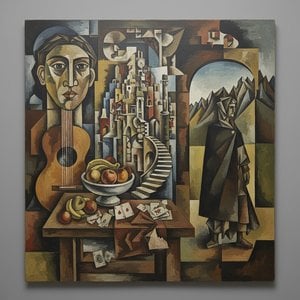
"Autoportrait (9)" de Pablo Picasso: Una obra maestra cubista que captura la esencia del artista joven y su visión del mundo en 1901. Influencias impresionistas y expresionistas en esta pieza emblemática."
 Ver más
Biografía del artista
¡Explora el arte revolucionario de Pablo Picasso! Descubre el Cubismo, los Periodos Azul y Rosa, Guernica y su impacto perdurable en el arte moderno del siglo XX. #Picasso #Cubismo
Reproducción al óleo hecha a mano
Óleo sobre lienzo pintado a mano en el tamaño y marco de su elección, realizado por encargo por nuestros artistas. ( Cambiar a impresiones Cambiar a imagen digital)
Esta obra está protegida por derechos de autor
La obra de arte que se muestra en esta página está protegida por las leyes de propiedad intelectual, lo que significa que no podemos crear ni vender legalmente una reproducción idéntica. Esta protección se hace cumplir en virtud de acuerdos internacionales como el Convenio de Berna y por las leyes nacionales, incluidas aquellas establecidas por el Ley de derechos de autor de los EE. UU. - Título 17.
Como una alternativa respetuosa y legal, ofrecemos obras de arte personalizadas y pintadas a mano inspiradas en la original. Nuestros expertos y profesionales del arte estudian cuidadosamente el estilo, el sentimiento y la esencia artística de la obra original para crear una pieza nueva y única que evoque la misma sensación, siendo al mismo tiempo una creación original por derecho propio.
Este método cumple plenamente con las normativas de derechos de autor, ya que no implica la copia ni la duplicación de la obra protegida. En su lugar, se trata de una reinterpretación creativa: una nueva pintura influenciada por la original, pero que no es idéntica a ella.
More about this painting
 Ver en contexto
 Enviar
 Compartir
 Detalles
 Guía
Guía

 Descargar
 Similares
 Radiografía
 Presentación de diapositivas
 Q&A
Q&A Estadísticas
Order your painting in four simple steps
Take your time. You can change any answer; the price in your order card follows each choice.
1 Step one of four
Which size would you like?
These sizes keep the proportions of the original painting. The drawing shows your choice on a wall, above a two-metre sofa.
Or give your own measurements
Elija entre nuestros tamaños predefinidos que respetan las proporciones originales de la obra.

Indique el ancho y el alto que necesite para adaptarse a su marco o pared. Al tratarse de una obra pintada a mano, si requiere un tamaño con una proporción distinta, el artista puede pintar un poco más alrededor de la imagen o recortarla ligeramente; usted elige. Le enviaremos una maqueta digital para su aprobación antes de comenzar la pintura. La imagen que se muestra en esta página no refleja el resultado real; solo la maqueta lo hace.
2 Step two of four
How should it be prepared: rolled, stretched or framed?
The prices below are for the size you chose in step one.
Choose the edges of the stretched canvas
Choose your frame

White €1

Blurside €1

Extended €1

P118B €10

P118H €10

P118W €10

P438Z €10

P508JH €12

P508YH €12

P805H €10

P805Z €10

P919BZ €10

P919G €10

P919XJ €10

P959ZH €10

P968JZ €12

W106C €8

W218G €10

W218JH €8

W218Y €10

W307PJ €10

W316G €10

W316PJ €8

W316Y €10

W398PJ €8

W4111J €10

W500HY €15

W500JH €15

W692G €12

W849H €8

W940BG €15

W953PJ €8

H24-GOLD €30

H24-SILVER €30

H36-GOLD €45

H36-SILVER €45
Con marco
Moulding: . Overall size with the frame: .
3 Step three of four
Would you like anything changed in the painting?
Most people answer no. Because each painting is made by hand, our artist can also adapt it for you.
After order, ArtsDot.com team will email client for instructions and provide a mockup preview
4 Step four of four
A few finishing options
All of them are optional. The answers already selected cost nothing extra.
Who paints it?
Envío a todo el mundo () en 3-4 semanas en lugar de las 5 semanas estándar. (2 noviembre). Sin comprometer la calidad.
A nameplate, as in a museum?
Detalles de la placa de bronce grabada
This elegant plaque features the artist's name and the title of the artwork, finely engraved for a timeless presentation.
It is made from bronze with a refined, elegant finish. The text is precisely laser-engraved for a sharp and permanent result. Measuring 9x2 cm, the plaque is compact yet easy to read. It's built to be durable and scratch-resistant, offering a professional, museum-quality look. Mounting is simple thanks to the included adhesive backing.
Detalles de la placa de acrílico transparente
The plaque includes essential engraved details such as the artist's name, the title of the artwork, the date it was created, the type of media used-like oil on canvas or watercolor-a brief description of the piece, and a QR code that links to the complete artwork information.
It is crafted from clear acrylic, offering a sleek, modern appearance. The text is UV-engraved in black to ensure strong visual contrast. With a size of 10x15 cm, it ensures optimal readability. It comes equipped with two metal hooks for secure wall mounting. The plaque is designed to be weather-resistant, making it suitable for various environments, and it includes interactive features that work seamlessly with smartphone scanning.
Detalles de la placa de acrílico negro
This elegant plaque includes engraved information such as the artist's name, the title of the artwork, the date it was created, the type of media used (like oil on canvas or watercolor), a short description of the artwork, and a QR code for quick access to more information.
The plaque itself is made from refined black acrylic with a premium finish. The text is laser-engraved in white for high contrast and readability. Its size is 10x15 cm, designed to be easy to read. It comes with two metal hooks for professional mounting. The design is sleek and fits any interior style. It is also weather-resistant and durable, with built-in digital integration for mobile compatibility.
A protective varnish?
When do you need it?
✓ Check and order
Your painting, as you ordered it

Pablo Picasso
Técnica de reproducción
Dimensiones de la reproducción
-

Selección de artistas premium
Mayor nivel de detalle, delicadeza y tiempo de producción adicional
-

Enmarcado de reproducción
-
-
Para obras de arte o reproducciones que midan más de 105 cm (aproximadamente 41 pulgadas) en cualquiera de sus lados, el marco se enviará como un kit desmontado. Este método garantiza una entrega segura y evita daños durante el transporte.
Se requiere montaje profesional: este no es un producto para hacer usted mismo (DIY).
El kit debe ser ensamblado y el lienzo tensado por un enmarcador profesional con experiencia, utilizando cola para madera (no incluida), una tenaza para tensar lienzos y sargentos para mantener los bastidores alineados mientras la cola se seca. Un montaje incorrecto o una tensión desigual del lienzo pueden dañar la obra de arte de forma permanente y no están cubiertos por nuestra garantía.
 Para obras de arte o reproducciones que midan más de 105 cm (aproximadamente 41 pulgadas) en cualquiera de sus lados, el marco se enviará como un kit desmontado. Este método garantiza una entrega segura y evita daños durante el transporte.
Se incluyen todos los listones de madera maciza, cortados con precisión según las medidas.
Se ensambla con los tornillos incluidos, además de cola para madera para las uniones de las esquinas, la cual no se incluye y debe ser proporcionada por su enmarcador.
Se requieren herramientas profesionales que no están incluidas: un alicate para tensar lienzos (tensor) y abrazaderas para mantener los bastidores alineados mientras se seca el pegamento.
Importante:
Las uniones de las esquinas requieren cola para madera, los listones deben sujetarse con prensas hasta que la cola esté completamente seca, y para tensar el lienzo en el bastidor ensamblado se requiere una pinza para tensar lienzos. Ninguno de estos elementos está incluido en el kit. Por favor, contacte con un profesional del enmarcado con experiencia antes de realizar un pedido de este tamaño.

Cartela
-
-

Barniz protector
Barniz brillante (realza los colores y protege contra la luz y la humedad)
-

Personalizar mi obra
Ejemplos de lo que se puede personalizar: sustituir el rostro por una foto del cliente; añadir una mascota (por ejemplo, cambiar un gato por un perro); incluir un mensaje oculto en el fondo; cambiar el paisaje o los elementos del fondo.
-

Envío urgente
Envío a todo el mundo () en 3 o 4 semanas, en lugar de las 5 semanas habituales. (2 noviembre). Sin comprometer la calidad.
-
Envío urgente
Envío internacional () en 5 semanas. (9 noviembre).
Incluido
Precio total final
€ 234
La opción de vidrio solo está disponible en tamaños inferiores a 110 cm.
Included with every order
- Envío exprés gratuito a todo el mundo
- Lienzo de lino de alta calidad
- Seguro de envío total
- Garantía de reembolso de aranceles aduaneros
- Garantía de fidelidad cromática exacta
- Política de devolución de 100 días (solo por defectos)
- Garantía de devolución del 100% del dinero
- Descuento por cantidad


Pablo Picasso: A Revolutionary Artist
Pablo Diego José Francisco de Paula Juan Nepomuceno María de los Remedios Cipriano de la Santísima Trinidad Ruiz y Picasso (25 October 1881 – 8 April 1973) was a Spanish painter, sculptor, printmaker, ceramicist, and theatre designer who spent most of his adult life in France. One of the most influential artists of the 20th century, he is known for co-founding the Cubist movement, the invention of constructed sculpture, the co-invention of collage, and for the wide variety of styles that he helped develop and explore. Among his most famous works are the proto-Cubist Les Demoiselles d'Avignon (1907) and the anti-war painting Guernica (1937), a dramatic portrayal of the bombing of Guernica by German and Italian air forces during the Spanish Civil War. Beginning his formal training under his father José Ruiz y Blasco aged seven, Picasso demonstrated extraordinary artistic talent from a young age, painting in a naturalistic manner through his childhood and adolescence. During the first decade of the 20th century, his style changed as he experimented with different theories, techniques, and ideas. After 1906, the Fauvist work of the older artist Henri Matisse motivated Picasso to explore more radical styles, beginning a fruitful rivalry between the two artists, who subsequently were often paired by critics as the leaders of modern art.- Born on October 25, 1881, in Málaga, Spain, Pablo Ruiz y Picasso demonstrated artistic talent from a very young age.
- His father, José Ruiz y Blasco, was an art teacher who provided his son with early training. It’s said Picasso's first words were “piz, piz” – attempting to say ‘pencil’.
- Picasso quickly surpassed his father’s abilities, showing remarkable skill in naturalistic depictions.
- The family moved to A Coruña and later Barcelona after the tragic loss of Picasso’s sister.
- In Barcelona, he attended the School of Fine Arts but often clashed with traditional academic instruction. He briefly studied at the Royal Academy of San Fernando in Madrid, finding it stifling and preferring to study masters like Velázquez and Goya independently.
The Blue Period (1901–1904)
The Blue Period marked Picasso’s early artistic explorations, characterized by melancholic hues—primarily blues and greens—that conveyed profound sorrow and introspection. Influenced by the suicide of his friend Carlos Casagemas, Picasso sought to express human suffering through emotionally charged imagery. This period reflects a deep preoccupation with themes of poverty, loneliness, and despair, as evidenced in paintings like “La Vie” and “The Old Guitarist.” The stylistic choices—simplified forms, muted colors, and expressive brushstrokes—were deliberately designed to evoke feelings of sadness and isolation.- Picasso’s exploration of emotion was paramount during this time, mirroring the pervasive atmosphere of grief and disillusionment prevalent in post-impressionistic circles.
- The artist's palette consisted predominantly of blues and greens, reflecting his preoccupation with themes of melancholy and loss—a conscious decision to communicate profound psychological states through visual language.
The Rose Period (1904–1906)
Following the Blue Period’s somber introspection, Picasso transitioned into a more optimistic phase known as the Rose Period. This stylistic shift coincided with his relationship with Fernande Olivier and reflected a newfound interest in portraying human figures—particularly women—with tenderness and compassion. The palette expanded beyond blues to incorporate warmer tones of pink, orange, and yellow, capturing moments of joy and intimacy. Notable works from this period include “Woman with Guitar” and “Family of Saltimbanques,” demonstrating Picasso’s evolving artistic vision.- Picasso's stylistic evolution during the Rose Period signaled a departure from the emotional intensity of his Blue Period, embracing a more lyrical aesthetic that celebrated human connection and beauty.
- The incorporation of warmer hues—pink, orange, and yellow—created a visual contrast with the melancholic blues of his earlier oeuvre, reflecting Picasso’s newfound optimism and desire to depict positive emotions.
Cubism: A Revolutionary Breakthrough
Picasso's artistic journey culminated in the groundbreaking development of Cubism alongside Georges Braque. This revolutionary movement shattered traditional perspective and representation, fragmenting objects into geometric planes—often simultaneously depicted from multiple viewpoints—creating a visual illusion of depth and complexity. Les Demoiselles d’Avignon (1907) stands as a seminal example of Proto-Cubism, foreshadowing the stylistic innovations that would define Cubist art. Analytic Cubism, characterized by monochromatic palettes and meticulous dissection of forms, pushed artistic boundaries while Synthetic Cubism introduced collage elements—incorporating textures and materials from outside the canvas—expanding the scope of artistic expression.- Picasso’s pioneering exploration of Cubism fundamentally altered the course of modern art, challenging conventions of representation and establishing a new visual language that prioritized geometric abstraction over illusionistic realism.
- The stylistic hallmarks of Analytic Cubism—monochromatic color schemes and meticulous fragmentation—were meticulously executed to convey an intellectual understanding of spatial relationships, reflecting Picasso’s commitment to artistic innovation.
Preguntas y respuestas
¿Es "Pablo Picasso" de Pablo Picasso una pintura, un dibujo o un grabado?
"Pablo Picasso" de Pablo Picasso está clasificada como Arte de pared. Esta categoría describe la técnica o el tipo de obra de arte que representa el original.
¿Qué sentimiento transmite "Pablo Picasso" de Pablo Picasso dentro de Analytical Cubism?
"Pablo Picasso" transmite un tono emocional Melancólico dentro del movimiento Analytical Cubism.
¿Cuántas personas ven "Pablo Picasso"?
La página Estadísticas de "Pablo Picasso" de Pablo Picasso presenta las estadísticas de visitas públicas: visitas mensuales de esta obra, una comparación con las obras más vistas del artista y el origen de sus visitantes.
Obras relacionadas


Pablo Picasso
1881 - 1973, España
Biografía del artista
Pablo Picasso: Un Artista Revolucionario
Vida Temprana y Formación (1881-1904)
- Nacido el 25 de octubre de 1881 en Málaga, España, Pablo Ruiz y Picasso demostró un talento artístico desde muy temprana edad.
- Su padre, José Ruiz y Blasco, era profesor de arte quien proporcionó a su hijo una formación inicial. Se dice que las primeras palabras de Picasso fueron “piz, piz” – intentando decir ‘lápiz’.
- Picasso rápidamente superó las habilidades de su padre, mostrando una habilidad notable en representaciones naturalistas.
- La familia se mudó a A Coruña y luego a Barcelona tras la trágica pérdida de la hermana de Picasso.
- En Barcelona, asistió a la Escuela de Bellas Artes pero a menudo chocaba con las instrucciones académicas tradicionales. Estudió brevemente en la Real Academia de San Fernando en Madrid, encontrándola sofocante y prefiriendo estudiar a los maestros como Velázquez y Goya por su cuenta.
Los Períodos Azul y Rosa (1901-1906)
- El Período Azul (aproximadamente 1901-1904) se caracteriza por pinturas sombrías dominadas por tonos de azul y verde azulado.
- Estas obras a menudo representan figuras marginadas – mendigos, ciegos, prostitutas – reflejando melancolía y comentario social. Ejemplos clave incluyen La Vie (1903) y El Guitarrista Viejo (1903-1904).
- Después de esto, surgió el Período Rosa (1904-1906) con tonos más cálidos – rosas, naranjas y rojos.
- Este período refleja una perspectiva más optimista, a menudo representando artistas de circo, harlequines y acróbatas. Familia de Saltimbanques (1905) ejemplifica este cambio.
Los Años Revolucionarios: Cubismo y Más Allá (1907-1919)
- 1907 marcó un momento decisivo con Les Demoiselles d'Avignon, influenciado por la escultura iberica y las máscaras africanas. Esta pintura rompió con la perspectiva tradicional, allanando el camino para el Cubismo.
- Trabajando en estrecha colaboración con Georges Braque, Picasso cofundó el Cubismo, alterando fundamentalmente la forma en que los artistas representaban la realidad.
- Cubismo Analítico (1909-1912) presentaba formas fragmentadas, colores apagados y una disección de objetos en formas geométricas.
- Cubismo Sintético (1912-1919) incorporó elementos de collage – recortes de periódicos, retazos de tela – para crear superficies texturizadas y nuevas capas visuales.
Neoclasicismo y Surrealismo (Década de 1920 - Década de 1930)
- La década de 1920 vio a Picasso explorar estilos neoclásicos con figuras monumentales que enfatizaban las formas clásicas.
- También se involucró con el movimiento surrealista, aunque nunca se alineó completamente con sus principios. Su obra combinaba estilos anteriores con imágenes surrealistas y perspectivas distorsionadas.
Años Posteriores y Legado (1940-1973)
- Durante la Segunda Guerra Mundial, Picasso permaneció en Francia, produciendo declaraciones anti-guerra poderosas como Guernica (1937), una respuesta visceral al bombardeo de Guernica durante la Guerra Civil Española.
- Guernica se convirtió en un símbolo perdurable del horror de la guerra y sigue siendo una de sus obras más celebradas.
- A lo largo de las décadas de 1950 y 60, Picasso continuó experimentando con diversos medios – cerámica, escultura, grabado – demostrando una versatilidad notable.
- Se casó con Jacqueline Roque en 1961. Murió el 8 de abril de 1973 en Mougins, Francia.
Influencias y Significado Histórico
- El desarrollo artístico de Picasso estuvo moldeado por los maestros españoles como Velázquez y Goya, la escultura iberica, el arte africano y Henri Matisse.
- Su impacto en el arte del siglo XX es inmenso. Co-fundó el Cubismo, pionero en el collage y la escultura construida, y desafió constantemente las convenciones artísticas.
- La experimentación incansable de Picasso rediseñó el arte moderno y continúa inspirando a los artistas hoy en día.
- Su prolífica producción – estimada en más de 50.000 obras – consolida su posición como uno de los artistas más importantes e influyentes de la historia.


Artículos relacionados
Los 10 Maestros del Cubismo Expresionista: Obras que Transformaron el Arte | ArtsDot
Descubre los 10 lienzos cubistas más influyentes de Picasso, Braque y otros maestros. Explora la historia, técnica y significado del movimiento artístico que revolucionó el arte moderno. Reproducciones de alta calidad en ArtsDot.com.

Los 10 Retratos Cubistas Esenciales que Revolucionaron el Arte Moderno | ArtsDot
Descubre los 10 retratos cubistas esenciales de Picasso, Braque y otros maestros. Explora la historia, técnica y significado de este revolucionario movimiento artístico. Encuentra reproducciones de arte exclusivas en ArtsDot.com.

Pablo Picasso: A Revolutionary Vision – Cubism, Symbolism & Enduring Legacy
Explore the revolutionary art of Pablo Picasso with ArtsDot.com. Discover Cubism's origins, symbolism in his masterpieces & investment insights for collectors. Expert appraisal & custom reproductions available.