


 Ver en contexto
 Enviar
 Compartir
 Detalles

 Descargar
 Similares
 Radiografía
 Presentación de diapositivas
 Estadísticas
Spring Night
 Social Realism
 27.0 x 33.0 cm
 Ver más
Reproducción al óleo hecha a mano
Óleo sobre lienzo pintado a mano en el tamaño y marco de su elección, realizado por encargo por nuestros artistas. ( Cambiar a Impresión Cambiar a imagen digital)




































Elija entre nuestros tamaños predefinidos que respetan las proporciones originales de la obra.

Puede ingresar sus propias dimensiones para adaptarse a un marco o espacio específico. Si el tamaño seleccionado no coincide con las proporciones de la imagen original, recortaremos la obra o extenderemos la pintura con elementos adicionales pintados a mano. Se le enviará una maqueta digital para su aprobación antes de comenzar la producción.
Tenga en cuenta que la vista previa en pantalla no refleja el recorte o la extensión reales. Solo la maqueta mostrará con precisión la composición final.
Si bien existen tamaños personalizados, recomendamos seleccionar una dimensión de la lista predefinida para preservar las proporciones originales.
Tras realizar el pedido, el equipo de ArtsDot.com enviará un correo electrónico al cliente para solicitar instrucciones y proporcionarle una vista previa del boceto.
Envío a todo el mundo () en 3-4 semanas en lugar de las 5 semanas estándar. (10 septiembre). Sin comprometer la calidad.

Envío exprés gratuito a todo el mundo

Lienzo de lino de alta calidad

Seguro de envío total

Garantía de reembolso de impuestos aduaneros

Garantía de fidelidad cromática exacta

Política de devolución de 100 días (solo por defectos)

Garantía de devolución del 100% del dinero

Descuento por cantidad
 La opción de vidrio solo está disponible en tamaños inferiores a 110 cm.

Spring Night
Técnica de reproducción
Dimensiones de la reproducción
-


Precio total final
$ 288
Artist Background
Leonard Pytlak was an American artist associated with the Works Progress Administration (WPA) during the Great Depression era in the United States. His WPA prints are celebrated for their poignant portrayal of everyday American life. As a notable artist, Pytlak's work can be found in various museums and galleries, including the Smithsonian American Art Museum.The Painting
Spring Night is a captivating piece that showcases Pytlak's ability to evoke a sense of calm and serenity. The scene features a street at night with trees in the background, and two people walking down the road. A car can be seen parked near the center of the image, adding a touch of modernity to the otherwise peaceful atmosphere.- The use of lithography allows for a high level of detail and precision in the artwork.
- The Smithsonian American Art Museum has an extensive collection of Pytlak's work, including Spring Night.
- Leonard Pytlak's unique style and technique have made him a notable artist in the world of American art.
The captivating "Spring Night" by Leonard Pytlak is a must-see for anyone interested in American art and the WPA era. With its serene atmosphere and precise details, this lithograph is a true masterpiece of its time.
Obras relacionadas


Biografía del artista
Leonard Pytlak: A Chronicle of American Urban Life
Leonard Pytlak (1910-1998) wasn’t a name that frequently graces the headlines of art history, yet his work quietly holds a remarkable significance within the narrative of mid-20th century American art. Born in Newark, New Jersey, and nurtured by a keen eye for detail, Pytlak emerged as a pivotal figure in the realm of graphic arts, particularly through his contributions to the Works Progress Administration (WPA) and subsequent explorations of screenprinting. His legacy isn’t one of grand gestures or revolutionary movements, but rather a meticulous and deeply human portrayal of everyday American life – the bustling streets of New York City, the quiet moments within its tenements, and the resilient spirit of its working class.
Pytlak's artistic journey began with formal training at the Newark School of Fine and Industrial Art and further honed at the prestigious Art Students League in New York. It was here, amidst a vibrant community of artists, that he discovered his passion for printmaking, a medium perfectly suited to capturing the nuances of urban experience. The WPA, established during the Great Depression, provided him with an unprecedented opportunity – a lifeline and a platform to document the realities of the era. His work for the WPA wasn’t simply decorative; it was a vital record of a nation grappling with economic hardship and social change. He produced murals, lithographs, and screenprints that offered glimpses into the lives of ordinary people, from dockworkers and street vendors to factory laborers and tenement residents.
The WPA Years: A Window into Depression-Era America
Pytlak’s association with the WPA was a defining period in his career. During this time, he became deeply involved in the Graphic Arts Division, contributing significantly to the production of over ninety-six prints. These works are not merely reproductions of scenes; they're imbued with a palpable sense of empathy and observation. Titles like “Back Alley,” “Bowery El-Theater,” and "Fall Day" aren’t just descriptive; they evoke specific atmospheres and narratives. His lithographs, often characterized by their meticulous detail and subtle tonal variations, captured the gritty beauty of New York City – its shadows, its textures, and its inhabitants.
Notably, Pytlak's work during this period aligns with the broader Ashcan School movement, though he possessed a unique sensibility. Like artists such as Robert Henri, he focused on depicting everyday life without romanticizing it. However, unlike the more overtly social commentary of some Ashcan painters, Pytlak’s prints often possess a quiet dignity and a sense of understated observation. His work also reflects the influence of WPA's emphasis on accessibility – creating art for the people, by the people.
Beyond the WPA: Screenprinting and Artistic Innovation
Following his tenure with the WPA, Pytlak continued to explore printmaking, particularly through the development of screenprinting. He played a pioneering role in popularizing this technique as a viable medium for fine art, establishing the National Serigraph Society and collaborating with other artists like Hyman Warsager. Screenprinting allowed him greater control over color and texture, enabling him to create richer, more layered compositions. This shift marked a significant evolution in his artistic practice, moving beyond the traditional lithographic process.
His experimentation with screenprinting led to exhibitions at prestigious galleries such as Kennedy & Company and the ACA Gallery, solidifying his reputation within the art world. He also received recognition through Guggenheim Fellowships, further validating his artistic vision and commitment to innovation. His work during this period demonstrates a willingness to embrace new technologies while retaining a deep respect for traditional printmaking techniques.
Legacy and Historical Significance
Leonard Pytlak’s contribution to American art often remains understated, yet his legacy is substantial. His WPA prints provide invaluable insights into the social and economic realities of the Great Depression era, offering a poignant record of a nation in transition. Beyond their historical significance, Pytlak's works possess a remarkable aesthetic quality – a quiet beauty born from meticulous observation and a deep understanding of human experience. His exploration of urban landscapes and working-class life continues to resonate today, reminding us of the enduring power of art to document, interpret, and connect with the complexities of our shared history.
His work is now held in collections at institutions like the British Museum, the Smithsonian American Art Museum, and the Metropolitan Museum of Art, ensuring that his vision will continue to be appreciated for generations to come. Pytlak’s legacy isn't one of flamboyant displays or grand pronouncements; it’s a testament to the quiet power of observation, empathy, and artistic innovation.

leonard pytlak
1910 - 1998
Datos clave
- Artistic Movement Or Style: WPA prints, lithography, silkscreen
- Artists Or Movements Influenced By This Artist:
- WPA Graphics Program
- Ashcan School
- Artists Who Influenced This Artist: ['Anthony Velonis']
- Date Of Birth: 1910
- Date Of Death: 1998
- Full Name: Leonard Pytlak
- Nationality: American
- Notable Artworks:
- Spring Night
- Back Alley
- Fall Day
- Place Of Birth: Newark, New Jersey
Artículos relacionados

Giclée Prints: Archival Quality & Aesthetic Nuances for the Discerning Collector
Explore the world of giclée prints with ArtsDot. Learn about archival quality, aesthetic nuances & investment potential. Expert guidance for discerning art collectors seeking museum-quality reproductions and lasting value.

Grant Wood & American Regionalism: Identity, Myth & the Rural Landscape
Explore the world of Grant Wood & American Regionalism with ArtsDot. Discover the symbolism behind 'American Gothic', recurring themes, and the movement's lasting impact on art history. High-quality reproductions available.

The Enduring Legacy of Fine Art Prints: Technique, History & Aesthetic Impact
Explore the rich history & techniques of fine art prints. Discover investment potential, assess authenticity, and learn how to preserve your collection with expert guidance. Trusted insights for discerning collectors.

Regionalismo Americano: Un Crisol de Identidad en el Arte y la Sociedad
Explora el Regionalismo Americano: su historia, artistas clave como Benton y Wood, y su profundo compromiso con la sociedad de la Gran Depresión. Un análisis exhaustivo para amantes del arte.
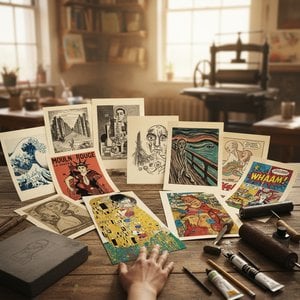
Las 10 Litografías Legendarias que Revolucionaron el Arte | ArtsDot
Descubre las 10 litografías legendarias de Toulouse-Lautrec, Munch y Goya que revolucionaron el arte. Explora su historia, técnica y significado en ArtsDot.com. Reproducciones de museo para tu hogar.