

 Vista previa
 Compartir
 Compartir
 Ver detalles

 Descargar
 Ver similares
 Radiografía
 Presentación de diapositivas
The Bottle


 Leer más
Adquiera una imagen digital de alta resolución y optimizada, muy superior a la vista previa en línea.
Cada archivo es preparado meticulosamente por nuestros especialistas internos mediante el uso de herramientas avanzadas y un experto retoque manual. Nos aseguramos de que cada imagen posea una claridad excepcional, una precisión cromática impecable y un detalle minucioso.
El archivo final se entrega por correo electrónico en un plazo de 72 horas, optimizado para su uso inmediato en entornos profesionales, editoriales y de impresión. Esta es la misma calidad en la que confían los estudios de diseño, las editoriales y las galerías de primer nivel.
Imagen Digital
Descarga un archivo de alta resolución para exhibición personal, impresión y proyectos creativos. ( Pedir impresión Encargar reproducción pintada a mano)
Incluido en cada compra de imágenes digitales
Entrega digital experta, garantizada.
Al elegir ArtsDot.com, no solo está adquiriendo una imagen; está recibiendo una obra de arte digital mejorada profesionalmente, elaborada con precisión y respaldada por una garantía de satisfacción. Esto es todo lo que incluye su pedido, automáticamente:

Entrega rápida por email
Recibirá su archivo de imagen digital en alta resolución por correo electrónico en un plazo de 72 horas tras realizar su pedido, listo para su uso inmediato.

Archivo digital optimizado por IA
Su obra de arte se optimiza profesionalmente mediante herramientas avanzadas de IA y edición manual, garantizando el máximo detalle, claridad y precisión cromática.

Reenvío gratuito de por vida
¿Has borrado o perdido tu archivo por error? No te preocupes: te lo volveremos a enviar en cualquier momento, sin coste adicional.

Sin gastos de importación, siempre
Disfrute de su obra de arte al instante sin aduanas, aranceles ni gastos de envío; las descargas digitales siempre están libres de impuestos.

Garantía de precisión de color
Garantizamos que su imagen digital refleje los colores originales con la mayor fidelidad posible, mediante el uso de herramientas profesionales y gestión del color.

Garantía de satisfacción de 60 días
Si no está satisfecho con su imagen digital, la revisaremos o le reembolsaremos el 100% en un plazo de 60 días, sin preguntas.

100% Garantía de devolución de dinero
¿No está satisfecho? Obtenga un reembolso completo dentro de los 60 días posteriores a la recepción de su archivo digital, sin necesidad de explicaciones.

Descuentos por volumen
Compra 3 imágenes, ahorra 10% - Compra 5, ahorra 15% - Compra 10+, ahorra 20%. Ideal para proyectos creativos, galerías y agencias.
Descripción del coleccionable
A Masterpiece of Synthetic Cubism
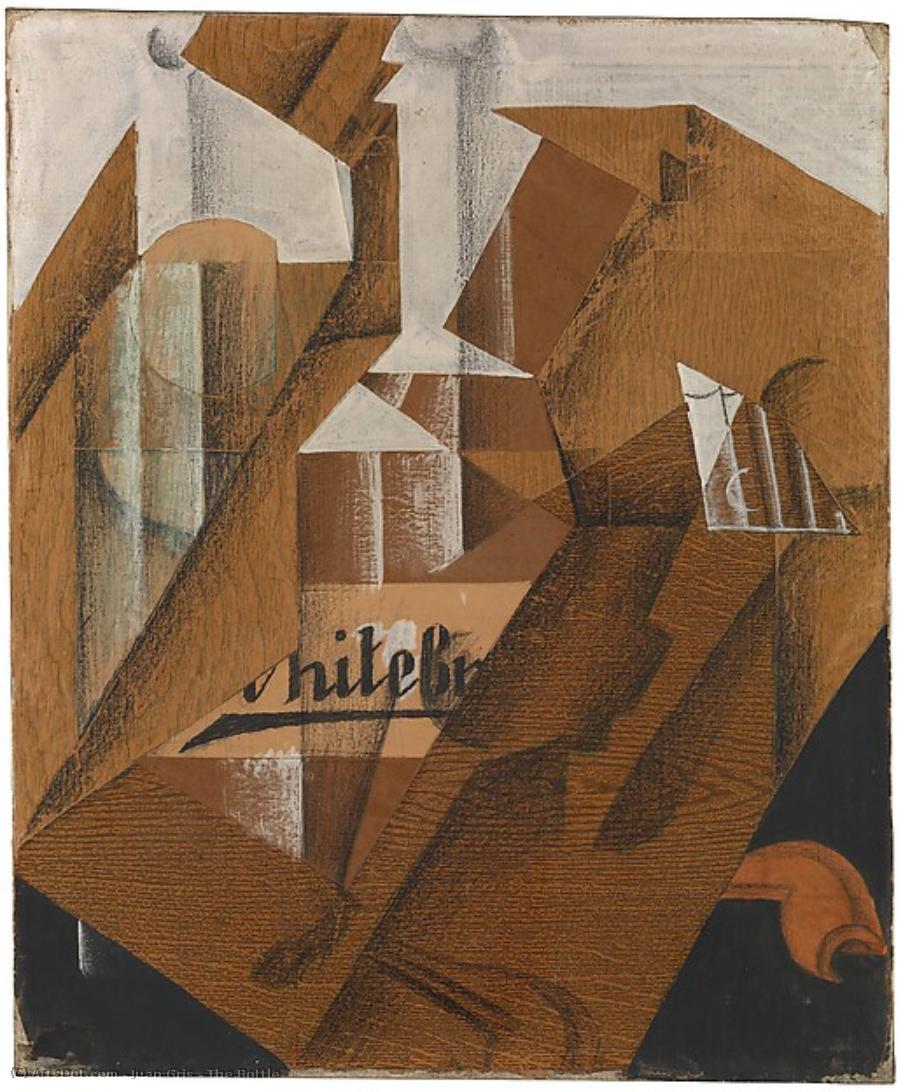
In the vibrant, experimental atmosphere of 1914 Paris, Juan Gris achieved a profound synthesis of reality and abstraction in his seminal work, The Bottle. This composition serves as a breathtaking testament to the era of papier collé, a technique that revolutionized the way artists approached the canvas. Unlike the more fragmented and austere approaches of his contemporaries, Picasso and Braque, Gris utilized a method that felt lush, deliberate, and deeply textured. The painting invites the viewer into a meticulously constructed world where the boundaries between everyday objects and artistic invention blur, creating a sense of organized chaos that is both intellectually stimulating and visually captivating.
The subject matter—a collection of bottles, a cup, and a clock—transcends mere still life. Through the clever use of layered papers and paint, Gris transforms mundane items into a complex architectural arrangement. The central bottle, bearing the name "Philip," acts as an anchor for the eye, its translucent brown tones suggesting the weight and depth of real glass. Surrounding it, the presence of other vessels and the rhythmic geometry of the clock create a dense, layered environment. This is not merely a depiction of objects; it is an exploration of how we perceive space and form through the intersection of different materials and textures.
The Alchemy of Paper and Paint
What distinguishes The Bottle is Gris’s unparalleled mastery of the papier collé technique. During a prolific eight-month period in 1914, Gris experimented with the hybrid medium of adhering diverse paper elements—ranging from newspaper clippings to patterned wallpapers—directly onto the canvas. This method allowed him to introduce "real" textures into the painted realm, challenging the traditional sanctity of oil painting. He did not simply paste shapes; he carefully planned each layer, using cut and matched pieces of paper to build a structural foundation that he would then outline, shade, and highlight with masterful precision.
This technique creates a fascinating tension between trompe l’oeil (deceiving the eye) and pure abstraction. While some elements mimic the appearance of physical depth and light, others remain resolutely flat and graphic. For the discerning collector or interior designer, this duality offers an incredible versatility. The work possesses a rhythmic, decorative quality that can anchor a modern room with its sophisticated geometry, yet it retains a profound historical weight that commands respect in any gallery setting.
A Legacy of Intellectual Beauty
Beyond its visual allure, The Bottle represents the intellectual climax of Gris’s exploration into Cubism. His background in engineering is evident in the structural integrity of the composition; every fragment feels essential to the whole. The work captures a specific moment in art history—the transition from the analytical deconstruction of objects to the synthetic reconstruction of new realities. It is a piece that rewards repeated viewing, as the eye discovers new intersections of color, shadow, and texture with every glance.
For those seeking to bring a piece of the Parisian avant-garde into their personal or professional spaces, a high-quality reproduction of this work offers more than just decoration. It provides an entry point into the revolutionary spirit of 1914. The painting’s rich palette of earth tones, punctuated by the sharp lines of newsprint and geometric forms, makes it an ideal centerpiece for sophisticated interiors that value historical depth, intellectual rigor, and the timeless beauty of the Cubist movement.
Obras relacionadas


Biografía del artista
Juan Gris: Pionero del Cubismo
- Nacimiento: 23 de marzo de 1887, Madrid, España
- Fallecimiento: 11 de mayo de 1927
Primeros Años y Desarrollo Artístico
José Victoriano González-Pérez, conocido como Juan Gris, nació en Madrid, España. Su vida temprana incluyó estudiar ingeniería en la Escuela de Artes y Ciencias desde 1902 hasta 1904. Durante este tiempo, contribuyó con dibujos a publicaciones locales, demostrando una aptitud temprana para la representación visual. De 1904 a 1905, Gris estudió pintura con José Moreno Carbonero, desarrollando aún más sus habilidades artísticas. En 1905, adoptó el seudónimo Juan Gris, un nombre que se convertiría en sinónimo de su estilo distintivo.
Influencias Parisinas y el Ascenso del Cubismo
Un momento crucial en la carrera de Gris llegó en 1906 cuando se mudó a París. Este traslado lo expuso a una vibrante comunidad artística, donde se hizo amigo de figuras influyentes como Henri Matisse, Georges Braque y Fernand Léger. Fue profundamente influenciado por Pablo Picasso, inicialmente presentando ilustraciones humorísticas a revistas como *L'Assiette au Beurre*, *Le Rire*, *Le Charivari* y *Le Cri de Paris*. Alrededor de 1910, Gris comenzó a pintar seriamente, dedicándose a desarrollar un estilo cubista personal. Se alejó de la ilustración satírica hacia composiciones más abstractas.
Obras Clave y Estilo Artístico
La producción artística de Juan Gris se caracteriza por varias características clave:
- Claridad y Orden: Su obra enfatizaba la claridad y el orden, influyendo en el estilo purista defendido por Amédée Ozenfant y Charles Edouard Jeanneret (Le Corbusier).
- Estructura Geométrica: El "período cristalino" de Gris, ejemplificado en obras como *Naturaleza muerta frente a una ventana abierta* y *Place Ravignan* (1915), mostraba una fuerte estructura geométrica.
- Cubismo Sintético: Después de 1913, Gris abrazó el Cubismo Sintético, utilizando técnicas como papier collé o collage extensivamente. Esto implicaba incorporar materiales del mundo real en sus pinturas, agregando textura y profundidad.
Obras notables incluyen:
- Guitarra frente al mar (1925): Demuestra su simplicidad y adherencia a los principios cubistas.
- Homenaje a Pablo Picasso (1912): Su primera exposición en el Salon des Indépendants, un testimonio de su creciente reconocimiento dentro del mundo del arte.
Legado y Significado Histórico
La contribución de Juan Gris al Cubismo es significativa. Se movió más allá de la fase analítica anterior del movimiento hacia un enfoque más estructurado y sintético. Su énfasis en la claridad, las formas geométricas y la incorporación de objetos cotidianos en sus composiciones lo estableció como una figura líder en el arte del siglo XX. Su obra continúa siendo celebrada por su rigor intelectual y belleza estética, influyendo en generaciones posteriores de artistas.

Juan Gris
1887 - 1927 , España
Datos clave
- Artistas Que Influyeron:
- Pablo Picasso
- Georges Braque
- Henri Matisse
- Fecha De Fallecimiento: 11 de mayo de 1927
- Fecha De Nacimiento: 23 de marzo de 1887
- Influenciado Por:
- Amédée Ozenfant
- Charles Edouard Jeanneret
- Lugar De Nacimiento: Madrid, España
- Movimiento Artístico: Cubismo, Cubismo Sintético
- Nacionalidad: Española
- Nombre Completo: Juan Gris
- Obras Notables:
- Guitarra frente al mar
- Homenaje a Pablo Picasso
- Naturaleza muerta ante ventana
- Place Ravignan
- Frutero, vaso y periódico

