


 Ver en contexto
 Enviar
 Compartir
 Detalles

 Descargar
 Similares
 Radiografía
 Presentación de diapositivas
 Estadísticas
Sea Idyll


 Ver más
Giclée / Impresión de arte
Impresiones giclée o en lienzo de calidad de museo con producción rápida y opciones de acabado flexibles. ( Comprar pintura hecha a mano Cambiar a imagen digital)




P118B $10

P118H $10

P118W $10

P438Z $10

P508JH $12

P508YH $12

P805H $10

P805Z $10

P919BZ $10

P919G $10

P919XJ $10

P959ZH $10

P968JZ $12

W106C $8

W218G $10

W218JH $8

W218Y $10

W307PJ $10

W316G $10

W316PJ $8

W316Y $10

W398PJ $8

W4111J $10

W500HY $15

W500JH $15

W692G $12

W849H $8

W940BG $15

W953PJ $8




Elija entre nuestros tamaños predefinidos que respetan las proporciones originales de la obra.

Puede introducir sus propias dimensiones para adaptarse a un marco o espacio específico. Si el tamaño seleccionado no coincide con las proporciones de la imagen original, recortaremos la obra de arte o extenderemos la imagen con un borde con efecto espejo o de color sólido. Se enviará una maqueta digital para su aprobación antes de que comience la producción.
Tenga en cuenta que la vista previa en pantalla no refleja el recorte o la extensión real. Solo la maqueta mostrará con precisión la composición final.
Aunque existen tamaños personalizados, recomendamos seleccionar una dimensión de la lista predefinida para preservar las proporciones originales.
Envío a todo el mundo () en 2 semanas en lugar de las 4/5 semanas estándar. (9 septiembre)

Envío exprés gratuito a todo el mundo

Lienzo de lino de alta calidad

Seguro de envío total

Garantía de reembolso de impuestos aduaneros

Garantía de fidelidad cromática exacta

Política de devolución de 100 días (solo por defectos)

Garantía de devolución del 100% del dinero

Descuento por cantidad
 La opción de vidrio solo está disponible en tamaños inferiores a 110 cm.

Sea Idyll
Giclée / Impresión de arte
Dimensiones de la reproducción
-


Precio total final
$ 62
Joaquín Sorolla’s “Sea Idyll”: A Sun-Drenched Reverie of Leisure
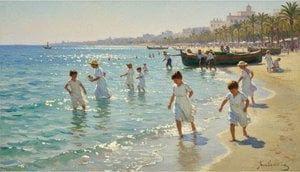
Joaquin Sorolla y Bastida, a pivotal figure in late 19th and early 20th century Spanish art, possessed an extraordinary gift for capturing the ephemeral beauty of light and life. His "Sea Idyll," completed in 1908 and currently residing within the walls of the Hispanic Society of America in New York City, is a prime example of this talent—a luminous tableau that invites viewers into a moment of serene contemplation by the Mediterranean coast. More than just a depiction of a seaside scene, it’s an exploration of joy, connection, and the simple pleasures of existence, rendered with Sorolla's signature vibrant palette and masterful brushwork.
The painting immediately establishes a mood of blissful tranquility. Two women – one reclining gracefully on the sand, partially submerged in the cool water, and the other seated upright, her straw hat casting a delicate shadow – are presented in an intimate tableau. Their postures suggest effortless relaxation, their hands raised to their faces as if lost in thought or perhaps engaged in playful interaction. Scattered throughout the composition are several birds, adding a touch of lively movement and further enhancing the sense of natural harmony. The backdrop is dominated by the shimmering expanse of the sea under a clear, azure sky, punctuated by fluffy white clouds that drift lazily across the horizon. Sorolla’s use of horizontal lines creates a feeling of spaciousness and openness, while the warm tones of the sand and water contrast beautifully with the cooler hues of the sky.
A Masterclass in Impressionistic Technique
Sorolla's technique is characterized by its remarkable immediacy and spontaneity. He employed loose, expressive brushstrokes—a hallmark of Impressionism—to capture the fleeting effects of light and atmosphere. Notice how he doesn’t meticulously render every detail; instead, he relies on suggestive strokes to convey texture and form. The water, for instance, isn't painted with precise lines but rather with a series of broken colors that create an illusion of shimmering movement. Similarly, the figures are rendered with a sense of fluidity, their forms dissolving into the surrounding light. This technique wasn’t simply about replicating what he saw; it was about conveying how he *felt* looking at the scene – a vibrant, almost palpable energy.
Sorolla's background in academic training is evident in his careful attention to color and composition, yet he skillfully subverts traditional conventions. He utilizes a steep horizon line, pushing the sky forward and creating a sense of depth that draws the viewer into the scene. The high horizon also contributes to the painting’s feeling of lightness and airiness. Furthermore, Sorolla's use of complementary colors—the warm yellows and oranges of the sand and water juxtaposed against the cool blues and greens of the sky—intensifies the visual impact of the work.
Historical Context and Symbolic Resonance
“Sea Idyll” was painted during a period of significant artistic innovation in Spain, as artists began to break away from the rigid academic traditions of the past. Sorolla’s work reflects this shift towards greater freedom and experimentation. He drew inspiration from his travels throughout Europe, particularly his time in Paris, where he encountered the Impressionist movement. However, unlike many of his European contemporaries, Sorolla retained a distinctly Spanish sensibility, capturing the warmth and light of his homeland with unparalleled skill.
The painting’s subject matter—a leisurely afternoon by the sea—holds symbolic significance as well. It represents a moment of respite from the pressures of modern life, a celebration of friendship and connection. The two women in the painting embody a sense of carefree joy and feminine grace. Some art historians interpret the scene as an allegory for the “golden age” of Spain, evoking memories of a time when life was simpler and more idyllic. Sorolla’s frequent depiction of young women in these settings—often nude or partially clothed—has been interpreted by some as reflecting a fascination with beauty and sensuality, while others see it as a celebration of female freedom and independence.
A Timeless Masterpiece: Reproduction and Beyond
“Sea Idyll” remains one of Sorolla’s most beloved works, admired for its luminous quality, evocative atmosphere, and profound sense of joy. High-quality reproductions capture much of the original's magic, offering a beautiful addition to any home or office space. When selecting a reproduction, consider factors such as print material (canvas, paper), color accuracy, and detail level. The Hispanic Society of America offers stunning prints that faithfully reproduce Sorolla’s masterful brushwork and vibrant palette. For those seeking an authentic experience, exploring the original painting in person at the Hispanic Society of America is highly recommended – a chance to truly immerse oneself in the world of this remarkable artist.
Obras relacionadas


Biografía del artista
Primeros años y formación
Joaquín Sorolla y Bastida, un renombrado pintor español, nació el 27 de febrero de 1863 en Valencia, España. Era hijo mayor de Joaquín Sorolla, comerciante, y Concepción Bastida. Tras quedar huérfano a los dos años, fue criado por su tía materna y su tío. Su vocación artística se manifestó temprano, recibiendo sus primeras lecciones de arte a la edad de nueve años en su ciudad natal. Posteriormente estudió bajo la tutela de Cayetano Capuz, Salustiano Asenjo y José Benlliure en Roma. Una beca de cuatro años le permitió estudiar pintura en Roma, Italia, donde se vio influenciado por Francisco Pradilla.Desarrollo Artístico y Estilo
El estilo artístico de Sorolla evolucionó desde una formación académica hacia un enfoque más luminoso e impresionista. Aunque inicialmente pintó obras con temas históricos y religiosos para complacer a las academias, pronto desarrolló su propio lenguaje visual caracterizado por la captura magistral de la luz mediterránea y el movimiento. Su habilidad para representar escenas cotidianas, especialmente aquellas relacionadas con la playa y los niños jugando, lo convirtió en un artista único. Su técnica se basaba en pinceladas rápidas y vibrantes que transmitían una sensación de espontaneidad y vitalidad.Obras Destacadas y Logros
Sorolla dejó un legado impresionante de obras maestras. Entre ellas destacan:- Italian Girl with Flowers (Niña Italiana con Flores), una obra que ejemplifica su habilidad para capturar la esencia de sus sujetos.
- Bathing Time (Tiempo de Baño), demostrando su dominio del equilibrio entre luz y color, especialmente en escenas marinas.
- White Slave Trade (Trata de Blancas), un ejemplo raro de realismo social en su obra, abordando temas importantes de la época.
- Numerosas pinturas costumbristas que retratan la vida en las playas españolas, con figuras vibrantes y llenas de energía.
Influencia e Importancia Histórica
Joaquín Sorolla es considerado uno de los máximos exponentes del luminismo español y un precursor del impresionismo en España. Su capacidad para capturar la luz y el color con una técnica innovadora lo distingue de otros artistas de su época. Su obra ha influido a generaciones de pintores españoles, y su legado continúa siendo apreciado por su vitalidad, optimismo y representación fiel de la vida cotidiana. El Museo Sorolla en Madrid es un testimonio de su importancia histórica y una fuente invaluable para el estudio de su arte. Su habilidad para plasmar la alegría y la belleza del Mediterráneo lo ha convertido en un icono de la pintura española. Su obra, caracterizada por la luminosidad y la bravura, sigue inspirando a artistas hoy en día.
Joaquín Sorolla y Bastida
1863 - 1923 , España
Datos clave
- Artistas Influyentes: ['Francisco Pradilla']
- Estilo Artístico: Realismo, Luminismo
- Fecha De Fallecimiento: 23 de agosto de 1923
- Fecha De Nacimiento: 27 de febrero de 1863
- Lugar De Nacimiento: Valencia, España
- Nacionalidad: Española
- Nombre Completo: Joaquín Sorolla y Bastida
- Obras Notables:
- Italian Girl with Flowers
- Bathing Time
- White Slave Trade
Artículos relacionados

Portrayals of Power & Perception: A Historical Survey of Women in Art
Explore the rich history of women in art – from iconic muses to groundbreaking artists. Discover feminist movements & reclaim female narratives with ArtsDot. Expert insights for discerning collectors.

Manuel Benedito Vives: A Study of Light, Color & Emotional Resonance in Contemporary Spanish Painting
Explore the captivating world of Manuel Benedito Vives, a celebrated Spanish painter influenced by Sorolla. Discover his masterful portraits, luminous landscapes & enduring legacy – a favorite of the Spanish Royal Family. Art collectors will appreciate this in-depth study.
Joaquín Sorolla: Capturing Spanish Light & Life – A Legacy of Impressionism
Explore the luminous world of Joaquín Sorolla, Spanish master of Impressionism. Discover his life, techniques & legacy – a guide for art collectors and enthusiasts. Invest in timeless beauty.

The Allure of the Horizon: A Comprehensive Exploration of Seascape Art Through History & Emotion
Explore the captivating world of seascape art! Discover its history, key artists & movements – from Dutch Masters to Impressionism. Expert insights for collectors and enthusiasts at ArtsDot.

Impresionismo: 10 Obras Maestras que Capturan la Luz y el Momento
Descubre 10 obras maestras del impresionismo de Monet, Renoir y Degas. Explora la luz, el color y las historias detrás de estos icónicos cuadros. Reproducciones de arte en ArtsDot.com para decorar tu hogar con estilo.


