- Inicio

- Impresión en lienzo
- James Ensor
- Les pommes rouges

 Encargar reproducción Comprar imagen en alta resolución
 Enviar
 Compartir
 Detalles
 Añadir a favoritos

 Descargar
 Similares
 Radiografía
 Presentación de diapositivas
Les pommes rouges


 Ver más
Giclée / Impresión de arte
Impresión giclée o en lienzo de calidad de museo con producción rápida y opciones de acabado flexibles.




P118B $10

P118H $10

P118W $10

P438Z $10

P508JH $12

P508YH $12

P805H $10

P805Z $10

P919BZ $10

P919G $10

P919XJ $10

P959ZH $10

P968JZ $12

W106C $8

W218G $10

W218JH $8

W218Y $10

W307PJ $10

W316G $10

W316PJ $8

W316Y $10

W398PJ $8

W4111J $10

W500HY $15

W500JH $15

W692G $12

W849H $8

W940BG $15

W953PJ $8




Elija entre nuestros tamaños predefinidos que respetan las proporciones originales de la obra.

Puede introducir sus propias dimensiones para adaptarse a un marco o espacio específico. Si el tamaño seleccionado no coincide con las proporciones de la imagen original, recortaremos la obra de arte o extenderemos la imagen con un borde con efecto espejo o de color sólido. Se enviará una maqueta digital para su aprobación antes de que comience la producción.
Tenga en cuenta que la vista previa en pantalla no refleja el recorte o la extensión real. Solo la maqueta mostrará con precisión la composición final.
Aunque existen tamaños personalizados, recomendamos seleccionar una dimensión de la lista predefinida para preservar las proporciones originales.
Entrega mundial () en 2 semanas en lugar de las 4/5 semanas estándar. (18 julio)

Envío exprés gratuito a todo el mundo

Lienzo de lino de alta calidad

Seguro de envío total

Garantía de reembolso de impuestos aduaneros

Garantía de fidelidad de color

Política de devolución de 60 días (solo por defectos)

Garantía de devolución del 100% del dinero

Descuento por pedido múltiple
 La opción de vidrio solo está disponible en tamaños inferiores a 110 cm.

Les pommes rouges
Giclée / Impresión de arte
Tamaño de la reproducción
-


Precio total final
-
Descripción de la obra
James Ensor’s “Les Pommes Rouges”: A Window into a Troubled Psyche
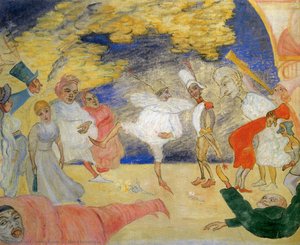
James Ensor's "Les Pommes Rouges" (1889) isn’t merely a still life; it’s a meticulously constructed psychological landscape, a glimpse into the artist’s uniquely unsettling vision. Painted during a period of intense experimentation and social critique within Belgian art, this work embodies the burgeoning Expressionist movement while retaining Ensor's deeply personal and often macabre sensibility. The painting depicts a simple arrangement – red and green apples resting on a white-covered table alongside two oranges – yet it’s laden with symbolic weight and an undeniable sense of unease. The stark simplicity of the composition, coupled with the unsettling color palette and the subtly distorted forms, immediately draws the viewer into a world where beauty and decay coexist in precarious balance.
A Masterclass in Expressionist Technique
Ensor’s technique is deliberately jarring, a departure from the polished realism favored by the Académie Royale des Beaux-Arts. He employs thick, impasto brushstrokes that build up layers of color, creating a tactile surface and emphasizing the physicality of the paint itself. The apples aren't rendered with photographic accuracy; instead, they are plump, almost aggressively vibrant in their reds and greens, hinting at an underlying tension. Notice how he uses short, choppy strokes to define the edges, contributing to the painting’s overall sense of agitation. The white tablecloth, far from being a neutral backdrop, is treated with a similar energetic application of paint, suggesting a surface that's both pristine and subtly corrupted. The oranges, similarly rendered, possess an almost bruised quality, furthering the feeling of impending decay.
Symbolism and the Shadowed World of Ensor
Ensor’s work is notoriously rich in symbolism, often drawing upon personal anxieties and social commentary. The apples themselves are a potent symbol – traditionally associated with knowledge, temptation, and mortality. Their vibrant color can be interpreted as both alluring and dangerous, reflecting the precariousness of human existence. The presence of the oranges, frequently linked to wealth and abundance, introduces an element of ironic contrast, suggesting that even prosperity is ultimately fleeting and potentially deceptive. Crucially, the painting’s unsettling atmosphere isn't simply decorative; it reflects Ensor’s own troubled psyche – a man grappling with themes of mortality, isolation, and the anxieties of modern life. The masks, so central to his artistic vocabulary, are subtly implied through the arrangement and the overall mood, hinting at hidden identities and concealed emotions.
Historical Context: Rebellion and Artistic Innovation
"Les Pommes Rouges" was created during a period of significant upheaval in the Belgian art world. Ensor’s work challenged the established norms of academic painting, rejecting its emphasis on idealized beauty and historical subject matter in favor of a more personal and emotionally charged approach. He aligned himself with the burgeoning Symbolist movement, which explored psychological themes and employed evocative imagery to convey complex ideas. His rejection of convention, coupled with his willingness to tackle uncomfortable subjects – death, decay, and social critique – made him a controversial figure during his lifetime. “Les Pommes Rouges” stands as a testament to Ensor’s artistic courage and his pioneering role in shaping the course of modern art. It's a painting that demands attention, inviting viewers to confront their own anxieties and contemplate the darker aspects of human experience.
ArtsDot offers exquisite hand-painted reproductions of James Ensor’s “Les Pommes Rouges,” allowing you to bring this captivating masterpiece into your home or office. Each reproduction is meticulously crafted by skilled artists, ensuring that every detail – from the vibrant colors to the textured brushstrokes – faithfully captures the essence of the original painting. Explore our collection today and experience the power and beauty of Ensor’s vision.
Obras similares


Biografía del artista
vida temprana y trayectoria artística
James Sidney Edouard, Baron Ensor, un destacado pintor y grabador belga, nació el 13 de abril de 1860 en Ostend, Bélgica. Su vida temprana estuvo marcada por un trasfondo cultural diverso, con un padre inglés, James Frederic Ensor, y una madre belga, María Caterina Haegheman. Falta de interés en los estudios académicos tradicionales, Ensor abandonó la escuela a los quince años para dedicarse al arte, recibiendo formación con pintores locales y posteriormente estudiando en la Academia Real de Bellas Artes en Bruselas.Estilo artístico y temas
El estilo artístico de Ensor se caracterizó por su exploración de la mente inconsciente e imágenes oníricas, lo que influyó significativamente en el expresionismo y el surrealismo. Sus pinturas a menudo presentaban asuntos extraños, incluyendo carnavales, máscaras, teatro de marionetas, esqueletos y alegorías fantásticas. Obras notables incluyen Las Máscaras Escandalizadas (1883) y Esqueletos luchando por un ahorcado (1891), que muestran su mezcla única de lo grotesco y lo fantástico.Reconocimiento y legado
A pesar de la resistencia inicial, la obra de Ensor ganó gradualmente aceptación y elogios. Para 1920, era el tema de importantes exposiciones; en 1929, fue nombrado barón por el rey Alberto, y en 1933, recibió la Legión de Honor. Su legado como figura pionera en el arte moderno es evidente en su influencia en movimientos artísticos posteriores, incluyendo el expresionismo y el surrealismo.Obras clave y exposiciones
* La Intriga (90 x 150 cm, Museo Real de Bellas Artes, Amberes, Bélgica) * Tribulaciones de San Antonio (1887, ahora en la colección del Museo de Arte Moderno, Nueva York)- Descubra más sobre la vida y obra de James Ensor en ArtsDot: James Ensor
- Explore el Museo Mu.Zee en Ostend, Bélgica, que presenta una colección de arte belga desde 1830 en ArtsDot: Descubra el Museo Mu.Zee en Ostend, Bélgica
- Aprenda más sobre la pintura simbolista y su influencia en el expresionismo y el surrealismo en Wikipedia: Pintura Simbolista

James Ensor
1860 - 1949 , Bélgica
Datos clave
- Artistas Influenciados Por Este Artista:
- Expresionismo
- Surrealismo
- Artistas Que Influyeron:
- Pieter Bruegel el Viejo
- Francisco Goya
- Fecha De Muerte: 19 de noviembre de 1949
- Fecha De Nacimiento: 13 de abril de 1860
- Lugar De Nacimiento: Ostend, Bélgica
- Movimiento Artístico: Expresionismo, Surrealismo
- Nacionalidad: Belga
- Nombre Completo: James Ensor
- Obras Notables:
- Las Máscaras Escandalizadas
- Esqueletos luchando
- Tribulaciones de San Antonio
- Cristo entrando en Bruselas
Artículos relacionados

Bernard Cathelin: A Poetic Realist's Exploration of Still Life and the French Landscape
Explore the captivating world of Bernard Cathelin, a master of French Poetic Realism. Discover his stunning still lifes & landscapes, and learn about his legacy with ArtsDot.

Jean-Baptiste-Siméon Chardin: Master of Still Life & Everyday Elegance
Explore the serene world of Jean-Baptiste-Siméon Chardin, master of still life & genre painting. Discover his revolutionary techniques, enduring legacy, and timeless depictions of everyday elegance. Learn more at ArtsDot.

The Sublimity of Color: Exploring the Emotional Landscapes of Mark Rothko's Abstract Expressionism
Explore the profound emotional depth of Mark Rothko's abstract expressionism. Discover the history, techniques & lasting impact of this pivotal Color Field painter. Expert insights for collectors and art enthusiasts.

Martin Johnson Heade: Luminism, American Identity & the Poetic Still Life
Explore the captivating world of Martin Johnson Heade, a master of Luminism. Discover his serene landscapes, vibrant still lifes & profound connection to American identity. Learn about his techniques and legacy.

The Bountiful Still Life: Symbolism & Artistic Representation of Fruit Across Art History
Explore the rich history of still life painting & the symbolism of fruit across art movements. Discover masterpieces from Caravaggio to Cézanne with ArtsDot – expert guidance & museum-quality reproductions.