


 Vista previa
 Compartir
 Compartir
 Ver detalles

 Descargar
 Ver similares
 Radiografía
 Presentación de diapositivas
untitled (154)


 Leer más
Giclée / Impresión de arte
Impresiones giclée o en lienzo de calidad de museo con producción rápida y opciones de acabado flexibles. ( Cambiar a pintura hecha a mano Cambiar a imagen)




P118B $10

P118H $10

P118W $10

P438Z $10

P508JH $12

P508YH $12

P805H $10

P805Z $10

P919BZ $10

P919G $10

P919XJ $10

P959ZH $10

P968JZ $12

W106C $8

W218G $10

W218JH $8

W218Y $10

W307PJ $10

W316G $10

W316PJ $8

W316Y $10

W398PJ $8

W4111J $10

W500HY $15

W500JH $15

W692G $12

W849H $8

W940BG $15

W953PJ $8




Elija entre nuestros tamaños predefinidos que respetan las proporciones originales de la obra.

Puede introducir sus propias dimensiones para adaptarse a un marco o espacio específico. Si el tamaño seleccionado no coincide con las proporciones de la imagen original, recortaremos la obra de arte o extenderemos la imagen con un borde con efecto espejo o de color sólido. Se enviará una maqueta digital para su aprobación antes de que comience la producción.
Tenga en cuenta que la vista previa en pantalla no refleja el recorte o la extensión real. Solo la maqueta mostrará con precisión la composición final.
Aunque existen tamaños personalizados, recomendamos seleccionar una dimensión de la lista predefinida para preservar las proporciones originales.
Envío a todo el mundo () en 2 semanas en lugar de las 4/5 semanas estándar. (10 agosto)

Envío exprés gratuito a todo el mundo

Lienzo de lino de alta calidad

Seguro de envío completo

Garantía de reembolso de aranceles aduaneros

Garantía de fidelidad cromática exacta

Política de devolución de 60 días (solo por defectos)

Garantía de devolución del 100% del dinero

Oferta por volumen
 La opción de vidrio solo está disponible en tamaños inferiores a 110 cm.

untitled (154)
Giclée / Impresión de arte
Tamaño de la reproducción
-


Precio total
$ 62
Descripción de la pieza
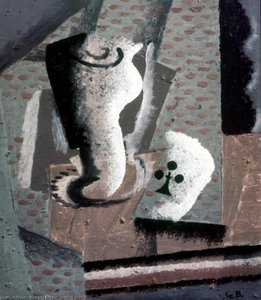
Georges Braque’s Quiet Revolution: Decoding ‘Untitled (154)’
Georges Braque’s “Untitled (154)” stands as a testament to the understated brilliance of Cubism, an artistic movement that irrevocably altered the course of modern art. Painted in 1913, this deceptively simple composition—a depiction of a man seated at a table laden with objects—holds within it layers of intellectual and visual complexity that continue to fascinate scholars and collectors alike.
- Subject Matter: The scene portrays an ordinary domestic tableau – a man absorbed in contemplation, accompanied by a table displaying commonplace items. This deliberate choice wasn’t intended to convey grand narratives but rather to explore the fundamental building blocks of perception itself.
- Style & Technique: Braque's masterful application of Cubist principles is immediately apparent. He employs fragmented planes and intersecting lines—a technique pioneered alongside Pablo Picasso—to dismantle traditional perspective and represent objects from multiple viewpoints simultaneously. The muted palette – predominantly browns, ochres, and creams – reinforces this sense of spatial ambiguity.
- Historical Context: Created during the turbulent years leading up to World War I, “Untitled (154)” reflects the anxieties and uncertainties of its time. Cubism emerged as a reaction against Impressionism’s focus on fleeting impressions, advocating instead for a more analytical approach to depicting reality. It mirrored the broader intellectual currents of the era, influenced by thinkers like Henri Bergson who questioned the notion of linear time.
Exploring Spatial Illusion and Analytical Cubism
The painting’s power resides in its ability to challenge our ingrained assumptions about how we see the world. Braque meticulously dissects each element—the man, the table, the vase, the cup—reducing them to geometric forms that overlap and intersect without adhering to conventional spatial conventions. This is quintessential Analytical Cubism; it's not about capturing a visual likeness but rather investigating the underlying structure of form.
- Color Palette: The subdued color scheme contributes significantly to the painting’s mood, fostering a feeling of quiet contemplation and introspection. Braque deliberately avoids vibrant hues, opting for earthy tones that emphasize texture and materiality.
- Material Exploration: Braque's innovative use of collage—incorporating textured paper fragments into the canvas—further underscores his commitment to experimentation. This technique reflects the broader artistic ethos of Cubism, which sought to break free from academic constraints and embrace new possibilities for visual expression.
Symbolic Resonance & Emotional Impact
"Untitled (154)" transcends mere representation; it invites viewers to engage in a dialogue about perception and consciousness. The man’s posture—seated calmly, gazing downwards—suggests a state of detached observation, mirroring the artist's own intellectual rigor. The objects on the table serve as symbols of everyday life, yet they are presented in a way that disrupts our habitual ways of seeing them.
- Compositional Harmony: Despite its fractured appearance, the painting achieves remarkable compositional balance. Braque skillfully arranges the elements to create a sense of visual stability, demonstrating his mastery of artistic form.
- Legacy & Influence: Braque’s “Untitled (154)” remains an enduring emblem of Cubist innovation and continues to inspire artists today. Its understated elegance and intellectual depth solidify its place as one of the most significant artworks of the early 20th century.
Obras relacionadas


Biografía del artista
**vida temprana y formación**
georges braque, un destacado pintor francés, collageador, dibujante, grabador y escultor, nació el 13 de mayo de 1882 en Argelo, Val-d'Oise. Creció en Le Havre y inicialmente se formó para ser pintor de casas y decorador, como su padre y abuelo. Sin embargo, las inclinaciones artísticas de Braque lo llevaron a estudiar pintura en la École des Beaux-Arts en Le Havre de 1897 a 1899.**evolución artística y fauvismo**
En 1902, después de completar su aprendizaje con un decorador en París, Braque asistió a la Academia Humbert hasta 1904. Este período marcó su introducción al fauvismo, un estilo caracterizado por colores vibrantes y respuestas emocionales. Influenciado por las obras de henri matisse y andré derain, Braque adoptó un enfoque fauvista, como se ve en su pintura the patience (fauvismo, óleo sobre lienzo).**contribución al cubismo**
La colaboración de Braque con pablo picasso desde 1908 hasta 1912 llevó al desarrollo del cubismo. Sus obras cubistas analíticas, como georges braque: the patience y pablo picasso: clarinet(cubismo analítico, óleo sobre lienzo), se consideran hitos en la historia del arte.**legado y obras notables**
* Houses at l'Estaque: un testimonio del uso innovador de la geometría y la perspectiva simultánea de Braque. * The Patience(fauvismo, óleo sobre lienzo): demuestra el estilo fauvista de Braque. * Clarinet(cubismo analítico, óleo sobre lienzo): una obra cubista colaborativa con Picasso.**museos y colecciones**
* Musée d'Orsay: presenta una extensa colección de arte impresionista y postimpresionista, incluyendo obras de Braque. * Musée de l'Orangerie: exhibe una amplia gama de obras de arte, incluyendo las de Braque y otros artistas notables.- Descubra más sobre la vida y obra de Georges Braque en ArtsDot.com
- Explore la colección del Musée d'Orsay, que presenta obras de Braque y otros artistas, en Musée d'Orsay - Wikipedia
- Aprenda más sobre el fauvismo y su influencia en el desarrollo del cubismo con el movimiento artístico fauvista en ArtsDot.com

Georges Braque
1882 - 1963 , Francia
Datos clave
- Artistas Influenciados Por Este Artista: ['Pablo Picasso']
- Artistas Que Influyeron:
- Henri Matisse
- André Derain
- Paul Cézanne
- Fecha De Muerte: 31 de agosto de 1963
- Fecha De Nacimiento: 13 de mayo de 1882
- Lugar De Nacimiento: Argenteuil, Francia
- Movimiento Artístico: Cubismo, Fauvismo
- Nacionalidad: Francés
- Nombre Completo: Georges Braque
- Obras Notables:
- Casas en L'Estaque
- La paciencia (Fauvismo)
- Violin y Paleta
- Mandola
Artículos relacionados

Deconstruyendo la Realidad: Los Años Formativos y la Influencia Duradera del Cubismo Analítico
Explora la génesis y el impacto del Cubismo Analítico. Un análisis profundo de Picasso, Braque y su revolucionario lenguaje visual. Descubre cómo este movimiento transformó el arte moderno y sentó las bases para las vanguardias.

Georges Braque: Las 25 Obras Maestras del Cubismo y su Legado en el Arte Moderno
Descubre las 25 obras maestras de Georges Braque, pionero del cubismo. Explora su innovadora técnica, colores y el legado del arte moderno francés. Reproducciones de alta calidad en ArtsDot.com. ¡Encuentra tu inspiración!

Los 10 Maestros del Cubismo: Obras que Revolucionaron el Arte | ArtsDot
Descubre los 10 lienzos cubistas que revolucionaron el arte moderno. Explora las obras maestras de Picasso, Braque y Gris en ArtsDot.com. Reproducciones de alta calidad para tu hogar.

Los 10 Maestros del Cubismo: Obras que Revolucionaron el Arte |
Descubre los 10 lienzos cubistas que revolucionaron el arte moderno. Explora la historia de Picasso, Braque y otros maestros del cubismo en . Reproducciones de alta calidad para tu hogar.

Georges Braque: Pioneering Cubism & the Evolution of Modern Form
Explore the revolutionary art of Georges Braque, a pioneer of Cubism alongside Picasso. Discover his artistic evolution, key works, and lasting impact on modern art. A guide for discerning collectors.



