


 Ver en contexto
 Enviar
 Compartir
 Detalles

 Descargar
 Similares
 Radiografía
 Presentación de diapositivas
Still life (with clarinet)
 Acrylic
- WallArt
- Analytical Cubism
 1927
1927 53.0 x 73.0 cm
 Ver más
Reproducción al óleo hecha a mano
Óleo sobre lienzo pintado a mano en el tamaño y marco de su elección, realizado por encargo por nuestros artistas. ( Comprar impresión Comprar imagen)




P118B $10

P118H $10

P118W $10

P438Z $10

P508JH $12

P508YH $12

P805H $10

P805Z $10

P919BZ $10

P919G $10

P919XJ $10

P959ZH $10

P968JZ $12

W106C $8

W218G $10

W218JH $8

W218Y $10

W307PJ $10

W316G $10

W316PJ $8

W316Y $10

W398PJ $8

W4111J $10

W500HY $15

W500JH $15

W692G $12

W849H $8

W940BG $15

W953PJ $8




Elija entre nuestros tamaños predefinidos que respetan las proporciones originales de la obra.

Puede ingresar sus propias dimensiones para adaptarse a un marco o espacio específico. Si el tamaño seleccionado no coincide con las proporciones de la imagen original, recortaremos la obra o extenderemos la pintura con elementos adicionales pintados a mano. Se le enviará una maqueta digital para su aprobación antes de comenzar la producción.
Tenga en cuenta que la vista previa en pantalla no refleja el recorte o la extensión reales. Solo la maqueta mostrará con precisión la composición final.
Si bien existen tamaños personalizados, recomendamos seleccionar una dimensión de la lista predefinida para preservar las proporciones originales.
Tras realizar el pedido, el equipo de ArtsDot.com enviará un correo electrónico al cliente para solicitar instrucciones y proporcionarle una vista previa del boceto.
Envío a todo el mundo () en 3-4 semanas en lugar de las 5 semanas estándar. (31 agosto). Sin comprometer la calidad.

Envío exprés gratuito a todo el mundo

Lienzo de lino de alta calidad

Seguro de envío total

Garantía de reembolso de impuestos aduaneros

Garantía de fidelidad cromática exacta

Política de devolución de 60 días (solo por defectos)

Garantía de devolución del 100% del dinero

Descuento por cantidad
 La opción de vidrio solo está disponible en tamaños inferiores a 110 cm.

Still life (with clarinet)
Técnica de reproducción
Dimensiones de la reproducción
-


Precio total final
$ 263
A Moment Frozen in Time: Georges Braque’s Still Life with Clarinet
The painting “Still life (with clarinet)” by Georges Braque, completed in 1927, transcends mere representation; it embodies the spirit of Cubism and invites contemplation on themes of materiality, perception, and artistic innovation. Captured in dimensions of 53 x 73 cm, this artwork exemplifies Braque’s masterful command of technique and his unwavering commitment to challenging established artistic paradigms.The Genesis of Geometric Fragmentation
Braque's exploration into Cubism began alongside Pablo Picasso, marking a pivotal moment in the history of modern art. Rejecting traditional illusionistic painting—where objects appear as they are seen from a single viewpoint—Cubists dismantled forms into geometric planes and facets, presenting multiple perspectives simultaneously. In “Still life,” this approach is vividly realized. The grapes themselves aren’t depicted as plump spheres but rather fractured into angular segments, mirroring the clarinet resting on the tabletop. This deliberate fragmentation isn't simply stylistic; it reflects Braque’s intellectual preoccupation with how our senses perceive reality and how artists can convey complex ideas through simplified visual elements.Palette and Texture: Hints of Impressionism Revisited
Despite its Cubist principles, “Still life” retains subtle echoes of Impressionistic influences. Braque employs a muted palette dominated by earthy tones—ochres, browns, and greens—creating an atmosphere of quiet contemplation. However, unlike the shimmering surfaces characteristic of Impressionism, Braque prioritizes texture through meticulous brushwork. Thick impasto strokes build up on the canvas, particularly around the oranges and grapes, adding depth and physicality to the composition. This textural richness contrasts with the geometric planes, suggesting a tension between observation and interpretation—a hallmark of Braque’s artistic vision.Historical Context: The Avant-Garde Embrace of Everyday Objects
The painting emerged during a period of intense experimentation within the Parisian avant-garde movement. Artists were actively rejecting academic conventions and seeking new ways to express emotion and experience. Cubism wasn't merely an aesthetic style; it was a philosophical stance—a belief that art should grapple with fundamental questions about perception and representation. Braque’s choice to depict commonplace objects like fruit and musical instruments – specifically the clarinet – speaks to this broader trend. It suggests a desire to elevate the ordinary into something extraordinary, prompting viewers to consider beauty in unexpected places.Symbolism Beyond Surface Appearance
While seemingly simple in its visual vocabulary, “Still life” carries symbolic weight. The clarinet itself represents artistic creativity and intellectual pursuit—a deliberate nod to Braque’s own artistic endeavors. Furthermore, the arrangement of the fruit – scattered grapes and oranges – can be interpreted as symbolizing abundance and ripeness, but also perhaps hinting at decay and transformation. These subtle nuances invite viewers to engage in a deeper dialogue with the artwork, prompting reflection on themes of beauty, mortality, and the artist’s role in capturing fleeting moments of existence.Emotional Resonance: A Quiet Reflection
Ultimately, “Still life (with clarinet)” succeeds in conveying a profound sense of stillness and introspection. The muted colors, textured brushstrokes, and fragmented forms combine to create an image that is both visually arresting and emotionally resonant. It’s a painting that invites viewers to pause, observe carefully, and contemplate the complexities of perception—a testament to Braque's enduring legacy as one of the pioneers of modern art.Obras relacionadas


Biografía del artista
**vida temprana y formación**
georges braque, un destacado pintor francés, collageador, dibujante, grabador y escultor, nació el 13 de mayo de 1882 en Argelo, Val-d'Oise. Creció en Le Havre y inicialmente se formó para ser pintor de casas y decorador, como su padre y abuelo. Sin embargo, las inclinaciones artísticas de Braque lo llevaron a estudiar pintura en la École des Beaux-Arts en Le Havre de 1897 a 1899.**evolución artística y fauvismo**
En 1902, después de completar su aprendizaje con un decorador en París, Braque asistió a la Academia Humbert hasta 1904. Este período marcó su introducción al fauvismo, un estilo caracterizado por colores vibrantes y respuestas emocionales. Influenciado por las obras de henri matisse y andré derain, Braque adoptó un enfoque fauvista, como se ve en su pintura the patience (fauvismo, óleo sobre lienzo).**contribución al cubismo**
La colaboración de Braque con pablo picasso desde 1908 hasta 1912 llevó al desarrollo del cubismo. Sus obras cubistas analíticas, como georges braque: the patience y pablo picasso: clarinet(cubismo analítico, óleo sobre lienzo), se consideran hitos en la historia del arte.**legado y obras notables**
* Houses at l'Estaque: un testimonio del uso innovador de la geometría y la perspectiva simultánea de Braque. * The Patience(fauvismo, óleo sobre lienzo): demuestra el estilo fauvista de Braque. * Clarinet(cubismo analítico, óleo sobre lienzo): una obra cubista colaborativa con Picasso.**museos y colecciones**
* Musée d'Orsay: presenta una extensa colección de arte impresionista y postimpresionista, incluyendo obras de Braque. * Musée de l'Orangerie: exhibe una amplia gama de obras de arte, incluyendo las de Braque y otros artistas notables.- Descubra más sobre la vida y obra de Georges Braque en ArtsDot.com
- Explore la colección del Musée d'Orsay, que presenta obras de Braque y otros artistas, en Musée d'Orsay - Wikipedia
- Aprenda más sobre el fauvismo y su influencia en el desarrollo del cubismo con el movimiento artístico fauvista en ArtsDot.com

Georges Braque
1882 - 1963 , Francia
Datos clave
- Artistas Influenciados Por Este Artista: ['Pablo Picasso']
- Artistas Que Influyeron:
- Henri Matisse
- André Derain
- Paul Cézanne
- Fecha De Muerte: 31 de agosto de 1963
- Fecha De Nacimiento: 13 de mayo de 1882
- Lugar De Nacimiento: Argenteuil, Francia
- Movimiento Artístico: Cubismo, Fauvismo
- Nacionalidad: Francés
- Nombre Completo: Georges Braque
- Obras Notables:
- Casas en L'Estaque
- La paciencia (Fauvismo)
- Violin y Paleta
- Mandola
Artículos relacionados

Georges Braque: Las 25 Obras Maestras del Cubismo y su Legado en el Arte Moderno
Descubre las 25 obras maestras de Georges Braque, pionero del cubismo. Explora su innovadora técnica, colores y el legado del arte moderno francés. Reproducciones de alta calidad en ArtsDot.com. ¡Encuentra tu inspiración!

Georges Braque: Pioneering Cubism & the Evolution of Modern Form
Explore the revolutionary art of Georges Braque, a pioneer of Cubism alongside Picasso. Discover his artistic evolution, key works, and lasting impact on modern art. A guide for discerning collectors.
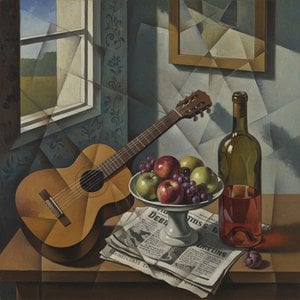
Deconstructing Reality: A Comprehensive Exploration of Cubist Still Life
Explore the revolutionary world of Cubist Still Life with ArtsDot. Discover Picasso & Braque's groundbreaking techniques, its philosophical roots, and lasting impact on modern art. Expert insights for collectors.

Cultivating Ambiance: A Curatorial Guide to Art Selection for Wine Cellars and Tasting Rooms – Enhancing Oenological Experience Through Landscape, Symbolism, and Interior Harmony
Elevate your wine cellar or tasting room with curated art! Expert guidance on landscape paintings, symbolism & lighting to enhance the oenological experience. Discover how art transforms spaces and tells your winery's story.

The Bountiful Still Life: Symbolism & Artistic Representation of Fruit Across Art History
Explore the rich history of still life painting & the symbolism of fruit across art movements. Discover masterpieces from Caravaggio to Cézanne with ArtsDot – expert guidance & museum-quality reproductions.



