

 Ver en contexto
 Enviar
 Compartir
 Detalles
 Guía
Guía

 Descargar
 Similares
 Radiografía
 Presentación de diapositivas
 Preguntas y respuestas
 Estadísticas
Self Portrait


 Ver más
Giclée / Impresión de arte
Impresiones giclée o en lienzo de calidad de museo con producción rápida y opciones de acabado flexibles. ( Comprar pintura hecha a mano Cambiar a imagen digital)




P118B €10

P118H €10

P118W €10

P438Z €10

P508JH €12

P508YH €12

P805H €10

P805Z €10

P919BZ €10

P919G €10

P919XJ €10

P959ZH €10

P968JZ €12

W106C €8

W218G €10

W218JH €8

W218Y €10

W307PJ €10

W316G €10

W316PJ €8

W316Y €10

W398PJ €8

W4111J €10

W500HY €15

W500JH €15

W692G €12

W849H €8

W940BG €15

W953PJ €8




Elija entre nuestros tamaños predefinidos que respetan las proporciones originales de la obra.

Introduzca el ancho y el alto que necesite para adaptarse a su marco o pared. Una impresión solo puede recortarse, nunca hacerse más grande que la imagen original, por lo que un tamaño con una forma distinta perderá parte de la obra. Le enviaremos una maqueta digital para su aprobación antes de realizar cualquier impresión. La imagen que se muestra en esta página no refleja el recorte real; solo la maqueta lo hace.
Envío a todo el mundo () en 2 semanas en lugar de las 4/5 semanas estándar. (10 noviembre)

Envío exprés gratuito a todo el mundo

Lienzo de lino de alta calidad

Seguro de envío total

Garantía de reembolso de aranceles aduaneros

Garantía de fidelidad cromática exacta

Política de devolución de 100 días (solo por defectos)

Garantía de devolución del 100% del dinero

Descuento por cantidad
 La opción de vidrio solo está disponible en tamaños inferiores a 110 cm.

Self Portrait
Giclée / Impresión de arte
Dimensiones de la reproducción
-


Precio total final
€ 56
George Caleb Bingham’s Self Portrait: A Window into Frontier Soul
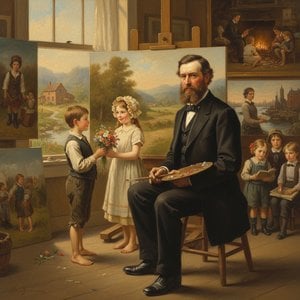
George Caleb Bingham's "Self Portrait," completed in 1877, isn’t merely a depiction of an artist; it’s a meticulously crafted snapshot of the American spirit during its formative years. Executed in oil on canvas with a masterful blend of realism and Romanticism—a stylistic hallmark of his era—the painting transcends simple likeness to convey profound emotional depth and intellectual contemplation. It stands as a testament to Bingham's unwavering commitment to capturing not just what he looked like, but who he was as an artist grappling with the complexities of his time.- Composition & Perspective: The portrait adheres to a classic compositional framework—a three-quarter view centered within the frame—reflecting the conventions of American portraiture during the late 19th century. Minimal perspective contributes to a sense of immediacy, pulling the viewer directly into Bingham’s gaze and fostering an intimate connection with his inner world.
- Color Palette & Texture: Dominating the canvas is a subdued palette of browns, whites, and blacks—colors that mirror the earthy tones of the Missouri frontier landscape—creating a textural richness achieved through layering thin glazes of pigment. The smooth skin tone contrasts subtly with the slightly rougher surface of the shirt and bow tie, hinting at the artist’s careful attention to detail.
- Symbolism & Emotion: Holding a sketchbook and pencil in his right hand is more than just an indication of his profession; it symbolizes Bingham's creative process—his engagement with observation and intellectual inquiry. His expression—characterized by thoughtful eyes and a hint of melancholy—suggests a contemplative spirit deeply attuned to the anxieties and aspirations of his time, mirroring the broader cultural landscape of the American West.
- Technique & Materials: Bingham’s technique demonstrates remarkable skill in achieving subtle gradations and textures through meticulous brushwork. Thin glazes of oil paint are skillfully blended to create luminous effects and imbue the canvas with a palpable sense of atmosphere—a hallmark of Luminism, which sought to capture the grandeur of nature alongside psychological insight.
Historical Context: The Frontier Ideal
Bingham’s “Self Portrait” emerged during a period defined by westward expansion and burgeoning industrialization – forces reshaping American identity and culture. The painting embodies the Romantic fascination with the sublime—the awe-inspiring beauty of untamed wilderness—while simultaneously acknowledging the hardships endured by pioneers striving to forge new lives in unfamiliar territories. It reflects the broader artistic preoccupation with portraying human experience against the backdrop of dramatic landscapes, capturing both vulnerability and resilience.Beyond Likeness: Capturing Inner Reflection
More than just a portrait of appearance, Bingham’s masterpiece delves into the artist's psyche—his intellectual curiosity and emotional sensitivity. The sketchbook symbolizes not only his craft but also his engagement with ideas and observations—a reflection of the broader humanist ethos prevalent in American art during this period. The melancholic gaze conveys a profound awareness of human mortality and the complexities of existence, inviting viewers to contemplate their own place within the grand narrative of history.A Legacy of Authenticity: Reproduction Excellence
ArtsDot offers exceptional reproductions of George Caleb Bingham’s “Self Portrait,” meticulously crafted to preserve the artist's original vision—capturing the subtle nuances of color, texture, and light that define this iconic work. Experience the enduring power of American Realism & Luminism through a stunning print that brings the spirit of the frontier into your home or studio.Preguntas y respuestas
¿En qué técnica está ejecutada "Self Portrait" de George Caleb Bingham?
La técnica de "Self Portrait" de George Caleb Bingham es Oil On Canvas. Las reproducciones pretenden recrear la apariencia de esta técnica.
¿En qué estancia se sugiere exhibir "Self Portrait", considerando su paleta de colores?
Los colores de la paleta Earthy de "Self Portrait" de George Caleb Bingham armonizan con su espacio recomendado: un Living Room.
¿Cómo se relaciona el tema de "Self Portrait" con la temática habitual de George Caleb Bingham?
"Self Portrait" representa self-portrait, american frontier, artist's identity, frontier life, sketchbook drawing, contemplative expression, missouri landscape, mientras que los temas recurrentes de George Caleb Bingham son frontier spirit & observation, realism, american identity, symbolic reflection, emotion, notable portrait, legacy. Al comparar ambos, se observa cómo la obra se relaciona con los temas habituales del artista.
Obras relacionadas


Biografía del artista
Primeros años y comienzos artísticos
George Caleb Bingham, un artista estadounidense, nació en Augusta County, Virginia, en 1811. Fue el segundo de siete hijos de Mary Amend y Henry Vest Bingham. Tras la difícil situación financiera de su familia, se mudaron a Franklin, Missouri, donde comenzó el viaje artístico de Bingham. A los nueve años, asistió a Chester Harding, un famoso retratista estadounidense, durante su breve estancia en Franklin.Desarrollo artístico y estilo
Bingham fue en gran medida autodidacta, con sus primeros trabajos influenciados por sus aprendizajes con los fabricantes de gabinetes Jesse Green y Justinian Williams. A los diecinueve años, pintaba retratos por 20 dólares cada uno, a menudo completándolos en un solo día. Su sólido dibujo y su capacidad para capturar rasgos impresionaron a los mecenas, lo que le llevó a viajar a St. Louis para continuar su oficio.Obras destacadas y redescubrimiento
El trabajo de Bingham ejemplifica el estilo luminista, capturando la vida estadounidense a lo largo del río Missouri. Entre sus obras más destacadas se encuentran:- Order at the Border (1850), que muestra su mezcla única de realismo y luminismo.
- The County Election (1844), una representación esencial de la vida fronteriza estadounidense.
- St. Louis Jockey, on the Battlefield (1862), que destaca su capacidad para capturar la esencia de la cultura estadounidense.
Legado e influencia
La influencia de Bingham en el arte estadounidense es innegable. Su estilo luminista ha inspirado a generaciones de artistas, incluidos los que aparecen en las populares obras de arte de ArtsDot. Explore más trabajos de Bingham y el movimiento luminista en la plataforma de ArtsDot.- Descubra la extensa colección de George Caleb Bingham en la página de George Caleb Bingham de ArtsDot.
- Aprenda más sobre el estilo luminista y su influencia en el arte estadounidense.

George Caleb Bingham
1811 - 1879 , Estados Unidos de América
Datos clave
- Artistas Influenciados: ['Artistas de WahooArt']
- Artistas Que Influyeron:
- Chester Harding
- Jesse Green
- Justinian Williams
- Fecha De Fallecimiento: 7 de julio de 1879
- Fecha De Nacimiento: 20 de marzo de 1811
- Lugar De Nacimiento: Augusta County, EE. UU.
- Movimiento Artístico: Luminismo y Realismo Americano
- Nacionalidad: Estadounidense
- Nombre Completo: George Caleb Bingham
- Obras Notables:
- Order at the Border
- The County Election
- St. Louis Jockey, on the Battlefield
Artículos relacionados
John George Brown: Capturing American Life & Sentiment in 19th-Century Genre Painting
Explore the captivating genre paintings of John George Brown, celebrated for his realistic depictions of 19th-century American life. Discover his legacy & find museum-quality reproductions at ArtsDot.

Grant Wood & American Regionalism: Identity, Myth & the Rural Landscape
Explore the world of Grant Wood & American Regionalism with ArtsDot. Discover the symbolism behind 'American Gothic', recurring themes, and the movement's lasting impact on art history. High-quality reproductions available.

Maestría Cubista: Las 25 mejores obras de Georges Braque
Explora las 25 obras maestras de Georges Braque y el cubismo. Encuentra reproducciones de museo en ArtsDot.com.

Realismo Estadounidense: 10 Obras Maestras que Cambiaron el Arte y la Decoración
Descubre 10 obras maestras del Realismo Estadounidense: Winslow Homer, Edward Hopper y más. Explora la historia, técnica y emoción de estos icónicos cuadros. Encuentra reproducciones de arte de museo en ArtsDot.com.

Georges Seurat: Las 25 Obras Maestras del Pionero Puntillista | ArtsDot
Descubre las 25 obras maestras de Georges Seurat, el innovador del puntillismo. Explora su técnica única, colores vibrantes y legado artístico en ArtsDot.com. Reproducciones de arte de museo para tu hogar.


