


 Vista previa
 Compartir
 Compartir
 Ver detalles

 Descargar
 Ver similares
 Radiografía
 Presentación de diapositivas
Sueño caballo


 Leer más
Giclée / Impresión de arte
Impresiones giclée o en lienzo de calidad de museo con producción rápida y opciones de acabado flexibles. ( Encargar reproducción pintada a mano Comprar descarga)




P118B $10

P118H $10

P118W $10

P438Z $10

P508JH $12

P508YH $12

P805H $10

P805Z $10

P919BZ $10

P919G $10

P919XJ $10

P959ZH $10

P968JZ $12

W106C $8

W218G $10

W218JH $8

W218Y $10

W307PJ $10

W316G $10

W316PJ $8

W316Y $10

W398PJ $8

W4111J $10

W500HY $15

W500JH $15

W692G $12

W849H $8

W940BG $15

W953PJ $8




Elija entre nuestros tamaños predefinidos que respetan las proporciones originales de la obra.

Puede introducir sus propias dimensiones para adaptarse a un marco o espacio específico. Si el tamaño seleccionado no coincide con las proporciones de la imagen original, recortaremos la obra de arte o extenderemos la imagen con un borde con efecto espejo o de color sólido. Se enviará una maqueta digital para su aprobación antes de que comience la producción.
Tenga en cuenta que la vista previa en pantalla no refleja el recorte o la extensión real. Solo la maqueta mostrará con precisión la composición final.
Aunque existen tamaños personalizados, recomendamos seleccionar una dimensión de la lista predefinida para preservar las proporciones originales.
Envío a todo el mundo () en 2 semanas en lugar de las 4/5 semanas estándar. (16 agosto)

Envío exprés gratuito a todo el mundo

Lienzo de lino de alta calidad

Seguro de envío completo

Garantía de reembolso de aranceles aduaneros

Garantía de fidelidad cromática exacta

Política de devolución de 60 días (solo por defectos)

Garantía de devolución del 100% del dinero

Oferta por volumen
 La opción de vidrio solo está disponible en tamaños inferiores a 110 cm.

Sueño caballo
Giclée / Impresión de arte
Tamaño de la reproducción
-


Precio total
$ 62
Descripción de la pieza
Dreaming Horse
Franz Marc was a prominent figure in the German Expressionist movement, and his painting Dreaming Horse is a quintessential example of this style. Created in 1912, this oil on canvas artwork showcases Marc’s unique blend of vibrant colors and emotive subjects.Style and Media
The Dreaming Horse painting exemplifies the characteristics of Expressionism, with its bold brushstrokes and vivid colors. Marc's use of oil paint allowed him to achieve a thick, textured surface that adds depth and volume to the horse’s form. The artist’s simplified, almost abstracted style focuses on the essential elements of the subject matter, creating a dynamic energy that brings the horse to life.Meaning and Interpretation
The Dreaming Horse can be seen as a representation of Marc’s deep connection with nature and his belief in the spiritual power of animals. The horse's serene expression and dreamlike state suggest a sense of mysticism and otherworldliness, inviting viewers to contemplate the deeper meanings of the work. As an Expressionist artist, Marc sought to convey his emotional responses to the world around him, and this painting is no exception.Relevant Works by Franz Marc
Some of Marc's other notable works include The Red Deer, which can be found on ArtsDot.com. This painting, created in 1912, is a testament to Marc’s unique style and his ability to blend vibrant colors with emotive subjects. Another notable work is Sleeping Deer, which showcases Marc’s use of cubist techniques and his fascination with the natural world.- Visit ArtsDot.com to discover more masterpieces by Franz Marc
- Learn more about the Museum Collection Hugo Fischer on ArtsDot.com
- Read about the life and work of Franz Marc on Wikipedia
Photo Description: The painting is a colorful and abstract piece of artwork featuring various animals and objects. The main focus is on two blue birds, one located in the top left corner and another towards the bottom right side of the painting. There are also several other birds scattered throughout the image, some closer to the center while others are positioned near the edges. In addition to the birds, there are three people visible within the painting. One person is situated on the left side, another in the middle, and a third one towards the right side of the artwork. The people appear to be interacting with or observing the animals in the scene. The painting also includes various objects such as a guitar located near the top center, a bowl positioned at the bottom left corner, and two apples placed on the right side of the image. These elements contribute to the overall vibrant and dynamic nature of the artwork. Size: Unknown Date: Unknown Artist Information:
A Life Immersed in Color and Spirit
Franz Moritz Wilhelm Marc, born in Munich in 1880, was a painter whose brief but intensely focused career irrevocably altered the course of German Expressionism. His story is one of profound spiritual seeking translated into a vibrant visual language, a quest to understand the essence of life through the purity he found in the natural world—particularly within the animal kingdom. Initially influenced by his father, Wilhelm Marc, a landscape painter; young Franz’s artistic path wasn't immediately certain. He briefly considered theology, grappling with questions of faith and existence before ultimately dedicating himself to art at the Academy of Fine Arts in Munich. These early explorations into religious thought would remain deeply embedded within his work, shaping his belief that art could be a conduit for spiritual experience. His academic training provided him with technical foundations, but it was encounters with the works of Vincent van Gogh that truly ignited his artistic imagination. Van Gogh’s expressive brushstrokes and emotional intensity resonated profoundly with Marc, inspiring him to embrace a similar approach in his own paintings. He quickly abandoned traditional academic conventions, favoring instead a style characterized by simplification and abstraction—a deliberate rejection of representational art in favor of conveying inner feelings and perceptions. This stylistic shift was driven by a conviction that art should transcend mere imitation of reality, aiming instead to capture the essence of experience itself. Marc’s artistic vision was profoundly shaped by his engagement with philosophical currents of the time, notably Nietzsche’s critique of morality and metaphysics. He sought to express the anxieties and uncertainties inherent in modern life, reflecting on themes of death, suffering, and transcendence—subjects that would become central to his oeuvre. His exploration of symbolism—particularly Jungian archetypes—further enriched his artistic vocabulary, allowing him to delve into the unconscious mind and explore universal myths and symbols. Marc’s artistic output spanned a remarkable range of mediums, including oil paintings, watercolors, etchings, and lithographs. However, it is his animal paintings that stand out as particularly iconic, embodying his unwavering devotion to nature and his belief in its spiritual significance. These works—such as *The Red Deer*, *Sleeping Deer*, and *Dreaming Horse*—are characterized by their luminous colors, stylized forms, and evocative compositions—a testament to Marc’s mastery of artistic technique and his ability to communicate profound emotional truths. His distinctive style—often described as “animal mysticism”—became synonymous with the Blaue Reiter circle, cementing his place among the foremost artists of German Expressionism. The Blaue Reiter group—which included Wassily Kandinsky, Gabriele Münter, Franz Ernst Krauss, and Alexej Rode—challenged prevailing artistic conventions and championed a radical aesthetic that prioritized intuition and emotion over rational representation. Marc’s participation in this influential collective fostered an environment of experimentation and collaboration, propelling him to the forefront of avant-garde art. Despite facing persecution during the Nazi era—when his work was deemed “degenerate”—Marc's legacy endured, securing his position as one of Germany’s most celebrated painters. His paintings continue to inspire artists and viewers alike, reminding us of the transformative power of art to convey spiritual insight and capture the beauty of the natural world. Marc died in 1916 during World War I—a tragic loss for the artistic community—but his enduring influence on modern art remains undeniable. He is remembered as a visionary artist who dared to confront existential questions and express profound emotions through a uniquely expressive visual language. His unwavering commitment to artistic integrity—coupled with his deep reverence for nature—continues to resonate powerfully today.Obras relacionadas


Biografía del artista
Franz Marc: Un Pionero del Expresionismo Alemán
Primeros Años y Educación
- Franz Moritz Wilhelm Marc nació el 8 de febrero de 1880, en Múnich, Alemania.
- Su padre, Wilhelm Marc, era pintor de paisajes que inicialmente influyó en las inclinaciones artísticas de su hijo.
- Marc consideró la teología brevemente antes de dedicarse al arte, estudiando en la Academia de Bellas Artes de Múnich después de asistir a la Universidad de Múnich.
- Los primeros estudios incluían copiar a los maestros antiguos y explorar diversas técnicas artísticas.
Desarrollo Artístico e Influencias
- Inicialmente, el trabajo de Marc estuvo influenciado por el Impresionismo y los estilos de pintura académica.
- Un momento decisivo llegó durante las visitas a París donde conoció la obra de Vincent van Gogh, impactando profundamente su uso del color y la expresión emocional.
- Experimentó con diferentes grupos artísticos como la Neue Künstlervereinigung München antes de cofundar Der Blaue Reiter.
- La obra de Robert Delaunay también influyó en la exploración de formas abstractas y colores vibrantes de Marc.
Der Blaue Reiter y Obras Clave
- En 1911, Marc cofundó Der Blaue Reiter (El Caballo Azul) con Wassily Kandinsky, un periódico y grupo artístico que se convirtió en el centro del movimiento expresionista alemán.
- Este grupo buscaba significado espiritual en el arte y rechazaba las convenciones artísticas tradicionales.
- Obras notables de este período incluyen:
- El Tigre (1912) – mostrando su estilo en evolución y el uso simbólico de los animales.
- Ciervo Rojo (1912) - demostrando un enfoque creciente en los temas animales.
- La Torre de Caballos Azules, Los Zorros y el Destino de los Animales (1913) – representando la culminación de su visión artística.
Temas y Estilo Artístico
- El arte de Marc se caracteriza por sus colores vibrantes, formas simplificadas y representación simbólica de los animales.
- Creía que los animales poseían una pureza y una conexión espiritual con la naturaleza que los humanos habían perdido.
- Su uso del color no era meramente descriptivo sino expresivo, transmitiendo emociones e estados internos.
- Buscaba representar la esencia de sus sujetos en lugar de representaciones realistas.
Primera Guerra Mundial y Trágico Final
- Con el estallido de la Primera Guerra Mundial en 1914, Marc fue inscrito en el ejército alemán.
- A pesar de buscar exención debido a su estatus artístico, sirvió como caballería.
- Murió trágicamente el 4 de marzo de 1916, en la Batalla del Vardo.
- Su muerte truncó una prometedora carrera pero consolidó su lugar en la historia del arte.
Legado e Importancia Histórica
- La obra de Franz Marc sigue siendo altamente influyente por su uso expresivo del color, imágenes simbólicas y profundidad espiritual.
- Se considera una figura clave en el desarrollo del Expresionismo Alemán y un precursor del arte abstracto.
- Sus pinturas se exhiben en importantes museos de todo el mundo, incluido el Lenbachhaus en Múnich, que alberga una extensa colección de su obra.
- La visión artística de Marc continúa inspirando a los artistas e intrigando al público hoy en día.

Franz Marc
1880 - 1916 , Alemania
Datos clave
- Artistas Que Influyeron:
- Vincent van Gogh
- Robert Delaunay
- Fecha De Muerte: 4 de marzo de 1916
- Fecha De Nacimiento: 8 de febrero de 1880
- Lugar De Nacimiento: Múnich, Alemania
- Movimiento Artístico: Expresionismo Alemán
- Movimientos Influenciados: ['Arte abstracto']
- Nacionalidad: Alemán
- Nombre Completo: Franz Marc
- Obras Notables:
- El Tigre
- Ciervo Rojo
- La Torre de Caballos Azules
- Los Zorros y el Destino
Artículos relacionados

Expresionismo Alemán: 10 Obras Maestras que Transformaron el Arte | ArtsDot
Descubre las 10 obras maestras del Expresionismo Alemán: Kirchner, Munch y más. Explora la historia, técnica y emoción detrás de estos lienzos icónicos. Reproducciones de arte de museo en ArtsDot.com. ¡Inspira tu hogar con arte!

Marc Chagall: Las 25 Obras Maestras del Sueño y el Color | ArtsDot
Descubre las 25 obras maestras de Marc Chagall, el pintor del sueño y la fantasía. Explora su arte moderno, surrealismo y vibrante paleta de colores en ArtsDot.com. Reproducciones de alta calidad para decorar tu hogar con belleza.

Las 10 Obras Maestras del Azul Pizarra: Arte, Historia y Decoración
Descubre las 10 pinturas más famosas dominadas por el azul pizarra. Explora la historia, técnica y belleza de Monet, Van Gogh y otros maestros. Encuentra reproducciones de arte exclusivas para decorar tu hogar en .

Franz Marc: Expressionism, Spirituality & the Animal Symbolism of a Modern Master
Explore the profound world of Franz Marc's Expressionist paintings. Discover his spiritual connection to animals, innovative use of color, and lasting impact on modern art history. Learn more at ArtsDot.
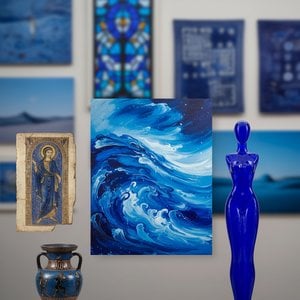
The Allure of Azure: Exploring the Symbolic & Aesthetic Depths of Blue in Art History
Explore the rich history of blue in art! Discover its symbolism, from ancient pigments to modern masterpieces by Kandinsky & Seurat. Uncover the psychological impact and cultural meanings behind this captivating hue.



