


 Vista previa
 Compartir
 Compartir
 Ver detalles

 Descargar
 Ver similares
 Radiografía
 Presentación de diapositivas
untitled (9919)

 Leer más
Giclée / Impresión de arte
Impresiones giclée o en lienzo de calidad de museo con producción rápida y opciones de acabado flexibles. ( Cambiar a pintura hecha a mano Cambiar a imagen)




P118B $10

P118H $10

P118W $10

P438Z $10

P508JH $12

P508YH $12

P805H $10

P805Z $10

P919BZ $10

P919G $10

P919XJ $10

P959ZH $10

P968JZ $12

W106C $8

W218G $10

W218JH $8

W218Y $10

W307PJ $10

W316G $10

W316PJ $8

W316Y $10

W398PJ $8

W4111J $10

W500HY $15

W500JH $15

W692G $12

W849H $8

W940BG $15

W953PJ $8




Elija entre nuestros tamaños predefinidos que respetan las proporciones originales de la obra.

Puede introducir sus propias dimensiones para adaptarse a un marco o espacio específico. Si el tamaño seleccionado no coincide con las proporciones de la imagen original, recortaremos la obra de arte o extenderemos la imagen con un borde con efecto espejo o de color sólido. Se enviará una maqueta digital para su aprobación antes de que comience la producción.
Tenga en cuenta que la vista previa en pantalla no refleja el recorte o la extensión real. Solo la maqueta mostrará con precisión la composición final.
Aunque existen tamaños personalizados, recomendamos seleccionar una dimensión de la lista predefinida para preservar las proporciones originales.
Envío a todo el mundo () en 2 semanas en lugar de las 4/5 semanas estándar. (8 agosto)

Envío exprés gratuito a todo el mundo

Lienzo de lino de alta calidad

Seguro de envío completo

Garantía de reembolso de aranceles aduaneros

Garantía de fidelidad cromática exacta

Política de devolución de 60 días (solo por defectos)

Garantía de devolución del 100% del dinero

Oferta por volumen
 La opción de vidrio solo está disponible en tamaños inferiores a 110 cm.

untitled (9919)
Giclée / Impresión de arte
Tamaño de la reproducción
-


Precio total
$ 62
Descripción de la pieza
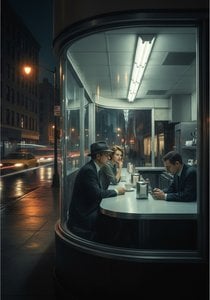
The Quiet Resonance of a Late-Night Diner
Edward Hopper's "Untitled (9919)," painted in 1942, isn’t merely a depiction of a vintage automobile and its occupant; it’s a distilled essence of American loneliness, a poignant snapshot of urban isolation rendered with remarkable precision and evocative light. The painting immediately draws the viewer into a scene of quiet contemplation, a moment suspended between the mundane and the melancholic. Hopper masterfully utilizes the geometry of the car's interior – the sharply defined dashboard, the prominent steering wheel, the angled windows – to create a sense of contained space, mirroring perhaps the internal landscape of the figure within.
The color palette is deliberately restrained, dominated by warm browns and yellows that suggest the aged leather and worn surfaces of the vehicle. These earthy tones are contrasted with the cool blues and greens of the exterior landscape, creating a subtle tension between the interior world of the driver and the anonymous city beyond. Hopper’s signature use of light – a diffused, almost artificial glow emanating from an unseen source – casts long shadows and highlights textures, lending the scene a palpable sense of depth and realism. It's not a vibrant, celebratory illumination; rather, it feels like the muted light of a late-night street, casting a contemplative mood.
A Master of Realism: Hopper’s Approach
Hopper was a pivotal figure in American Realism, moving beyond mere representation to capture the emotional and psychological complexities of everyday life. He wasn't interested in grand narratives or heroic figures; instead, he focused on the quiet moments, the unspoken anxieties, and the subtle gestures that define the human experience. His meticulous attention to detail – from the wrinkles around the driver’s eyes to the worn fabric of the seat – speaks volumes about his commitment to authenticity. Hopper's technique involved layering thin washes of paint, building up color gradually to create a luminous effect and capturing the nuances of light and shadow with astonishing accuracy.
Born in Nyack, New York, in 1882, Hopper’s early life instilled a deep appreciation for observation and detail. His artistic journey began with commercial illustration but quickly evolved into a profound exploration of American identity. His work often reflects the isolation and alienation prevalent in modern urban environments – themes that resonated deeply during the tumultuous years leading up to and including World War II. The painting’s composition, with its solitary figure seemingly lost in thought, powerfully embodies this sense of detachment.
Symbolism and Emotional Impact
The driver's posture—leaning slightly forward, absorbed in a book or document—suggests a retreat from the outside world, a desire for solitude. The open window offers a glimpse of a darkened landscape, hinting at an unseen city teeming with life yet inaccessible to the figure within. There’s a subtle tension between observation and detachment; the driver is present but not truly engaged. This ambiguity is central to the painting's enduring appeal.
"Untitled (9919)" isn’t simply a portrait of a man in a car; it’s a meditation on loneliness, contemplation, and the quiet rhythms of modern life. It invites viewers to contemplate their own experiences of isolation and the search for meaning in an increasingly complex world. Hopper's ability to capture such profound emotions with such understated elegance solidifies his place as one of America’s most enduring artists.
Obras relacionadas


Biografía del artista
**vida temprana e influencias**
edward hopper, un destacado pintor y grabador realista estadounidense, nació el 22 de julio de 1882 en Upper Nyack, Nueva York. Su familia, de ascendencia mayoritariamente holandesa, proporcionó una crianza cómoda que le permitió perseguir sus inclinaciones artísticas desde temprana edad. - **inspiraciones:** La obra de Hopper fue influenciada por las escrituras de Ralph Waldo Emerson y los maestros impresionistas franceses Édouard Manet y Edgar Degas. - **formación inicial:** Comenzó estudios de arte con un curso por correspondencia en 1899, posteriormente transfiriéndose a la Escuela de Arte y Diseño de Nueva York.**estilo artístico y temas**
edward hopper's representaciones cuidadosas y con un diseño preciso reflejaban su visión personal de la vida moderna estadounidense. Su obra se puede caracterizar por: - **escenas urbanas y rurales:** Ambos entornos fueron retratados con una mezcla única de realismo y profundidad emocional. - **iluminación:** Un dominio de la luz, a menudo utilizada para evocar sentimientos de aislamiento o contemplación. - **figuras:** A menudo sin rostro o en segundo plano, enfatizando al entorno sobre las figuras.**obras notables y su significado**
- House by the Railroad (Museo de Arte Moderno, Nueva York, Estados Unidos), un ejemplo de la capacidad de Hopper para evocar una sensación de melancolía a través de una composición simple pero poderosa. - Reclining Nude (50 x 35 cm, Nuevo Realismo, acuarela), que muestra su versatilidad para capturar la forma humana.**legado e influencia**
- **influencia en artistas futuros:** El estilo único de Hopper ha influido a numerosos artistas, incluyendo Pierre Sanford Ross, conocido por sus escenas urbanas y rurales. - **popularidad perdurable:** Sus obras continúan cautivando al público con sus temas atemporales de soledad y la condición humana.**explora más en ArtsDot**
- [https://ArtsDot.com/@/edward-hopper](obras de Edward Hopper) - /es/art/show/art-8xyffg-es/compra arte inspirado por los maestros)- Profundiza en el mundo del arte con la extensa colección de ArtsDot.
- Descubre cómo el legado de Edward Hopper continúa inspirando a artistas y amantes del arte.
**referencias**
- [https://ArtsDot.com/@/edward-hopper](Wikipedia: Edward Hopper) - [https://en.wikipedia.org/wiki/edward_hopper](Wikipedia: Biografía de Edward Hopper)
Edward Hopper
1931 - 1967 , Estados Unidos de América
Datos clave
- Artistas Influenciados: ['Pierre Sanford Ross']
- Artistas Que Influyeron:
- Ralph Waldo Emerson
- Édouard Manet
- Edgar Degas
- Fecha De Muerte: 1967
- Fecha De Nacimiento: 22 de julio de 1882
- Lugar De Nacimiento: Upper Nyack, EE. UU.
- Movimiento Artístico: Realismo americano
- Nacionalidad: Estadounidense
- Nombre Completo: Edward Hopper
- Obras Notables:
- House by the Railroad
- Reclining Nude
- Nighthawks
- Gas
- Chop Suey
Artículos relacionados

Echoes of Urban Life: A Visual Exploration of Street Scenes in Art History
Explore the captivating world of realism in art history! Discover iconic street scenes & genre paintings from masters like Courbet & Brown. Expert analysis & museum-quality reproductions at ArtsDot.
Edward Hopper: American Realism, Urban Isolation & the Poetics of Modern Loneliness
Explore the profound world of Edward Hopper's American realism. Discover the symbolism, themes & enduring legacy of this iconic artist – from 'Nighthawks' to his lesser-known masterpieces. Expert analysis and insights.

Realismo Estadounidense: 10 Obras Maestras que Cambiaron el Arte y la Decoración
Descubre 10 obras maestras del Realismo Estadounidense: Winslow Homer, Edward Hopper y más. Explora la historia, técnica y emoción de estos icónicos cuadros. Encuentra reproducciones de arte de museo en ArtsDot.com.

La Escuela del Cubo de Basura: Realismo Urbano y la Democratización del Arte Americano
Exploramos la Escuela del Cubo de Basura y el realismo urbano americano. Descubre cómo este movimiento artístico revolucionó la representación de la sociedad, democratizando el arte y desafiando las convenciones estéticas tradicionales.

Robert Henri & the Spirit of American Realism: A Legacy of Urban Life and Artistic Independence
Explore the life & legacy of Robert Henri, a pivotal figure in American Realism. Discover his captivating portraits, influence on the Ashcan School, and enduring impact on art history. Learn more at ArtsDot.



