
- Inicio

- Impresión en lienzo
- Edward Hopper
- Soir bleu

 Encargar reproducción Comprar imagen en alta resolución
 Enviar
 Compartir
 Detalles
 Añadir a favoritos

 Descargar
 Similares
 Radiografía
 Presentación de diapositivas
Soir bleu


 Ver más
Giclée / Impresión de arte
Impresión giclée o en lienzo de calidad de museo con producción rápida y opciones de acabado flexibles.




P118B $10

P118H $10

P118W $10

P438Z $10

P508JH $12

P508YH $12

P805H $10

P805Z $10

P919BZ $10

P919G $10

P919XJ $10

P959ZH $10

P968JZ $12

W106C $8

W218G $10

W218JH $8

W218Y $10

W307PJ $10

W316G $10

W316PJ $8

W316Y $10

W398PJ $8

W4111J $10

W500HY $15

W500JH $15

W692G $12

W849H $8

W940BG $15

W953PJ $8




Elija entre nuestros tamaños predefinidos que respetan las proporciones originales de la obra.

Puede introducir sus propias dimensiones para adaptarse a un marco o espacio específico. Si el tamaño seleccionado no coincide con las proporciones de la imagen original, recortaremos la obra de arte o extenderemos la imagen con un borde con efecto espejo o de color sólido. Se enviará una maqueta digital para su aprobación antes de que comience la producción.
Tenga en cuenta que la vista previa en pantalla no refleja el recorte o la extensión real. Solo la maqueta mostrará con precisión la composición final.
Aunque existen tamaños personalizados, recomendamos seleccionar una dimensión de la lista predefinida para preservar las proporciones originales.
Entrega mundial () en 2 semanas en lugar de las 4/5 semanas estándar. (22 julio)

Envío exprés gratuito a todo el mundo

Lienzo de lino de alta calidad

Seguro de envío total

Garantía de reembolso de impuestos aduaneros

Garantía de fidelidad de color

Política de devolución de 60 días (solo por defectos)

Garantía de devolución del 100% del dinero

Descuento por pedido múltiple
 La opción de vidrio solo está disponible en tamaños inferiores a 110 cm.

Soir bleu
Giclée / Impresión de arte
Tamaño de la reproducción
-


Precio total final
-
Descripción de la obra
Edward Hopper’s Soir Bleu: A Portrait of Urban Loneliness
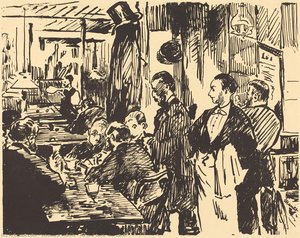
Edward Hopper's "Soir Bleu," painted in 1914, transcends mere representation; it embodies the very essence of American modernism—a quiet contemplation of solitude amidst the bustling cityscape. This deceptively simple black and white composition captures a moment frozen in time within a New York café, offering an enduring meditation on human experience that continues to resonate with audiences today.Subject Matter and Composition
The painting depicts a dimly lit interior scene featuring several figures seated at tables—presumably diners—engaged in conversation. Hopper meticulously renders the details of their surroundings: chairs positioned around tables laden with glassware, vases holding flowers, and bottles hinting at refreshment. However, the central focus isn’t on these objects themselves but rather on the individuals within them. Their faces are largely obscured, conveying a palpable sense of detachment and introspection. The careful arrangement of elements contributes to an atmosphere of stillness, emphasizing the isolation felt by each figure despite their presence in a shared space.Style and Technique: Impressionistic Roots with Hopper’s Distinct Vision
While rooted in Impressionism—particularly influenced by artists like Monet and Sisley—Hopper departs from purely optical observation. He employs a technique characterized by flattened planes of color and subtle tonal gradations, prioritizing mood and atmosphere over photographic accuracy. Hopper's masterful use of light is paramount; it casts long shadows across the tables and illuminates faces with an ethereal glow, creating a dramatic interplay between illumination and darkness that underscores the emotional core of the artwork. This deliberate manipulation of light isn’t merely decorative; it serves to heighten the sense of melancholy and reinforce the feeling of disconnection.Historical Context: The Dawn of Modern Consciousness
“Soir Bleu” emerged during a pivotal period in artistic history—the early years of the 20th century—when artists were grappling with new ideas about perception and representation. Hopper’s work reflects the anxieties and uncertainties inherent in this era, mirroring the growing disillusionment felt by many intellectuals and artists as traditional values crumbled under the pressure of industrialization and urbanization. The café setting itself speaks to the changing social landscape of New York City at the time, symbolizing both opportunity and anonymity—a dichotomy that captures the complexities of modern life.Symbolism: Absence Speaks Volumes
Perhaps the most striking element of “Soir Bleu” is its deliberate omission of expressive gestures or facial expressions. Hopper’s figures are presented as silent observers, their eyes averted from one another, conveying a profound sense of unspoken emotion. This absence isn't merely stylistic; it symbolizes the pervasive loneliness that characterizes modern existence—the difficulty of genuine connection in an increasingly impersonal world. The muted palette reinforces this mood, mirroring the emotional stillness of the scene and inviting viewers to contemplate the inner lives of those depicted.Emotional Impact: An Enduring Reflection on Human Isolation
“Soir Bleu” continues to captivate audiences because it taps into a universal human experience—the yearning for connection amidst the solitude of daily life. Hopper’s masterful depiction of light, shadow, and stillness evokes a feeling of melancholy and introspection, prompting viewers to confront questions about identity, emotion, and the nature of human relationships. It's a painting that lingers in the mind long after viewing, serving as a poignant reminder of the beauty found within quiet contemplation and the enduring power of visual art to communicate profound emotional truths.Obras similares



Biografía del artista
**vida temprana e influencias**
edward hopper, un destacado pintor y grabador realista estadounidense, nació el 22 de julio de 1882 en Upper Nyack, Nueva York. Su familia, de ascendencia mayoritariamente holandesa, proporcionó una crianza cómoda que le permitió perseguir sus inclinaciones artísticas desde temprana edad. - **inspiraciones:** La obra de Hopper fue influenciada por las escrituras de Ralph Waldo Emerson y los maestros impresionistas franceses Édouard Manet y Edgar Degas. - **formación inicial:** Comenzó estudios de arte con un curso por correspondencia en 1899, posteriormente transfiriéndose a la Escuela de Arte y Diseño de Nueva York.**estilo artístico y temas**
edward hopper's representaciones cuidadosas y con un diseño preciso reflejaban su visión personal de la vida moderna estadounidense. Su obra se puede caracterizar por: - **escenas urbanas y rurales:** Ambos entornos fueron retratados con una mezcla única de realismo y profundidad emocional. - **iluminación:** Un dominio de la luz, a menudo utilizada para evocar sentimientos de aislamiento o contemplación. - **figuras:** A menudo sin rostro o en segundo plano, enfatizando al entorno sobre las figuras.**obras notables y su significado**
- House by the Railroad (Museo de Arte Moderno, Nueva York, Estados Unidos), un ejemplo de la capacidad de Hopper para evocar una sensación de melancolía a través de una composición simple pero poderosa. - Reclining Nude (50 x 35 cm, Nuevo Realismo, acuarela), que muestra su versatilidad para capturar la forma humana.**legado e influencia**
- **influencia en artistas futuros:** El estilo único de Hopper ha influido a numerosos artistas, incluyendo Pierre Sanford Ross, conocido por sus escenas urbanas y rurales. - **popularidad perdurable:** Sus obras continúan cautivando al público con sus temas atemporales de soledad y la condición humana.**explora más en ArtsDot**
- [https://ArtsDot.com/@/edward-hopper](obras de Edward Hopper) - [https://ArtsDot.com/art.nsf/buy?open&ra=8xyffg](compra arte inspirado por los maestros)- Profundiza en el mundo del arte con la extensa colección de ArtsDot.
- Descubre cómo el legado de Edward Hopper continúa inspirando a artistas y amantes del arte.
**referencias**
- [https://ArtsDot.com/@/edward-hopper](Wikipedia: Edward Hopper) - [https://en.wikipedia.org/wiki/edward_hopper](Wikipedia: Biografía de Edward Hopper)
Edward Hopper
1931 - 1967 , Estados Unidos de América
Datos clave
- Artistas Influenciados: ['Pierre Sanford Ross']
- Artistas Que Influyeron:
- Ralph Waldo Emerson
- Édouard Manet
- Edgar Degas
- Fecha De Muerte: 1967
- Fecha De Nacimiento: 22 de julio de 1882
- Lugar De Nacimiento: Upper Nyack, EE. UU.
- Movimiento Artístico: Realismo americano
- Nacionalidad: Estadounidense
- Nombre Completo: Edward Hopper
- Obras Notables:
- House by the Railroad
- Reclining Nude
- Nighthawks
- Gas
- Chop Suey
Artículos relacionados

Concrete Visions: Exploring the Urban Landscape in Painting – From Realism to Contemporary Art
Explore the evolution of cityscape painting from Realism to contemporary art with ArtsDot. Discover key artists & invest in timeless urban visions. Expert guidance, museum-quality reproductions.

Urban Visions: A Historical & Artistic Exploration of the Cityscape in Painting
Explore the evolution of cityscape painting from historical maps to Impressionist masterpieces. Discover artists like Caillebotte, Utrillo & Matsumoto Shunsuke. Find museum-quality reproductions at ArtsDot.

La Sutileza del Neutro: Explorando la Abstracción en Blanco y Negro para una Arquitectura Moderna Elevada
Descubre cómo la abstracción en blanco y negro eleva el diseño arquitectónico moderno. Expertos revelan secretos de iluminación, materiales y minimalismo para espacios sofisticados y atemporales.

Realismo Americano: Comentario Social y Representación Artística en la Pintura del Siglo XX
Explora el Realismo Americano del siglo XX: un análisis profundo de sus artistas clave (Vertis Hayes, William Aiken Walker), técnicas y su poderoso comentario social. Descubre cómo este movimiento plasmó la identidad estadounidense.

Urban Visions: A Historical & Artistic Exploration of the Cityscape in Painting
Explore the evolution of cityscape painting from historical maps to Impressionist masterpieces. Discover artists like Caillebotte & Utrillo. Find museum-quality reproductions at ArtsDot.



