


The picture follows your choices: , .
Descripción del objeto
Claude Monet's "Blanc Cristal" captura la esencia del impresionismo: pinceladas suaves, colores vibrantes y una luz efímera que revela la belleza invernal de un paisaje normando. Una obra maestra inolvidable.
 Ver más
Biografía del artista
¡Explora a Claude Monet (1840-1926), el fundador del Impresionismo! Descubre nenúfares icónicos, paja y paisajes que capturan la luz y la esencia de la naturaleza. Una figura fundamental en el arte moderno.
Reproducción al óleo hecha a mano
Óleo sobre lienzo pintado a mano en el tamaño y marco de su elección, realizado por encargo por nuestros artistas. ( Cambiar a impresiones Cambiar a imagen digital)
More about this painting
 Ver en contexto
 Enviar
 Compartir
 Detalles
 Guía
Guía

 Descargar
 Similares
 Radiografía
 Presentación de diapositivas
 Q&A
Q&A Estadísticas
Order your painting in four simple steps
Take your time. You can change any answer; the price in your order card follows each choice.
1 Step one of four
Which size would you like?
These sizes keep the proportions of the original painting. The drawing shows your choice on a wall, above a two-metre sofa.
Or give your own measurements
Elija entre nuestros tamaños predefinidos que respetan las proporciones originales de la obra.

Indique el ancho y el alto que necesite para adaptarse a su marco o pared. Al tratarse de una obra pintada a mano, si requiere un tamaño con una proporción distinta, el artista puede pintar un poco más alrededor de la imagen o recortarla ligeramente; usted elige. Le enviaremos una maqueta digital para su aprobación antes de comenzar la pintura. La imagen que se muestra en esta página no refleja el resultado real; solo la maqueta lo hace.
2 Step two of four
How should it be prepared: rolled, stretched or framed?
The prices below are for the size you chose in step one.
Choose the edges of the stretched canvas
Choose your frame

White €1

Blurside €1

Extended €1

P118B €10

P118H €10

P118W €10

P438Z €10

P508JH €12

P508YH €12

P805H €10

P805Z €10

P919BZ €10

P919G €10

P919XJ €10

P959ZH €10

P968JZ €12

W106C €8

W218G €10

W218JH €8

W218Y €10

W307PJ €10

W316G €10

W316PJ €8

W316Y €10

W398PJ €8

W4111J €10

W500HY €15

W500JH €15

W692G €12

W849H €8

W940BG €15

W953PJ €8

H24-GOLD €30

H24-SILVER €30

H36-GOLD €45

H36-SILVER €45
Con marco
Moulding: . Overall size with the frame: .
3 Step three of four
Would you like anything changed in the painting?
Most people answer no. Because each painting is made by hand, our artist can also adapt it for you.
After order, ArtsDot.com team will email client for instructions and provide a mockup preview
4 Step four of four
A few finishing options
All of them are optional. The answers already selected cost nothing extra.
Who paints it?
Envío a todo el mundo () en 3-4 semanas en lugar de las 5 semanas estándar. (31 octubre). Sin comprometer la calidad.
A nameplate, as in a museum?
Detalles de la placa de bronce grabada
This elegant plaque features the artist's name and the title of the artwork, finely engraved for a timeless presentation.
It is made from bronze with a refined, elegant finish. The text is precisely laser-engraved for a sharp and permanent result. Measuring 9x2 cm, the plaque is compact yet easy to read. It's built to be durable and scratch-resistant, offering a professional, museum-quality look. Mounting is simple thanks to the included adhesive backing.
Detalles de la placa de acrílico transparente
The plaque includes essential engraved details such as the artist's name, the title of the artwork, the date it was created, the type of media used-like oil on canvas or watercolor-a brief description of the piece, and a QR code that links to the complete artwork information.
It is crafted from clear acrylic, offering a sleek, modern appearance. The text is UV-engraved in black to ensure strong visual contrast. With a size of 10x15 cm, it ensures optimal readability. It comes equipped with two metal hooks for secure wall mounting. The plaque is designed to be weather-resistant, making it suitable for various environments, and it includes interactive features that work seamlessly with smartphone scanning.
Detalles de la placa de acrílico negro
This elegant plaque includes engraved information such as the artist's name, the title of the artwork, the date it was created, the type of media used (like oil on canvas or watercolor), a short description of the artwork, and a QR code for quick access to more information.
The plaque itself is made from refined black acrylic with a premium finish. The text is laser-engraved in white for high contrast and readability. Its size is 10x15 cm, designed to be easy to read. It comes with two metal hooks for professional mounting. The design is sleek and fits any interior style. It is also weather-resistant and durable, with built-in digital integration for mobile compatibility.
A protective varnish?
When do you need it?
✓ Check and order
Your painting, as you ordered it

Blanc Cristal
Técnica de reproducción
Dimensiones de la reproducción
-

Selección de artistas premium
Mayor nivel de detalle, delicadeza y tiempo de producción adicional
-

Enmarcado de reproducción
-
-
Para obras de arte o reproducciones que midan más de 105 cm (aproximadamente 41 pulgadas) en cualquiera de sus lados, el marco se enviará como un kit desmontado. Este método garantiza una entrega segura y evita daños durante el transporte.
Se requiere montaje profesional: este no es un producto para hacer usted mismo (DIY).
El kit debe ser ensamblado y el lienzo tensado por un enmarcador profesional con experiencia, utilizando cola para madera (no incluida), una tenaza para tensar lienzos y sargentos para mantener los bastidores alineados mientras la cola se seca. Un montaje incorrecto o una tensión desigual del lienzo pueden dañar la obra de arte de forma permanente y no están cubiertos por nuestra garantía.
 Para obras de arte o reproducciones que midan más de 105 cm (aproximadamente 41 pulgadas) en cualquiera de sus lados, el marco se enviará como un kit desmontado. Este método garantiza una entrega segura y evita daños durante el transporte.
Se incluyen todos los listones de madera maciza, cortados con precisión según las medidas.
Se ensambla con los tornillos incluidos, además de cola para madera para las uniones de las esquinas, la cual no se incluye y debe ser proporcionada por su enmarcador.
Se requieren herramientas profesionales que no están incluidas: un alicate para tensar lienzos (tensor) y abrazaderas para mantener los bastidores alineados mientras se seca el pegamento.
Importante:
Las uniones de las esquinas requieren cola para madera, los listones deben sujetarse con prensas hasta que la cola esté completamente seca, y para tensar el lienzo en el bastidor ensamblado se requiere una pinza para tensar lienzos. Ninguno de estos elementos está incluido en el kit. Por favor, contacte con un profesional del enmarcado con experiencia antes de realizar un pedido de este tamaño.

Cartela
-
-

Barniz protector
Barniz brillante (realza los colores y protege contra la luz y la humedad)
-

Personalizar mi obra
Ejemplos de lo que se puede personalizar: sustituir el rostro por una foto del cliente; añadir una mascota (por ejemplo, cambiar un gato por un perro); incluir un mensaje oculto en el fondo; cambiar el paisaje o los elementos del fondo.
-

Envío urgente
Envío a todo el mundo () en 3 o 4 semanas, en lugar de las 5 semanas habituales. (31 octubre). Sin comprometer la calidad.
-
Envío urgente
Envío internacional () en 5 semanas. (7 noviembre).
Incluido
Precio total final
€ 233
La opción de vidrio solo está disponible en tamaños inferiores a 110 cm.
Included with every order
- Envío exprés gratuito a todo el mundo
- Lienzo de lino de alta calidad
- Seguro de envío total
- Garantía de reembolso de aranceles aduaneros
- Garantía de fidelidad cromática exacta
- Política de devolución de 100 días (solo por defectos)
- Garantía de devolución del 100% del dinero
- Descuento por cantidad


White Frost: A Winter Reverie Captured in Impressionist Light
Claude Monet’s *White Frost* stands as a quintessential embodiment of Impressionism—a movement that fundamentally challenged artistic conventions and championed the subjective experience of perception. Painted in 1875, this serene landscape captures not just a visual scene but also the very essence of winter’s quiet beauty, offering viewers an intimate glimpse into Monet’s artistic vision during his formative years.Impressionist Style: Embracing Fleeting Moments
The painting exemplifies the core tenets of Impressionism, characterized by a deliberate rejection of academic realism in favor of conveying atmosphere and emotion. Monet eschewed meticulous detail, opting instead for loose brushstrokes—short, broken dashes of color—that dance across the canvas surface. This technique wasn't merely stylistic; it was driven by Monet’s belief that capturing the ephemeral qualities of light – particularly its diffusion through snow – was paramount to artistic expression. Unlike traditional painters who sought to represent objects as they appeared objectively, Monet aimed to depict how he *saw* them—the shimmering luminescence and subtle tonal variations created by sunlight filtering through frosted branches and buildings. He wasn't interested in reproducing a photographic likeness but rather conveying the feeling of being present in that wintry moment.A Village Embraced by Snow: Composition and Technique
The composition itself is deceptively simple yet profoundly effective. Monet skillfully arranges the elements of his scene – a snow-covered village nestled amongst trees – to create a sense of depth and perspective. The dominant blues and greys of the sky and snow convey a palpable chill, while warmer hues—primarily yellows—suggested by the light reflecting off the rooftops and branches, inject a touch of warmth into the overall palette. Monet’s masterful blending of colors achieved through layering brushstrokes demonstrates his meticulous attention to detail despite his commitment to capturing fleeting impressions. The artist's technique is particularly notable in portraying the snow itself; he uses delicate strokes to convey its texture and luminosity, creating an illusion of crystalline brilliance. He meticulously observed how light interacted with the snow surface, translating these observations onto canvas with remarkable accuracy.Historical Context: Impressionism's Rebellion Against Tradition
The Impressionist movement arose as a reaction against the rigid formalism of academic painting—a tradition that prioritized idealized representations and meticulous rendering of form. Artists like Monet sought inspiration from Japanese prints (Japonisme), which emphasized flattened perspectives, bold colors, and an interest in capturing atmospheric effects. *White Frost* reflects this influence, demonstrating Monet’s willingness to experiment with unconventional approaches to composition and color theory—a boldness that cemented Impressionism's place as a revolutionary force in the art world. The Salon rejected many Impressionist paintings initially, deeming them unfinished and lacking in proper technique. However, Monet’s unwavering belief in his artistic vision ultimately prevailed, securing him a prominent position within the burgeoning Impressionist movement.Symbolic Resonance: Tranquility Amidst Winter’s Silence
Beyond its aesthetic qualities, *White Frost* possesses symbolic resonance. The snow-covered landscape represents purity, stillness, and contemplation — themes frequently explored by Romantic artists before Monet’s time. However, Monet transforms these ideas into something more nuanced—a celebration of beauty found in the quiet solitude of winter days. The painting invites viewers to pause and appreciate the subtle harmonies of color and light, fostering a feeling of serenity and wonder. It’s a reminder that even amidst the harshest conditions, there exists an undeniable grace and majesty—a sentiment perfectly captured by Monet's masterful brushstrokes.- Visit ArtsDot.com to explore more of Claude Monet's works, including Poppy Field in Giverny and The Walk, Woman with a Parasol.
- Learn more about the Musée de l’Orangerie and its collection of Impressionist art on Wikipedia.
At ArtsDot.com, we offer high-quality handmade oil painting reproductions of *Claude Monet*’s works, including *White Frost*. Our team of skilled artists uses only the finest materials to create beautiful and accurate reproductions of these masterpieces. Photo Description: The painting is a beautiful representation of a snowy village scene with people walking around in the town square. The sky above the town appears to be blue, but there's also some white frost on it, giving the impression that it might have been a cold day. There are several people scattered throughout the scene, some closer to the foreground and others further back. They appear to be going about their daily activities in the snowy village. The town square is surrounded by buildings, which give the painting a sense of depth and dimension. Overall, it's an impressive representation of a winter day in a small town. Size: Unknown Date: 1875 ARTIST INFORMATION: ================== Artist: Claude Monet Birth Year: 1840 Death Year: 1926 Birth City: Paris Birth Country: France Biography:
A Life Immersed in Light: The World of Claude Monet
Oscar-Claude Monet, a name synonymous with Impressionism, wasn't merely a painter of landscapes; he was a chronicler of fleeting moments, a poet of light and color. Born on November 14, 1840, in Paris, his early life took an unexpected turn when his family relocated to Le Havre, Normandy, at the age of five. While initially destined for a commercial career by his father, Claude Adolphe Monet (1800–1871), young Claude’s innate artistic talent quickly surfaced, manifesting first in charcoal caricatures sold locally — a testament to both his skill and entrepreneurial spirit. However, it was his encounter with Eugène Boudin that proved pivotal. Boudin didn't just teach Monet *how* to paint; he instilled within him the revolutionary idea of painting en plein air—directly from nature—a practice that would define his entire artistic journey.
Monet’s formal training began in Paris, briefly at the Académie Suisse, and under the academic history painter Charles Gleyre, where he was a classmate of Auguste Renoir. He initially struggled to find acceptance within the established art world, facing criticism for his unconventional approach to painting. Despite these challenges, Monet persevered, honing his skills and developing his distinctive style—a style that would ultimately revolutionize the artistic landscape.
His groundbreaking technique involved capturing the effects of light and atmosphere on a subject with loose brushstrokes and vibrant colors, prioritizing subjective perception over objective representation. This approach challenged the conventions of academic painting, which favored meticulous detail and idealized forms. Monet’s unwavering dedication to his craft resulted in an unparalleled output of paintings—over 2000 works that documented the changing seasons and landscapes of France.
Monet's legacy extends far beyond his artistic achievements; he is considered a pioneer of modern art, inspiring generations of artists with his bold experimentation and unwavering belief in capturing the beauty of the natural world. His enduring influence can be seen in countless artworks created by subsequent artists—a testament to the transformative power of Impressionism.
Monet died on December 5, 1926, leaving behind a vast artistic corpus that continues to captivate audiences worldwide. He is remembered as one of the most influential painters of the late nineteenth and early twentieth centuries—a true visionary who reshaped the course of art history.
Preguntas y respuestas
¿Qué tamaño de reproducción se sugiere para "Blanc Cristal" de Claude Monet?
El tamaño de impresión recomendado para "Blanc Cristal" de Claude Monet es Gran formato.
¿Qué tamaño y orientación se recomiendan para la impresión de "Blanc Cristal"?
Se recomienda imprimir "Blanc Cristal" de Claude Monet en un tamaño de Gran formato con una orientación Formato horizontal.
¿Qué edad tenía Claude Monet cuando creó "Blanc Cristal"?
Claude Monet tenía 35 años cuando creó "Blanc Cristal" en 1875. La edad se calcula a partir del año de nacimiento del artista, 1840.
Obras relacionadas


Claude Monet
1840 - 1926, Francia
Biografía del artista
Primeros Años y Influencias (1840-1860)
Nacido Oscar-Claude Monet el 14 de noviembre de 1840 en París, Francia, los primeros años de Claude Monet estuvieron marcados por una mudanza familiar a Le Havre, Normandía, cuando tenía solo cinco años. Su padre, un comerciante al por mayor, inicialmente tuvo la intención de que joven Claude siguiera una carrera en los negocios, pero el niño demostró un talento e interés innatos por dibujar desde muy temprana edad. Si bien su padre desaprobaba, su madre alentó sus inclinaciones artísticas.
Un momento decisivo llegó con el encuentro de Monet con Eugène Boudin, un pintor paisajista que le presentó los principios de la pintura en plein air – capturar escenas directamente del entorno natural. Esta experiencia moldeó fundamentalmente el enfoque artístico de Monet, enfatizando la observación y la espontaneidad sobre la precisión basada en estudio. También comenzó a hacer caricaturas para negocios locales, demostrando un espíritu emprendedor temprano junto con su talento artístico.
Formación Formal y Primeras Obras (1860-1874)
En 1859, Monet se mudó a París, sumergiéndose en el vibrante panorama artístico de la ciudad. Asistió brevemente a la Academia Suiza y estudió bajo Charles Gleyre, donde conoció a otros artistas como Auguste Renoir. Estos primeros años estuvieron caracterizados por la experimentación con diversos estilos, incluyendo el realismo y el retrato. Sus primeras obras, como paisajes y escenas marinas, reflejaban una habilidad en desarrollo pero carecían del estilo distintivo que definiría más tarde su obra.
La Guerra Franco-Prusiana (1870-1871) interrumpió su progreso artístico, obligándolo a buscar refugio en Londres. Durante este tiempo, estudió pintores paisajistas ingleses como J.M.W. Turner, cuyos efectos atmosféricos influyeron profundamente en su propio estilo en evolución.
El Nacimiento del Impresionismo y la "Impression, soleil levant" (1874-1883)
Monet, junto con otros artistas insatisfechos con el sistema conservador del Salón, comenzó a exhibir su obra de forma independiente. La exposición de 1874 organizada por estos artistas se considera un evento histórico en la historia del arte, dando origen al término "Impresionismo". La pintura de Monet “Impression, soleil levant” (Impresión, Amanecer), expuesta en esta muestra, proporcionó el nombre para el movimiento.
Este período vio a Monet desarrollar su estilo distintivo: pinceladas sueltas, colores vibrantes y un enfoque en capturar los momentos fugaces de luz y atmósfera. Pintaba con frecuencia en plein air, trabajando rápidamente para registrar sus impresiones inmediatas del paisaje.
Giverny y la Serie de las Lilas (1883-1926)
En 1883, Monet se estableció en Giverny, un pueblo al noroeste de París. Compró una casa con un jardín extenso, que transformó en un paraíso elaborado que incluía lirios acuáticos, sauces llorones y puentes japoneses – todos ellos convirtiéndose en temas recurrentes en su arte.
Las últimas décadas de la vida de Monet estuvieron dedicadas principalmente a pintar el estanque de lirios acuáticos de Giverny. Esto resultó en la monumental serie Lirios Acuáticos (Nymphéas), una vasta colección de pinturas que representan los reflejos del estanque y las cambiantes condiciones de luz. Estas obras, caracterizadas por su gran escala e inmersividad, se consideran entre sus mayores logros.
Desarrollo Artístico y Técnicas
Pintura al Aire Libre: El compromiso de Monet con la pintura al aire libre fue central para su desarrollo artístico. Esto le permitió observar directamente y capturar los efectos de la luz y la atmósfera. Color Fragmentado: Empleó una técnica llamada "color fragmentado", aplicando pequeños trazos de colores puros e inmezclados uno junto al otro, permitiendo que el ojo del espectador los mezcle ópticamente. Pintura por Series: La exploración de Monet de la pintura por series – representando el mismo tema bajo diferentes luces y condiciones climáticas – fue revolucionaria, demostrando el poder transformador de la luz y el tiempo.Logros Importantes y Reconocimiento
- Fundador del Impresionismo
- Creación de la icónica serie Lirios Acuáticos
- Revolucionando la pintura paisajista a través de las técnicas en plein air
- Alcanzando un éxito comercial considerable durante su vida, algo raro para los artistas vanguardistas.
Significado Histórico
El impacto de Claude Monet en la historia del arte es innegable. No solo lideró el movimiento impresionista, sino que también allanó el camino para la exploración de la subjetividad y la abstracción por parte del arte moderno. Su enfoque en capturar momentos fugaces y la experiencia subjetiva de ver influyó profundamente en las generaciones posteriores de artistas. Su obra continúa inspirando asombro y admiración, consolidando su lugar como una de las figuras más importantes del arte occidental.
Monet murió el 5 de diciembre de 1926, dejando un legado que sigue dando forma a nuestra comprensión de la luz, el color y la belleza del mundo natural. Museos como el Musée d'Orsay y el Musée Marmottan Monet en París albergan importantes colecciones de su obra, asegurando su presencia perdurable en el mundo del arte.


Artículos relacionados

25 Obras Maestras del Museo d'Orsay: Una Guía Imprescindible
Descubre las 25 joyas del impresionismo en el Museo d'Orsay. Explora obras de Monet y Van Gogh en ArtsDot.com.
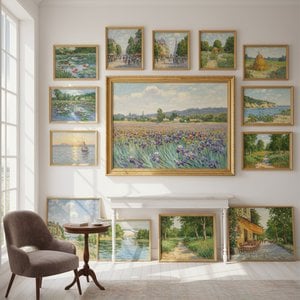
Los 10 Maestros del Paisaje Impresionista: Obras que Cambiaron la Historia del Arte
Descubre los 10 lienzos impresionistas que revolucionaron el arte. Explora la historia de Monet, Van Gogh y Renoir, sus técnicas y colores vibrantes. Encuentra reproducciones de alta calidad para decorar tu hogar en ArtsDot.com

Los 10 Maestros del Paisaje Impresionista: Obras que Cambiaron la Historia del Arte
Descubre los 10 lienzos impresionistas que revolucionaron el arte. Monet, Renoir y más… Explora la historia, técnica y belleza de cada obra maestra. Encuentra reproducciones de alta calidad para tu hogar en ArtsDot.com.