


 Vista previa
 Compartir
 Compartir
 Ver detalles

 Descargar
 Ver similares
 Radiografía
 Presentación de diapositivas
Angler
 Oil On Canvas
- WallArt
- Baroque Detail
 1700
1700 62.0 x 75.0 cm
 Rijksmuseum
 Leer más
Reproducción al óleo hecha a mano
Óleo sobre lienzo pintado a mano en el tamaño y marco de su elección, realizado por encargo por nuestros artistas. ( Pedir impresión Comprar descarga)




P118B $10

P118H $10

P118W $10

P438Z $10

P508JH $12

P508YH $12

P805H $10

P805Z $10

P919BZ $10

P919G $10

P919XJ $10

P959ZH $10

P968JZ $12

W106C $8

W218G $10

W218JH $8

W218Y $10

W307PJ $10

W316G $10

W316PJ $8

W316Y $10

W398PJ $8

W4111J $10

W500HY $15

W500JH $15

W692G $12

W849H $8

W940BG $15

W953PJ $8




Elija entre nuestros tamaños predefinidos que respetan las proporciones originales de la obra.

Puede ingresar sus propias dimensiones para adaptarse a un marco o espacio específico. Si el tamaño seleccionado no coincide con las proporciones de la imagen original, recortaremos la obra o extenderemos la pintura con elementos adicionales pintados a mano. Se le enviará una maqueta digital para su aprobación antes de comenzar la producción.
Tenga en cuenta que la vista previa en pantalla no refleja el recorte o la extensión reales. Solo la maqueta mostrará con precisión la composición final.
Si bien existen tamaños personalizados, recomendamos seleccionar una dimensión de la lista predefinida para preservar las proporciones originales.
Tras realizar el pedido, el equipo de ArtsDot.com enviará un correo electrónico al cliente para solicitar instrucciones y proporcionarle una vista previa del boceto.
Envío a todo el mundo () en 3-4 semanas en lugar de las 5 semanas estándar. (14 agosto). Sin comprometer la calidad.

Envío exprés gratuito a todo el mundo

Lienzo de lino de alta calidad

Seguro de envío completo

Garantía de reembolso de aranceles aduaneros

Garantía de fidelidad cromática exacta

Política de devolución de 60 días (solo por defectos)

Garantía de devolución del 100% del dinero

Oferta por volumen
 La opción de vidrio solo está disponible en tamaños inferiores a 110 cm.

Angler
Técnica de reproducción
Tamaño de la reproducción
-


Precio total
$ 313
Descripción de la obra
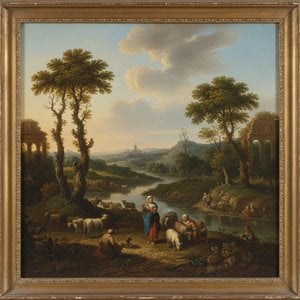
Angler - A Portrait of Rural Tranquility
The painting “Angler” by Carel de Moor (1655 – 1738), created around 1700, stands as a quintessential example of Leiden’s Baroque landscape tradition—a genre distinguished by its meticulous realism and profound engagement with the natural world. More than just a depiction of fishing activity, it embodies an idealized vision of rural life, capturing a moment of serene contemplation amidst pastoral beauty.- Subject Matter: The artwork portrays three figures – a young man diligently tending to his fishing line by a pond or canal—a scene rendered with remarkable detail—and two companions observing him from a weathered wooden fence. A milkmaid stands nearby, her gaze directed towards the fisherman’s actions, adding an element of domesticity and quiet observation to the composition.
- Style: De Moor adheres closely to the conventions established by Leiden’s leading artists of his era, notably Gerard Dou and Frans van Mieris. This stylistic lineage emphasizes clarity of form, subtle tonal gradations, and a masterful rendering of textures—characteristics that elevate “Angler” beyond mere representation into an emotionally resonant experience.
- Technique: Executed in oil on canvas using traditional brushwork techniques, the painting showcases De Moor’s exceptional skill in achieving luminous effects and conveying atmospheric depth. Glazes were skillfully employed to subtly modulate color hues and enhance the overall sense of realism—a testament to the artist's dedication to mastering the medium.
Composition & Perspective – A Triangular Harmony
The painting’s compositional structure is notably balanced, utilizing a triangular arrangement that draws the viewer’s eye towards the central figure—the fisherman himself. This deliberate positioning underscores his importance within the scene and establishes a visual hierarchy that guides the gaze across the canvas. Linear perspective contributes to creating depth, subtly diminishing the scale of distant buildings and emphasizing the immediacy of the pond’s surface. Aerial perspective—characterized by muted colors and softened contours—further enhances this illusion of distance, immersing the viewer in the tranquil atmosphere of the countryside.Color Palette & Light – Subtle Nuances of Pastoral Dusk
The color palette is dominated by earthy tones—ochres, browns, and greens—reflecting the natural environment depicted. However, subtle accents of blue—primarily in the sky—introduce a contrasting element that adds visual interest and reinforces the mood of quiet contemplation. Highlights of yellow illuminate the distant buildings and foliage, creating points of warmth against the cooler hues of the landscape. The diffused lighting suggests an overcast day or early morning light—conditions conducive to fostering serenity and enhancing the painting’s emotional impact.Symbolism & Emotional Resonance – Reflections of Inner Peace
Beyond its visual beauty, “Angler” carries symbolic weight. The act of fishing itself can be interpreted as representing patience, perseverance, and a connection to the rhythms of nature—values deeply cherished during the Baroque period. The figures’ postures convey calmness and repose, embodying an idealized vision of human existence harmoniously integrated with the natural world. Ultimately, De Moor's masterpiece invites contemplation on themes of tranquility, simplicity, and the enduring allure of pastoral landscapes.Historical Context – Leiden’s Artistic Legacy
Carel de Moor’s work is firmly rooted in Leiden’s artistic heritage—a tradition characterized by an unwavering commitment to realism and a profound appreciation for observation. Situated within the broader context of the Dutch Golden Age, “Angler” exemplifies the stylistic ideals that prevailed during this era—reflecting a fascination with capturing fleeting moments of beauty and conveying nuanced emotional states through masterful technique. It stands as a lasting testament to Leiden’s enduring contribution to European art history.Obras relacionadas


Biografía del artista
Carel de Moor: A Leiden Legacy of Baroque Detail
Carel de Moor (1655 – 1738) stands as a prominent figure within the Dutch Golden Age, an artist whose meticulous etchings and paintings cemented his place in the artistic canon of seventeenth-century Holland. Born in Leiden, he inherited a lineage steeped in artistic tradition—his father was a painter himself, establishing a familial commitment to visual art that profoundly shaped de Moor’s formative years. Unlike many artists of his time who pursued broader academic pursuits, Houbraken recounts that de Moor's father deliberately steered him toward drawing, recognizing his innate talent and fostering an early passion for capturing the nuances of observation. This dedication culminated in mentorship under Gerard Dou and Frans van Mieris, shaping his artistic sensibilities and grounding him within Leiden’s influential art circle.Early Life & Training
De Moor's upbringing instilled a deep appreciation for craftsmanship and realism—qualities that would characterize his entire oeuvre. His formal education at the St Luke’s Guild ensured he mastered the techniques of etching, alongside mastering other artistic disciplines. This foundational training provided him with an unparalleled understanding of anatomical precision and tonal gradation – skills he would later translate into breathtaking depictions of human form and emotion. The Guild's emphasis on meticulous observation mirrored Dou’s own approach to painting, fostering a commitment to capturing reality with unwavering accuracy.Guild Membership & Patronage
Becoming deacon multiple times underscored de Moor’s social standing and access to influential patrons. This connection facilitated commissions that allowed him to explore ambitious projects and refine his skills. His involvement in Leiden's civic life demonstrated not only his personal integrity but also his ability to navigate the complex dynamics of artistic patronage—a crucial element in securing funding for groundbreaking artworks and furthering his professional development. The support of wealthy families like the Van Cuypers enabled him to undertake monumental etchings that celebrated Leiden’s cultural achievements.De Moor's Artistic Style & Technique
De Moor’s artistic output is distinguished by an unparalleled level of detail, particularly evident in his portraits and genre scenes. He skillfully employed chiaroscuro—the dramatic interplay of light and shadow—a technique championed by Dou and Mieris—to imbue his subjects with psychological depth and convey emotion through subtle gestures and expressions. Consider “Portrait of a Gentleman” (1686), where de Moor’s masterful use of light sculpts the figure's face, revealing an inner life beyond mere appearance. Similarly, "The Adoration Of The Magi" exemplifies his ability to convey biblical narratives with dramatic visual impact—a testament to his command of artistic principles and his dedication to conveying profound human experience. His etchings are celebrated for their precision and tonal range, capturing textures and nuances that rival oil paintings; each line etched with painstaking care contributes to the overall illusionistic effect.Notable Works & Legacy
Among his most celebrated pieces are “Soldier Scene,” attributed to Carel de Moor II, showcasing a remarkable depiction of human anatomy and psychological realism—a testament to the influence of Mieris’s anatomical studies. This work exemplifies Leiden's artistic heritage and demonstrates de Moor’s ability to elevate etching beyond mere technical exercise into a vehicle for profound artistic expression. His son, Carel Isaac de Moor, continued the family tradition, perpetuating Leiden’s artistic legacy for decades to come—a lasting testament to Carel de Moor’s enduring contribution to Dutch art history. He remains an invaluable window into the aesthetic sensibilities and intellectual currents of seventeenth-century Holland—a beacon of Baroque artistry that continues to inspire admiration and scholarly study.
Carel de Moor
1655 - 1738 , Países Bajos
Datos clave
- Artistic Movement Or Style: Barroco
- Artists Or Movements Influenced By This Artist: ['Lucas van Leyden']
- Artists Who Influenced This Artist:
- Gerard Dou
- Frans van Mieris
- Date Of Birth: Leiden, Netherlands (1655)
- Date Of Death: 1738
- Full Name: Carel de Moor
- Nationality: Holandés
- Notable Artworks:
- Soldier Scene
- El Éxtasis de María Magdalena
- Place Of Birth: Leiden
Artículos relacionados

Solicitudes Comerciales
APS ofrece reproducciones de bellas artes y encargos personalizados desde 2004. Confían en nosotros corporaciones, hoteles y coleccionistas selectos para obras de arte de calidad museística, servicio discreto y soluciones artísticas completas. ¡Póngase en contacto con nosotros para obtener un presupuesto personalizado!

Los 10 Maestros del Siglo de Oro Holandés: Arte, Historia y Decoración Exclusiva
Descubre los 10 imprescindibles del Siglo de Oro Holandés: Rembrandt, Vermeer y más. Explora la historia, técnica y belleza de estos lienzos clásicos. Encuentra reproducciones de arte exclusivas para decorar tu hogar en .

Golden Light & Dutch Skies: Bringing the Magic of Dutch Golden Age Landscapes into Your Home
Transform your home with the breathtaking light of Dutch Golden Age landscapes. Discover how hand-painted oil reproductions of masterworks like Ruisdael and Vermeer bring timeless elegance, atmosphere, and soulful texture to modern interiors. Elevate your space with museum-quality art.
Nicolaes Berchem: Dutch Golden Age Pastoralism & the Evolution of Landscape Painting
Explore the captivating world of Nicolaes Berchem, a leading Dutch Golden Age painter. Discover his idyllic landscapes, masterful technique & lasting influence on art history. Learn more at ArtsDot.

Charles Leickert: Capturing the Dutch Golden Age Light – A Comprehensive Study of Technique, Context, and Legacy
Explore the captivating winter landscapes of Charles Leickert, a master of Dutch Golden Age light & atmosphere. Discover his techniques, symbolism, and lasting legacy – a comprehensive study for art enthusiasts and collectors.

