


 Vista previa
 Compartir
 Compartir
 Ver detalles
 Guía
Guía

 Descargar
 Ver artículos similares
 Radiografía
 Presentación de diapositivas
 Estadísticas
(80)


 Leer más
Giclée / Impresión de arte
Impresiones giclée o en lienzo de calidad de museo con producción rápida y opciones de acabado flexibles. ( Encargar reproducción pintada a mano Ver versión en imagen digital)




P118B €10

P118H €10

P118W €10

P438Z €10

P508JH €12

P508YH €12

P805H €10

P805Z €10

P919BZ €10

P919G €10

P919XJ €10

P959ZH €10

P968JZ €12

W106C €8

W218G €10

W218JH €8

W218Y €10

W307PJ €10

W316G €10

W316PJ €8

W316Y €10

W398PJ €8

W4111J €10

W500HY €15

W500JH €15

W692G €12

W849H €8

W940BG €15

W953PJ €8




Elija entre nuestros tamaños predefinidos que respetan las proporciones originales de la obra.

Introduzca el ancho y el alto que necesite para adaptarse a su marco o pared. Una impresión solo puede recortarse, nunca hacerse más grande que la imagen original, por lo que un tamaño con una forma distinta perderá parte de la obra. Le enviaremos una maqueta digital para su aprobación antes de realizar cualquier impresión. La imagen que se muestra en esta página no refleja el recorte real; solo la maqueta lo hace.
Envío a todo el mundo () en 2 semanas en lugar de las 4/5 semanas estándar. (22 octubre)

Envío exprés gratuito a todo el mundo

Lienzo de lino de alta calidad

Seguro de envío completo

Garantía de reembolso de impuestos aduaneros

Garantía de fidelidad cromática exacta

Política de devolución de 100 días (solo por defectos)

Garantía de devolución del 100% del dinero

Oferta por volumen
 La opción de vidrio solo está disponible en tamaños inferiores a 110 cm.

(80)
Giclée / Impresión de arte
Tamaño de la reproducción
-


Precio total
€ 54
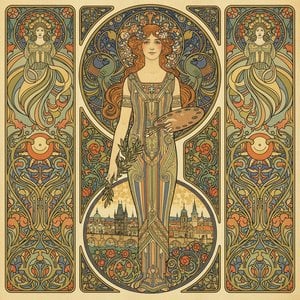
A Vision of Femininity and Mythic Harmony
In the golden twilight of the nineteenth century, few names evoke the sinuous elegance of the Belle Époque quite like Alphonse Mucha. His masterpiece, “The Slavonic Uprising,” stands as a breathtaking testament to the Art Nouveau movement, a period defined by its rejection of rigid academic structures in favor of organic, flowing lines and opulent ornamentation. Within this composition, we encounter a profound engagement with mythology and symbolism, where the boundaries between the human spirit and the natural world begin to dissolve. Mucha does not merely present a portrait; he invites the viewer into a dreamscape where idealized femininity meets the deep, resonant echoes of Slavic folklore.
The central figure of the work serves as an anchor for this mythic narrative—a woman whose presence is both ethereal and commanding. Draped in silks that seem to catch an unseen breeze, she embodies a sense of graceful movement that is characteristic of Mucha’s celebrated style. As her hair cascades down her shoulders like a waterfall of shimmering gold, it reflects the artist's meticulous fascination with botanical textures and natural forms. This fluidity is further enhanced by the presence of birds that dance through the composition, adding layers of depth and a rhythmic pulse to the scene, as if the very air around her is alive with song and motion.
The Alchemy of Line and Color
To behold this work is to witness a masterclass in technical precision. Mucha’s approach was far from accidental; it was a disciplined study of anatomy and botanical illustration blended with an almost magical use of color. Utilizing the delicate layering of thin washes—often employing tempera on canvas—he achieved a luminous surface that appears to glow from within. This technique creates a shimmering, pearlescent quality that makes the subject appear as though she is bathed in a soft, celestial light.
Every detail, from the intricate patterns on her garments to the delicate feathers of her avian companions, is rendered with an astonishing level of care. For the discerning collector or interior designer, this level of detail offers a profound visual richness. The way the colors interact—soft pastels meeting deeper, more resonant tones—creates a balanced palette that can anchor a room with both sophistication and warmth. It is a symphony of line and color that captures the eye and holds it, rewarding repeated observation with new discoveries in every curve and shadow.
Symbolism and the Soul of Art Nouveau
Beyond its aesthetic splendor, “The Slavonic Uprising” is deeply rooted in a complex web of allegory. Mucha’s work often sought to elevate the human experience through visual storytelling, weaving together Christian iconography and Slavic legends to create something transcendent. The interplay between the woman and the birds suggests a harmony between civilization and nature, a central theme of the Art Nouveau ethos. This piece is not just an object of beauty; it is a narrative vessel that carries the weight of cultural identity and spiritual aspiration.
For those seeking to bring a sense of historical depth and emotional resonance into a curated space, this reproduction offers more than mere decoration. It provides a window into a lost era of romanticism and intellectual curiosity. Whether placed in a grand salon or a quiet study, the painting radiates an aura of timeless elegance, making it an incomparable choice for anyone looking to inspire awe and contemplation through the enduring power of fine art.
Preguntas y respuestas
¿Cuántas personas ven "(80)"?
Existe una página de Estadísticas para "(80)". En ella se registran las visitas mensuales de la obra y de otras obras del artista, con desgloses por país e idioma.
¿Puedo ver "(80)" de Alphonse Maria Mucha bajo diferentes luces?
La página Rayos X de "(80)" de Alphonse Maria Mucha es un visor interactivo que permite desplazarse a través de once capas ópticas de la imagen de la obra, incluyendo una vista de estilo radiografía.
¿Qué atmósfera transmite "(80)"?
El ambiente general de "(80)" de Alphonse Maria Mucha es Romantic. Esta atmósfera describe la esencia general de la obra.
Obras relacionadas


Biografía del artista
Primeros Años y Educación
- Nacido: 15 de julio de 1860, en Ivanačice, Moravia (ahora parte de la República Checa)
- Mostró talento artístico desde una edad temprana.
- Estudió en la Academia de Bellas Artes de Praga pero se desilusionó con los enfoques tradicionales.
- Se mudó a París en 1887 para perseguir su propio estilo.
Estilo Artístico y Obras Notables
- Conocido por un estilo Art Nouveau distintivo caracterizado por líneas fluidas, formas orgánicas y una sensación de movimiento.
- Influenciado por artistas como Pierre-Auguste Renoir y Gustave Moreau.
- Obras Notables:
- La Insurrección Eslava - Muestra la combinación de motivos checos tradicionales con elementos Art Nouveau modernos.
- Salon des Cent
- Pinturas inspiradas en obras como Las Hijas de Tespio de Gustave Moreau, y La Ribambelle des Gobelins de Piero Dorazio.
- Ilustraciones basadas en Jóvenes Granjeros Rompiendo Lino de Sir Hubert von Herkomer.
- Frecuentemente presentó mujeres idealizadas con túnicas fluidas rodeadas de flores exuberantes.
Hitos Profesionales y Comisiones Importantes
- Colaboración con Sarah Bernhardt: Creó carteles y diseños para la actriz Sarah Bernhardt, comenzando con el cartel de Gismonda (1894), lo que lanzó su carrera.
- Exposición Universal en París (1900): Su estilo Art Nouveau ganó reconocimiento internacional en esta exposición. Decoró el Pabellón de Bosnia y Herzegovina y colaboró en el Pabellón Austriaco.
- Patronazgo de Charles Richard Crane: Recibió apoyo de Charles Richard Crane, lo que le permitió crear la monumental serie El Épico Eslavo (1912-30).
- Checoslovaquia Independiente: Diseñó sellos postales, billetes y documentos gubernamentales para la recién independiente Checoslovaquia.
Influencias y Legado
- Influenciado por las tradiciones artísticas checas y los movimientos de arte europeos modernos.
- Su estilo único allanó el camino para futuras generaciones de artistas en Art Nouveau y Secesión.
- Inspiró a otros artistas como Eva Prokopcová.
- El legado se extiende más allá de su obra de arte hasta influir en el diseño y la estética.
Vida Posterior y Muerte
- Se casó con Maruska (Marie/Maria) Chytilová en 1906.
- Visitó los Estados Unidos desde 1906 hasta 1910, donde nació su hija Jaroslava.
- Murió el 14 de julio de 1939 en Praga, Checoslovaquia.

Alphonse Maria Mucha
1860 - 1939 , República Checa
Datos clave
- Artistas Influenciados: ['Eva Prokopcová']
- Artistas Que Influyeron:
- Pierre-Auguste Renoir
- Gustave Moreau
- Fecha De Fallecimiento: 1939
- Fecha De Nacimiento: 15 de julio de 1860
- Lugar De Nacimiento: Brno, República Checa
- Movimiento Artístico: Art Nouveau
- Nacionalidad: Checo
- Nombre Completo: Alphonse Maria Mucha
- Obras Notables:
- La sublevación eslava
- Salón de los Cien
- Las hijas de Tespio
- La Ribambelle de Gobelins
Artículos relacionados

Art Nouveau: 10 Obras Maestras que Definieron un Movimiento Revolucionario |
Descubre las 10 obras maestras del Art Nouveau que revolucionaron el arte. Explora la belleza de Mucha, Klimt y más. Reproducciones de museo en para un hogar con estilo. ¡Inspírate ahora!
Alphonse Mucha: A Comprehensive Exploration of Art Nouveau's Master of Decorative Symbolism
Explore the life & art of Alphonse Mucha, master of Art Nouveau! Discover his iconic posters, stunning illustrations, and the monumental Slav Epic. A comprehensive guide for collectors & enthusiasts.

La Línea Fluida y la Forma Floreciente: Explorando el Legado Estético del Art Nouveau
Descubre el legado del Art Nouveau: su historia, influencias y artistas clave como Van de Velde y Boccioni. Un análisis profundo de este movimiento estético revolucionario.

La Edad Dorada Reinterpretada: Explorando los Principios Estéticos y el Legado Duradero del Art Déco
Descubre la elegancia atemporal del Art Déco. Explora su historia, características clave y artistas emblemáticos. Encuentra inspiración y obras exclusivas para decorar con estilo en ArtsDot.

Feathered Visions: A Historical & Artistic Exploration of Birds in Painting
Explore the rich history of birds in painting! Discover symbolism, artistic movements & master artists like Audubon. High-quality reproductions available at ArtsDot.


