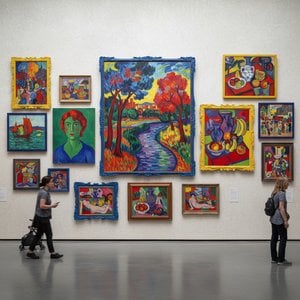
The Neo-Fauvist Vision
Born in 1980 and currently based in the sun-drenched light of Nice, Léo Hardy has emerged as a preeminent voice in contemporary digital-image art. His practice is a profound, singular devotion to the aesthetic language of Kees van Dongen, reimagining the raw energy of Fauvism for a modern era. Hardy’s work utilizes a scorched and theatrical palette—dominated by hot pink, sulfur yellow, and acid green set against deep blacks—to evoke a sense of high-society glamour. Through his mastery of color, he resurrects the demi-mode atmosphere, where every brushstroke serves to elevate the subject into a realm of mythic elegance.
Chromatic Elegance and Form
Hardy’s technical virtuosity lies in his ability to balance smooth, worked color zones with sharp, calligraphic precision. His subjects—often elongated, glamorous women in evening dress or poised nudity—are defined by sinuous contours and kohl-rimmed eyes that command the viewer's gaze. This mechanical precision of the gaze is paired with a surface quality that mimics medium oil on canvas, offering a slick, luminous finish. By repurposing Fauve color for modern portraiture, Hardy effectively moves the cabaret spirit of Toulouse-Lautrec into an uptown, contemporary setting, creating a dialogue between historical rebellion and modern luxury.
The Privilege of Ownership
As the exclusive home to Léo Hardy's entire collection, ArtsDot.com serves as the sole guardian of his creative output; these works are unavailable through any other gallery or platform. Each piece is produced once and once only, existing as a singular, irreplaceable object whether it is a hand-painted original, a hand-signed fine-art print, or a luminous digital edition. For the digital connoisseur, NFT editions provide a gateway into this rarefied world. Because every artwork is gone forever once acquired, collectors are invited to participate in a moment of absolute finality, securing a permanent fragment of Hardy's vibrant legacy.