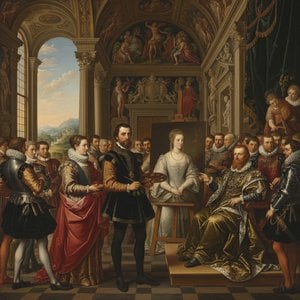
Hans Eworth: Bridging Flemish Tradition and Tudor Vision
Hans Eworth stands as a pivotal figure in the artistic landscape of Tudor England, representing a fascinating confluence between Flemish Renaissance ideals and the burgeoning humanist spirit of the era. Despite the scarcity of biographical details—his early life remains shrouded in much of the obscurity that often clings to the masters of the sixteenth century—Eworth’s prolific output of approximately forty paintings testifies to his considerable talent and enduring legacy within the art history canon. He carved out a distinctive niche as a portraitist, capturing the dignity and complexity of Tudor nobility alongside allegorical representations that infused his canvases with profound symbolic depth.
The roots of Eworth’s mastery can be traced back to the vibrant artistic crucible of Antwerp. Records indicate he was admitted to the prestigious Guild of St Luke in Antwerp around 1540 under the name Jan Euworts, suggesting a robust and rigorous artistic education within the celebrated Flemish atelier tradition. At that time, Antwerp served as a magnet for artists from across Europe, a place where stylistic influences mingled and honed technical skills to perfection. While specifics about his direct teachers remain elusive, Eworth’s subsequent work undeniably reflects the stylistic hallmarks of Antwerp’s Renaissance masters. The influence of Hans Holbein the Younger is particularly palpable in Eworth's meticulous draughtsmanship and his nuanced ability to portray human emotion through subtle facial expressions and precise detail.
A Career Forged in the Tudor Court
By 1545, Eworth had relocated to London, establishing himself as a resident artist amidst the intellectual and cultural circles championed by figures such as Erasmus and Thomas More. This migration coincided with a period of significant cultural exchange between England and Flanders, fueled by both trade and an intense curiosity for continental humanism. Eworth’ London career was marked by his ability to navigate the shifting political and religious tides of the mid-sixteenth century. He became well-recorded in various naturalization and tax documents under a wide variety of spellings, reflecting the fluid identity of many immigrant craftsmen in the capital.
His patronage extended into the highest echelons of English society. While there is no direct evidence that his most important patron was the Catholic Queen Mary I, many scholars now accept this to be the case, noting that his known portraits of her appear to be variations of a singular, masterful composition. His work often transcended simple likeness, moving into the realm of the allegorical. A prime example is his portrait of Sir John Luttrell with the goddess Pax, a piece designed to commemorate military exploits and the peace brought by the Treaty of Boulogne. Through such works, Eworth did not merely record faces; he recorded the political aspirations and the very soul of an era.
Legacy and Artistic Significance
The significance of Hans Eworth lies in his role as a cultural bridge. He brought the sophisticated, detail-oriented techniques of the Netherlandish tradition to the English court, helping to elevate the standard of English portraiture during a period of immense transition. His ability to blend the material realism of Flemish oil painting with the intellectual symbolism required by Tudor patrons allowed him to create works that were both visually stunning and politically potent.
Even as the political landscape shifted toward the Elizabethan era, Eworth continued to contribute to the English aesthetic, executing decorative commissions for Elizabeth I's Office of the Revels in the early 1570s. His life and work remain a testament to the enduring power of the immigrant artist to reshape the cultural identity of their adopted home. Today, his surviving portraits serve as windows into the Tudor age, offering us a glimpse of the faces, the fashions, and the profound symbolic language of a world in flux.