


The History of Musée d'Orsay
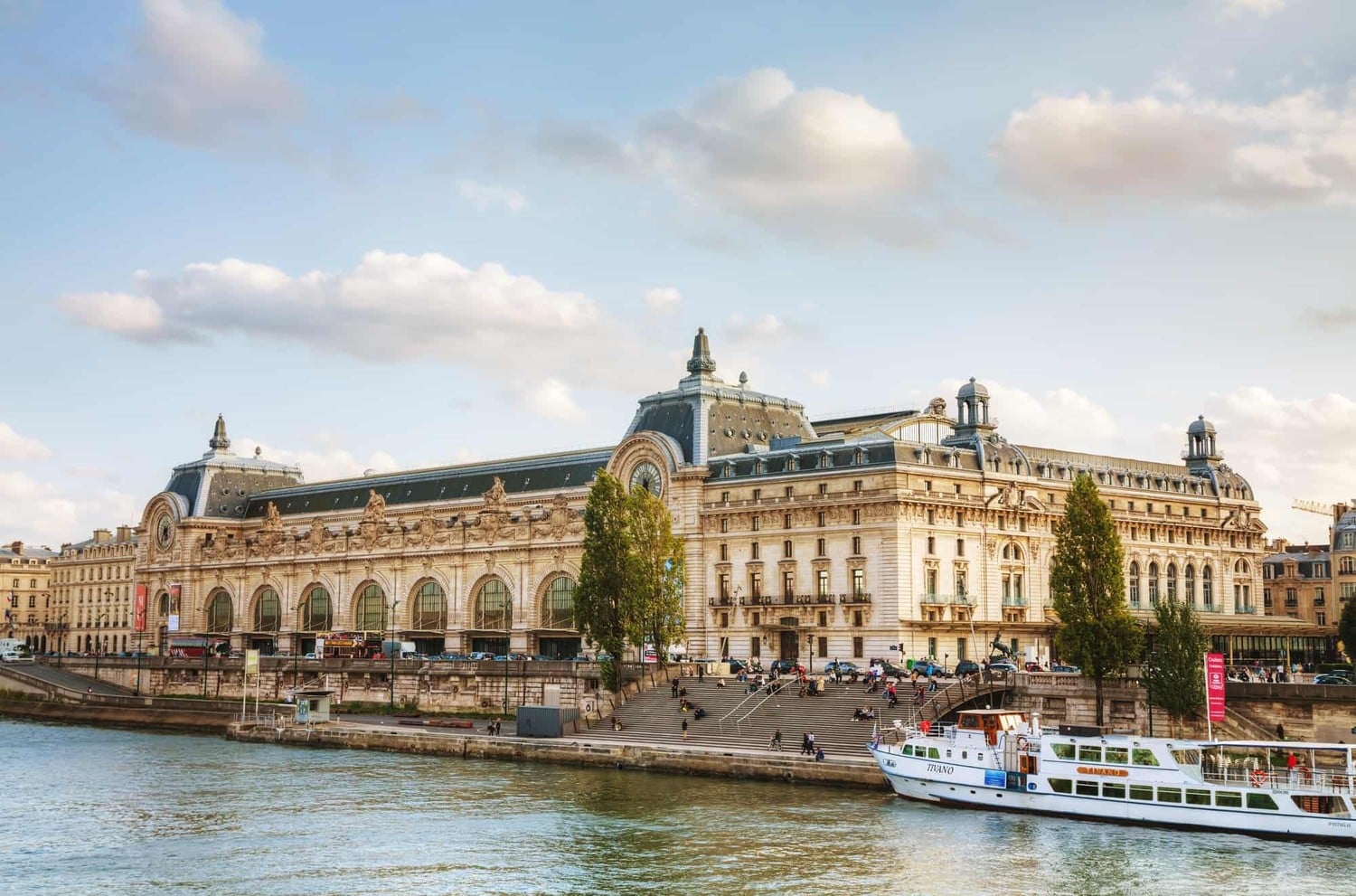
The Musée d'Orsay is located on the Left Bank of the Seine in Paris, France. The building was originally constructed as the Gare d'Orsay, a railway station built between 1898 and 1900. It was designed to serve the Chemin de Fer de Paris à Orléans. For several decades, the structure functioned as a terminal for steam engines before its eventual repurposing.
Following a significant reconfiguration of the interior, the site was transformed into a museum. President François Mitterrand officially opened the institution in December 1986. Today, it is one of the largest art museums in Europe. The collection focuses primarily on French art produced between 1848 and 1914.
The Architecture of the Former Station
The building originated as the Gare d’Orsay, a Beaux-Arts railway station designed by architects Lucien Magne, Émile Bénard, and Victor Laloux. Its structure was built between 1898 and 1900 to accommodate the steam engines of the Chemin de Fer de Paris à Orléans. The industrial bones of the terminal, defined by soaring ironwork and vast glass ceilings, were later reconfigured to house art. This transformation was managed by an architectural team including Pierre Colboc, Renaud Bardon, and Jean-Paul Philippon. The interior arrangement was subsequently organized by the Italian architect Gae Aulenti.
The spatial logic of the museum relies on the original layout of the station. The central nave's structures break up the immense sculpture and gallery spaces, providing a sense of order within the large volumes. Beneath the glass flooring, a 1:100 scale model of the Paris Opera area is encapsulated, offering a physical link to the urban history of the site. The design maintains a connection to the site's previous function while adapting the stone and iron for its current purpose.
A Collection of Impressionist Masterpieces
The museum holds the largest assembly of Impressionist and Post-Impressionist works in existence. This collection spans the period from 1848 to 1914, encompassing paintings, sculptures, furniture, photography, and architecture. While the total collection includes over 3,650 works, 2,300 are presented as permanent fixtures within the galleries.
The holdings focus on the transition toward modernism through the works of Berthe Morisot, Claude Monet, Édouard Manet, Edgar Degas, Pierre-Auguste Renoir, Paul Cézanne, Georges Seurat, Alfred Sisley, Paul Gauguin, and Vincent van Gogh. These artists moved away from academic tradition to explore light and atmosphere. The selection reflects the shift in visual language during the late nineteenth century.
- The Source, 1868 - Gustave Courbet
- Red Roofs, 1877 - Camille Pissarro
- The Apparition, 1874-1876 - Gustave Moreau
- A Modern Olympia, 1873-1874 - Paul Cézanne
- Les Repasseuses, 1884-1886 - Edgar Degas
Notable Masterpieces of the Collection
The collection contains significant works from the mid-to-late nineteenth century. Édouard Manet’s 1863 painting, Olympia, remains a central piece of the holdings. Nearby, Gustave Courbet’s 1866 work, The origin of the world, offers a study in realism. Jean-François Millet’s 1859 painting, The Angelus, is also held within the museum's permanent arrangement.
The museum houses several key works from the Impressionist and Post-Impressionist movements. Berthe Morisot’s 1872 painting, The Cradle, is a featured work in the galleries. Vincent Willem Van Gogh’s 1888 Starry Night Over the Rhone is another significant part of the holdings. Additionally, the museum contains The Apparition, a watercolor by Gustave Moreau painted between 1874 and 1876.
- The Apparition, 1874-1876 - Gustave Moreau
- The Cradle, 1872 - Berthe Morisot
- The origin of the world, 1866 - Gustave Courbet
- Olympia, 1863 - Édouard Manet


