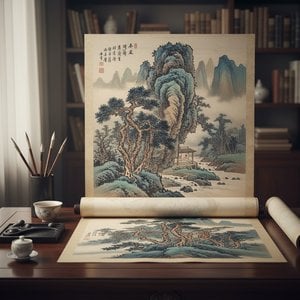
The Quiet Observer of the Jiangsu Landscape
In the bustling era of the Qing Dynasty, a man emerged from the Wu country of the Jiangsu province to capture the fleeting nuances of the natural world. Born in 1632, Wang Wu lived through a period of profound transition, yet his focus remained fixed upon the delicate intricacies of life. He was a man of letters as much as a man of the brush, finding expression through both poetry and painting. While many of his contemporaries sought influence by aligning themselves with established schools of thought, Wang Wu walked a solitary path. He remained unattached to any specific artistic faction, choosing instead to let the rhythms of nature dictate his hand.
His life was marked by a devotion to the minute. He did not seek to depict the vastness of mountains or the sweeping drama of storms, but rather the subtle textures of a petal or the precise curve of an insect's wing. This preference for the small and the detailed allowed him to develop a style that was both brilliant and incredibly fine. Through his eyes, the smallest elements of the garden became subjects of profound importance.
A Precision of Form and Color
The technique employed by Wang Wu required a steady hand and a patient spirit. He specialized in the bird-and-flower genre, a tradition that demands an intimate understanding of anatomy and botanical structure. His work is characterized by a meticulous attention to detail that brings a sense of life to the silk or paper upon which he worked. To look upon his depictions is to see the world through a lens of intense clarity.
His artistic identity was multifaceted, reflected in the various names he carried throughout his life:
- Qingzhong, his chosen style name.
- Xuedian daoren, a sobriquet that suggests a certain spiritual or scholarly depth.
- Wang'an, another name used to identify his creative persona.
This versatility in identity mirrored his versatility in subject matter. Whether he was rendering the heavy, layered folds of a peony or the slender, fragile stem of a narcissus, his brushwork remained consistent in its precision. He possessed the ability to translate the physical reality of a plant into a visual language that felt both immediate and deeply considered.
The Legacy of the Minute
As the years passed toward his death in 1690, Wang Wu's reputation grew through the quiet strength of his compositions. His ability to find complexity within simplicity ensured that his works would endure in private collections and scholarly circles. His paintings, such as those featuring plum blossoms or insects, demonstrate a mastery of the "minute style" that defined his career. He did not rely on grand gestures to command attention; instead, he relied on the truth of the subject itself.
Today, his contributions to the Qing Dynasty's artistic landscape are preserved in significant collections, including the Yale University Art Gallery and the Minneapolis Institute of Art. These works, such as The Friends of the Cold Season and Plum, Narcissus and Rock, offer a window into a mind that found the infinite within the infinitesimal. He remains a significant figure for those who value the quiet, disciplined observation of the natural world.
Ερωτήσεις και Απαντήσεις
Μπορώ να περιηγηθώ στα έργα του/της Wang Wu ανάλογα με τη διάθεση;
Μπορείτε να περιηγηθείτε στα έργα του/της Wang Wu ανάλογα με τη διάθεση στη σελίδα Κόρνερ Αίσθησης, όπου τα œuvres έχουν ταξινομηθεί σύμφωνα με την ατμόσφαιρα που αποπንέουν.
Από πού προέρχεται ο/η Wang Wu;
Ο/Η Wang Wu γεννήθηκε στην/στη People's Republic of China.
Υπάρχει μια πλήρης λίστα με τα έργα του/της Wang Wu;
Μπορείτε να περιηγηθείτε σε όλα τα έργα του/της Wang Wu στο αυτή η ιστοσελίδα μέσω της σελίδας με την πλήρη συλλογή τους (Όλα τα έργα).
Σε ποια πόλη και χώρα γεννήθηκε ο/η Wang Wu;
Ο/Η Wang Wu γεννήθηκε στην/στη Suzhou, στο/στη People's Republic of China.