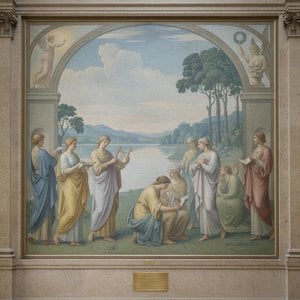
The Early Life and Education of Pharaon de Winter
Born in Bailleul, France, Pharaon de Winter was the third of twelve children in a family of clog-makers. His artistic journey began at the age of eleven when he started taking lessons from a local amateur artist. In 1861, he moved to Bruges to stay with an aunt, where he began learning art in earnest under the guidance of Henri-Julien de Stoop. Upon returning to France in 1869, he enrolled at the École des beaux-arts de Lille to study with Alphonse Colas. By 1872, he had moved to Paris to enter the École Beaux-Arts, working in the studios of Alexandre Cabanel. His first exhibition at the Salon took place in 1875.
Artistic Career and Later Years
De Winter became known for his genre scenes. In 1884, his work At the Dispensary was reproduced in Le Monde illustré. Following the death of his teacher Colas, he was named the Director of the drawing and painting courses at the École. After a dispute regarding teaching hours, he resigned to start his own school under the patronage of Carolus-Duran, though he eventually returned to his old position in 1905. His later years were marked by significant hardship; eye problems and the destruction of his parents' home and workshop in Bailleul during World War I resulted in the loss of about one-fifth of his total artistic output. He died in Lille.
Ερωτήσεις και Απαντήσεις
Ποιες διαθέσεις εκφράζουν τα έργα του/της Pharaon de Winter;
Στη σελίδα Κόρνερ Αίσθησης του καλλιτέχνη, μπορείτε να δείτε τα έργα του Pharaon de Winter ταξινομημένα ανάλογα με την ατμόσφαιρά τους.
Πού και πότε γεννήθηκε ο/η Pharaon de Winter;
Ο/Η Pharaon de Winter γεννήθηκε στην/στη Bailleul το 1849.
Σε ποια πόλη και χώρα γεννήθηκε ο/η Pharaon de Winter;
Ο/Η Pharaon de Winter γεννήθηκε στην/στη Bailleul, στο/στη France.