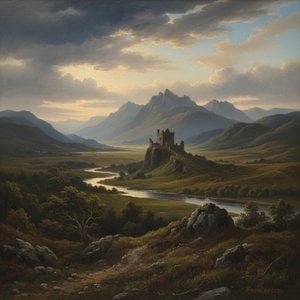
James Howe Carse: Bridging Scotland and the Australian Bush
James Howe Carse (1819-1900) wasn’t merely a painter; he was an explorer of landscapes, a chronicler of evolving environments, and a pivotal figure in establishing a distinctly Australian artistic voice. Born in Edinburgh to a family steeped in artistic tradition – his father, Alexander Carse, was himself a respected Scottish landscape painter – Carse inherited both a technical skill and a deep appreciation for the evocative power of nature. His journey took him across continents, culminating in a prolific career documenting the dramatic shifts occurring within Scotland and, crucially, the burgeoning landscapes of colonial Australia.
Carse’s early artistic training was primarily focused on capturing the rugged beauty of his native Scotland. He exhibited in London during the 1860s, producing scenes of familiar Scottish vistas – rolling hills, lochs shrouded in mist, and the dramatic coastline. These works established a foundation built upon meticulous observation and a keen understanding of light and shadow, hallmarks that would later inform his Australian paintings. However, it was his relocation to Australia in the mid-1860s that truly defined his artistic trajectory. Drawn by the promise of adventure and the allure of a rapidly changing frontier, Carse arrived in Adelaide, marking the beginning of a transformative period.
The Shaping of an Australian Eye
Carse’s time in Australia wasn't characterized by a sudden stylistic shift, but rather a gradual adaptation to a new visual language. Initially, his paintings mirrored his Scottish work – detailed depictions of familiar landscapes. Yet, as he spent years traversing the colonies, particularly Victoria and Queensland, he began to incorporate elements specific to the Australian environment: the vastness of the bush, the unique flora and fauna, and the interplay between burgeoning industry and untouched wilderness. This period witnessed a remarkable evolution in his technique; he moved away from the highly polished surfaces of his earlier work towards looser brushstrokes and a greater emphasis on capturing atmosphere and mood.
His depictions of industrial landscapes – factories alongside rivers, mines nestled amongst hills – offered a poignant commentary on Australia’s rapid development. These weren't romanticized portrayals; Carse presented the realities of colonial life with an unflinching honesty, juxtaposing the progress of industry with the enduring beauty of the natural world. Notable works like “Oldham, Lancashire, from Glodwick Fields” and “St Mary the Virgin, Deane Parish Church, Bolton,” demonstrate this early ability to capture industrial growth amidst rural beauty.
A Gold Medal and Recognition
Carse’s artistic reputation reached a significant milestone in 1876 when he secured a gold medal at the Intercolonial Exhibition held in Chicago. This prestigious award served as a powerful validation of his talent, catapulting him to international recognition. It was a testament not only to his technical skill but also to his ability to capture the essence of both Scottish and Australian landscapes with equal conviction. Returning to Australia, he continued to exhibit prolifically, gaining increasing acclaim for his evocative depictions of the bush and its inhabitants.
Legacy and Enduring Influence
James Howe Carse’s legacy extends beyond his individual paintings. He played a crucial role in establishing landscape painting as a distinct genre within Australian art. His work served as an inspiration to subsequent generations of artists, encouraging them to explore the vastness and diversity of the Australian landscape. His ability to seamlessly blend technical skill with emotional resonance ensured that his paintings continue to resonate with viewers today, offering a captivating glimpse into a pivotal period in Australian history – a time of dramatic transformation and the forging of a unique national identity.
Carse’s final years were spent in Mosman, New South Wales, where he passed away in 1900. His paintings remain an invaluable record of this era, offering a poignant reminder of the enduring power of art to capture both the beauty and the complexities of the human experience within the context of a changing world.
Ερωτήσεις και Απαντήσεις
Πώς μπορώ να παρακολουθήσω το έργο του/της James Howe Carse χρονολογικά;
Μπορείτε να δείτε τη χρονολογία των έργων του/της James Howe Carse στη σελίδα Χρονολόγιο Έργων, όπου τα έργα είναι ταξινομημένα ανά ημερομηνία δημιουργίας.
Μπορώ να περιηγηθώ στα έργα του/της James Howe Carse ανάλογα με τη διάθεση;
Στη σελίδα Κόρνερ Αίσθησης του James Howe Carse, τα έργα του καλλιτέχνη είναι διατεταγμένα ανάλογα με τη διάθεση.
Πού μπορώ να βρω τα έργα του καλλιτέχνη James Howe Carse ομαδοποιημένα ανά καλλιτεχνικό ρεύμα;
Μπορείτε να περιηγηθείτε στα έργα του/της James Howe Carse ανά καλλιτεχνικό κίνημα στη σελίδα των κινημάτων για τον/την James Howe Carse (Όλα τα Ρευmatά).