The Shadowy Master of Ferrara
In the golden, transformative era of the Italian Quattrocento, few figures loom as mysteriously yet significantly as Galasso Galassi. An essential, if somewhat elusive, pioneer of the School of Ferrara, Galassi’s presence in the annals of art history serves as a vital bridge between the late Gothic traditions and the burgeoning brilliance of the Early Renaissance. Active primarily between 1450 and 1488, his life was deeply intertwined with the vibrant cultural pulse of Ferrara, a city that would soon become a crucible for some of the most innovative artistic minds in Italy. While much of his personal biography remains shrouded in the mists of time, his influence is etched into the very foundations of the Ferrarese style, characterized by its unique blend of emotional intensity and structural rigor.
To understand Galassi is to understand the fertile ground from which he emerged. His artistic journey likely took him through the storied landscapes of Bologna and even Borgo San Sepolcro, where his early works began to garner recognition. This period of movement allowed him to absorb the diverse stylistic currents flowing through Northern Italy, blending the delicate grace of earlier masters with a burgeoning interest in the more robust, sculptural forms that would define the next generation. He was not merely a painter of scenes, but a foundational architect of a regional identity, helping to establish Ferrara as a center of profound aesthetic experimentation.
A Legacy of Influence and Lineage
The true historical weight of Galasso Galassi is perhaps best measured by the greatness of those he inspired. Art historians often point to his role as a potential mentor to Cosmè Tura, one of the most visionary and distinctive painters of the Renaissance. The possibility of an apprenticeship under Galassi suggests that the sharp lines, decorative exuberance, and obsessive attention to detail found in Tura’s masterpieces may have had their roots in Galassi’s own disciplined approach to composition. Through this lineage, Galassi’s artistic DNA flowed into the heart of the Este court, influencing the very fabric of Ferrarese visual culture.
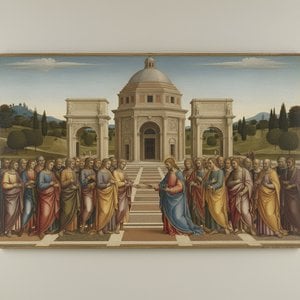
His contributions were not limited to a single medium or subject matter, though his most enduring traces are found in religious narratives. His work on scenes of The Passion for the church of Mezzaratta in Bologna stands as a testament to his ability to handle profound theological themes with a sense of gravity and grace. Even as later historians like Giorgio Vasari occasionally compressed or obscured his biographical details, the archival evidence remains: Galassi was a master whose hand helped shape the transition from the medieval mindset to the humanistic dawn of the Renaissance.
Reflecting on his life, we see an artist who:
- Served as a cornerstone for the School of Ferrara during its formative years.
- Bridged the gap between the traditions of Bologna and the innovations of the Ferrarese court.
- Provided the technical and conceptual groundwork for legendary successors like Cosmè Tura.
- Contributed to the spiritual and aesthetic landscape of Northern Italy through significant ecclesiastical commissions.
Ερωτήσεις και Απαντήσεις
Πού και πότε γεννήθηκε ο/η Galasso Galassi;
Ο/Η Galasso Galassi γεννήθηκε στην/στη Ferrara το 1423.
Πού ομαδοποιούνται τα έργα του Galasso Galassi με βάση λέξεις-κλειδιά;
Ανακαλύψτε τα έργα του/της Galasso Galassi ανά λέξη-κλειδί στη σελίδα των λέξεων-κλειδιών του/της Με Λέξεις-Κλειδιά. Κάθε λέξη-κλειδί ομαδοποιεί τα σχετικά έργα.
Πόσα έργα του/της Galasso Galassi είναι διαθέσιμα για περιήγηση;
Μπορείτε να περιηγηθείτε σε 3 έργα τέχνης έργα του Galasso Galassi στη σελίδα Όλα τα έργα.