The Son of a Carpenter
In the quiet streets of Spišská Sobota, a young man began to observe the world with a precision that would define his legacy. Born into a family where craftsmanship was a way of life, he was the son of Fridrich Wallachy, a carpenter, and Karolína Žofia Schwarczová. This lineage of makers likely influenced his early hand, as his first preserved works emerged when he was only eighteen years old. He did not merely see the landscape; he sought to map its essence through line and shadow.
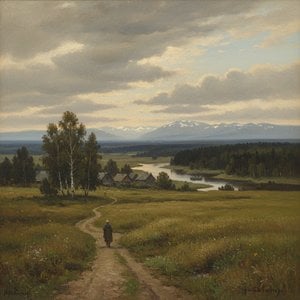
His early years were spent amidst the shifting light of the Tatra mountains. By the mid-1870s, he had begun a dedicated series of drawings that captured the soul of the sub-Tatra towns. He moved through the landscape, documenting the ruggedness of rock studies and the delicate movement of watercourses. His vision was one of quiet observation, turning his gaze toward the trees and the vegetation that clung to the mountain slopes.
A Record of the Tatra Landscape
His work often focused on the intersection of human habitation and the wild, untamed beauty of the mountains. He possessed a particular talent for capturing the atmosphere of specific locales, translating the physical reality of the region into detailed visual records. His studies were not mere sketches but were deep engagements with the topography of his home.
- Panoramic views of sub-Tatra towns set against the backdrop of the Tatras
- Detailed studies of rock formations and mountain vegetation
- Depictions of local life, such as a mill or a cottage near the Belianske Tatras
- Sketches of watercourses and the surrounding greenery
The precision of his hand is evident in his depictions of the village of Ujverbasz and the views near Velka. Even in his later years, his connection to the land remained a central theme of his output. He was a man who understood the structure of the world, from the architectural design of a family grave to the sweeping curves of a mountain ridge.
The Legacy of a Draughtsman
Eugen Wallachy lived a life deeply rooted in the soil and stone of his birthplace. He was a painter, a teacher, and a draftsperson, roles that allowed him to share his understanding of form and space with others. His ability to translate the three-dimensional world onto a two-dimensional surface made him a vital chronicler of the Spiš region during the late nineteenth century.
Though he passed away in 1934, his presence remains in the sketches and portraits that survived him. He left behind a visual history of a landscape that continues to define the identity of the Tatras. His work remains a quiet, steady witness to the mountains and the people who lived in their shadows.
Ερωτήσεις και Απαντήσεις
Πού μπορώ να βρω τα έργα του/της Eugen Wallachy ομαδοποιημένα ανά τεχνική;
Μπορείτε να περιηγηθείτε στα έργα του/της Eugen Wallachy ανά τεχνική στη σελίδα των δημιουργημάτων ανά τεχνική του/της Eugen Wallachy (Κατά Τεχνική).
Μπορώ να μελετήσω τη χρήση χρώματος του/της Eugen Wallachy σε όλα τα έργα του/της;
Το χρωματικό προφίλ των έργων του/της Eugen Wallachy εμφανίζεται στη σελίδα Γενετικό Σύστατο Παλέτας του καλλιτέχνη/της.
Υπάρχει 3D εικονική περιήγηση στα έργα του Eugen Wallachy;
Η 3D Μουσείο του Eugen Wallachy σας προσφέρει μια εικονική τρισδιάστατη γκαλερί, όπου μπορείτε να θαυμάσετε τα έργα του καλλιτέχνη.
Μπορώ να ταξινομήσω τα έργα του/της Eugen Wallachy ανά χρώμα;
Στη σελίδα Δείκτης Χρώματος του Eugen Wallachy, τα έργα του καλλιτέχνη είναι οργανωμένα ανά χρώμα.