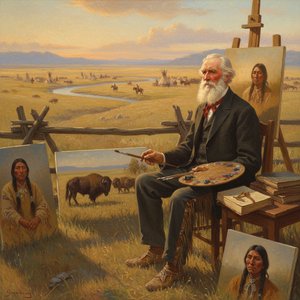
The Painter of the American West: The Life and Legacy of Edwin Evans
In the quiet landscapes of Lehi, Utah, a story began that would eventually bridge the rugged beauty of the American West with the refined elegance of Parisian academies. Born in 1860, Edwin Evans did not initially set out to capture the world through a brush. His early years were spent far from the easel, working as a railroad telegrapher, where he passed the hours sketching the fleeting moments of daily life. It was only through the keen eye of a stranger, Alonzo E. and the encouragement of mentors that Evans realized his true calling. This late but profound awakening set the stage for an artistic journey that would transform him from a humble sketcher into one of Utah’s most distinguished painters and educators.
The trajectory of Evans's career took a monumental leap when he traveled to France in 1888. Alongside a group of fellow artists known as the "art missionaries," Evans immersed himself in the vibrant atmosphere of Paris. Studying at the prestigious Académie Julian, he was exposed to the cutting-edge techniques of the era, absorbing the spirit of Impressionism that was then sweeping through Europe. This period of intense study allowed him to refine a style characterized by loose, textured brushstrokes and a masterful command of light. He learned to move beyond mere documentation, seeking instead to capture the very essence of his subjects—the warmth of a summer afternoon or the hazy, atmospheric glow of a rural farmyard.
A Mastery of Light and Landscape
Upon returning to the United States, Evans turned his gaze toward the landscapes of his homeland. He became celebrated for his ability to render the American West with a vibrant, emotive palette. His works often feature the brilliant golds, oranges, and deep reds of autumn, creating scenes that feel both nostalgic and intensely alive. In masterpieces such as Wheat Fields, Evans captured the shimmering brilliance of sun-drenched crops, an achievement that earned him an Honorable Mention at the 1893 Chicago World's Fair. His subject matter frequently revolved around the intersection of humanity and nature, depicting scenes of farm life, livestock, and the quiet dignity of rural labor.
The technical evolution of his work is particularly striking. While much of his early renown came from his oil paintings, Evans later embraced the delicate nuances of watercolor, demonstrating a versatility that allowed him to explore different levels of transparency and softness. Whether painting the heavy texture of a calf in a light-filled yard or the sweeping vistas of the Utah plains, his compositions always prioritized arrangement, balance, and specific detail. This dedication to structural harmony ensured that even his most spontaneous-looking works possessed a profound sense of permanence and grace.
An Enduring Influence on Art Education
Beyond the canvas, Edwin Evans left an indelible mark on the cultural fabric of Utah through his tireless commitment to art education. He was not merely a practitioner of fine art but a guardian of its future. His leadership roles were numerous and prestigious; he served as the head of the art department at the University of Utah for twenty-three years and held the presidency of both the Utah Art Institute and the Society of Utah Artists. Through these positions, he shaped the curriculum for generations of students, fostering a community where creativity could flourish.
His legacy is woven into the very institutions that define the region's artistic identity today. By establishing the Academy of Art in Salt Lake City and mentoring notable figures such as LeConte Stewart, Evans ensured that the techniques he brought back from Paris would take root in American soil. His life stands as a testament to the power of artistic discovery—a journey that began with sketches on a telegrapher's desk and culminated in a lifetime of profound beauty and educational excellence.
Ερωτήσεις και Απαντήσεις
Πού μπορώ να επισκεφτώ μια 3D γκαλερί με τα έργα του/της Edwin Evans Sr.;
Τα έργα τέχνης του/της Edwin Evans Sr. μπορούν να περιηγηθούν σε μια 3D γκαλερί στη σελίδα 3D Μουσείο του καλλιτέχνη/της.
Πόσα έργα του/της Edwin Evans Sr. είναι διαθέσιμα για περιήγηση;
Μπορείτε να περιηγηθείτε σε 1 έργα τέχνης έργα του Edwin Evans Sr. στη σελίδα Όλα τα έργα.
Υπάρχει χρονολόγιο με τα έργα του/της Edwin Evans Sr.;
Τα έργα του καλλιτέχνη Edwin Evans Sr. μπορούν να περιηγηθούν χρονολογικά στη σελίδα Χρονολόγιο Έργων.
Σε ποια ιστορική περίοδο δραστηριοποιήθηκε ο/η Edwin Evans Sr.;
Ο/Η Edwin Evans Sr. δραστηριοποιήθηκε κατά την περίοδο του/της 19th Century. Η συγκεκριμένη εποχή τοποθετεί τη δραστηριότητα του/της καλλιτέχνη/στη στην ιστορία.