The Portraitist of the Biedermeier Era
Vienna in the mid-19th century provides the backdrop for the career of Eduard Edlinger. He operates within the specific social and aesthetic constraints of the Biedermeier period, a time when the focus of art shifted toward the domestic, the personal, and the formal representation of status. His presence in the imperial capital is documented between 1834 and 1850, a period of significant political and social transition in the Austrian Empire.
Edlinger’s lineage suggests a life steeped in the technical demands of the craft. He is likely the son of Johann Georg Edlinger, a portraitist who served the Bavarian court in Munich. This connection implies a pedigree of professional training and an early immersion in the requirements of high-society portraiture. The family name itself carries the weight of a tradition that spanned from the mid-18th century through the mid-19th century, moving between Munich and Dresden.
The Imperial Commission
The weight of Edlinger's legacy rests upon a single, significant subject: Emperor Ferdinand I of Austria. The demand for his work came directly from the imperial court, likely even before the coronation of Ferdinand in 1834. This was a period when the visual representation of the monarch was essential for political legitimacy, particularly when the physical regalia of the crown were absent from the official iconography.
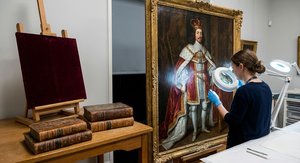
His most notable work, Emperor Ferdinand I, dated 1843, captures the monarch in a military uniform. The composition is specific and deliberate:
- The Emperor is depicted seated in a chair.
- He wears a formal military uniform.
- A bust of Emperor Francis I appears in the background.
- The work is rendered in oil on canvas.
This 1843 version is held in the collections of the Belvedere in Vienna. Other iterations and variations of his work on the Emperor have found their way into the collections of Prague Castle and the Schloss Zakupy.
Historical Footprint
Edlinger’s output remains tied to the formal requirements of his era. He was a painter of the courtly and the official, a man whose brush served the image of the Habsburg monarchy. While his career in Vienna was concentrated in a sixteen-year window, the survival of his portraits in national galleries ensures his place in the history of Austrian portraiture. He remains a figure defined by the precision of his likenesses and his ability to satisfy the visual demands of the Biedermeier elite.
Ερωτήσεις και Απαντήσεις
Πώς μπορώ να βρω όλα τα έργα του/της Eduard Edlinger ανά είδος μέσου;
Για να βρείτε όλα τα έργα του/της Eduard Edlinger ανά τεχνική, επισκεφθείτε τη σελίδα Κατά Τεχνική του καλλιτέχνη.
Μπορώ να ταξινομήσω τα έργα του/της Eduard Edlinger ανά χρώμα;
Στη σελίδα Δείκτης Χρώματος του Eduard Edlinger, τα έργα του καλλιτέχνη είναι οργανωμένα ανά χρώμα.
Υπάρχει μια χρονολογική αναδρομή για τον/την Eduard Edlinger;
Μια χρονολογική καταγραφή του έργου του/της Eduard Edlinger είναι διαθέσιμη στη σελίδα Χρονικό έργο, όπου τα έργα παρουσιάζονται με σειρά δημιουργίας, χωρισμένα σε περιόδους της καριέρας του/της.
Πού ομαδοποιούνται τα έργα του Eduard Edlinger με βάση λέξεις-κλειδιά;
Ανακαλύψτε τα έργα του/της Eduard Edlinger ανά λέξη-κλειδί στη σελίδα των λέξεων-κλειδιών του/της Με Λέξεις-Κλειδιά. Κάθε λέξη-κλειδί ομαδοποιεί τα σχετικά έργα.