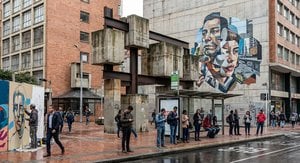
The Convergence of Nature and the Urban Pulse
Born in the vibrant heart of Santiago, Chile, in 1980, Depanite Matías Noguera has emerged as a profound voice in contemporary art, masterfully bridging the gap between the organic rhythms of the natural world and the kinetic energy of the urban landscape. His artistic journey is one of self-discovery and evolution, moving from the raw, communal spirit of street art to a sophisticated abstract language that speaks to the very essence of our environment. Noguera’s work does not merely depict nature; it reinterprets it through a lens of geometric complexity, inviting viewers into a space where the boundaries between the built environment and the wild become beautifully blurred.
The foundations of his practice were laid amidst the concrete textures and architectural rhythms of Chile. His early exposure to the interplay of spatial relationships and textural contrasts within urban landscapes instilled in him a lifelong fascination with how form and structure define our experience of space. This formative period was significantly enriched by his collaborative beginnings with the acclaimed street artist Alejandro ‘Mono’ González. Through this partnership, Noguera honed his ability to execute large-scale mural projects, learning the vital importance of collective expression and the power of visual narratives that can transform a public space into a site of profound contemplation.
A Language of Points and Lines
What distinguishes Noguera’s oeuvre is a highly specialized and hypnotic technique that eschews traditional shading in favor of a meticulous, layered approach. He constructs his monumental canvases using an intricate vocabulary of points and lines, creating patterns that dance across the surface to evoke the majesty of mountains, the fluidity of oceans, or the dense canopy of forests. This method allows him to achieve a remarkable sense of depth and complexity, where the eye is constantly drawn into new layers of detail. The resulting images possess a dual quality: they offer a sense of familiarity through their natural subject matter, yet simultaneously induce a state of beautiful disorientation through their abstract, rhythmic execution.
This technical precision serves a much deeper symbolic purpose. By breaking down the natural world into geometric components, Noguera explores themes of balance, harmony, and transformation. His work acts as a visual meditation on the interconnectedness of all living things, reflecting contemporary anxieties regarding environmental sustainability while offering a vision of structural unity. In his hands, the point and the line become the fundamental building blocks of an ecological consciousness, suggesting that even within the most complex systems, there is an underlying order and beauty waiting to be decoded.
Legacy and Artistic Significance
The impact of Noguera’s vision extends far beyond the borders of Chile. His exhibitions have traversed continents, bringing his unique brand of urban abstraction to diverse global audiences and cementing his reputation as a visionary of the modern era. The significance of his contribution to the contemporary art canon is perhaps most tangibly felt in the permanent collections of prestigious institutions, such as the Museo de Arte Contemporáneo in Santiago, which proudly displays his monumental murals.
As an artist who successfully transitioned from the ephemeral nature of muralism to the enduring complexity of fine art abstraction, Noguera stands as a testament to the power of continuous evolution. His ability to capture the soul of the natural world within the framework of urban geometry ensures that his work remains both timely and timeless, offering a poignant reflection on our place within an ever-changing, interconnected universe.
Ερωτήσεις και Απαντήσεις
Σε ποιες καλλιτεχνικές καμπάνιες συμμετείχε ο/η Depanite Matías Noguera;
Η σελίδα Όλα τα Ρευmatά ομαδοποιεί τα έργα του/της Depanite Matías Noguera ανά καλλιτεχνικό κίνημα.
Πού μπορεί να ανακαλυφθούν τα έργα του Depanite Matías Noguera ταξινομημένα ανά θέμα;
Η σελίδα Ατλάς Θεμάτων αναλύει τα έργα του Depanite Matías Noguera ανά θέμα.
Σε ποια πόλη και χώρα γεννήθηκε ο/η Depanite Matías Noguera;
Ο/Η Depanite Matías Noguera γεννήθηκε στην/στη Santiago, στο/στη Chile.