The Quiet Precision of the Still Life
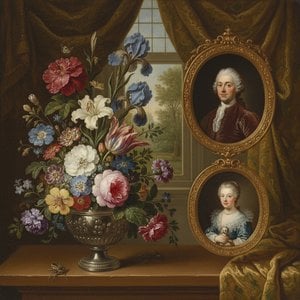
The light catches a glass vase, illuminating the delicate petals of roses and peonies. In the corner, a bowl of raspberries sits near a stone ledge, where insects crawl through the shadows. This is the domain of August Wilhelm Sievert, a German painter whose brush captured the fleeting stillness of nature. His work focuses on the intricate details of botanical life, from the heavy curve of a tulip to the subtle texture of a leaf. He operated in an era where the observation of the natural world was a pursuit of both science and art.
His hand is visible in the way he renders the translucency of petals and the hard, reflective surfaces of glassware. There is a specific tension in his compositions, a moment of suspended animation before the fruit decays or the insect moves. He worked with oils on canvas, translating the ephemeral beauty of a garden into a permanent, tactile reality. His presence in the art historical record is defined by this intense focus on the material world.
Technical Focus and Subject Matter
Sievert’s repertoire centers on the arrangement of flora and fruit, often utilizing specific vessels to anchor his compositions. His studies frequently include:
- Roses, peonies, and irises arranged in glass vases.
- Tulips, narcissae, and carnations.
- Fruit arrangements featuring grapes and raspberries.
- The inclusion of insects and beetles to add life to stone ledges.
The precision of his technique allows for a study of light as it interacts with different organic textures. A single work from 1741 shows his ability to balance the soft, organic shapes of flowers against the rigid, man-made lines of a relief vase. He does not merely paint flowers; he documents the physical weight and light-refracting properties of the natural world.
A Legacy in Color and Form
The traces of his career remain in the collections of the Bavarian State Painting Collections in Munich. His ability to capture the specific anatomy of a parrot tulip or the delicate veins of a leaf marks him as a specialist of the still life genre. While his life remains largely contained within the historical records of the early eighteenth century, his visual language remains clear. He leaves behind a record of botanical accuracy and a mastery of the still life tradition.
Ερωτήσεις και Απαντήσεις
Μπορώ να εξερευνήσω τα έργα του/της August Wilhelm Sievert ανά φάσμα χρωμάτων;
Τα έργα του August Wilhelm Sievert μπορούν να εξερευνηθούν ανά χρώμα στη σελίδα Δείκτης Χρώματος του καλλιτέχνη.
Πού μπορώ να βρω τα έργα του August Wilhelm Sievert ομαδοποιημένα ανά παλέτα χρωμάτων;
Για να βρείτε έργα του August Wilhelm Sievert σε μια συγκεκριμένη παλέτα χρωμάτων, επισκεφθείτε τη σελίδα Κατά Παλέτα Χρωμάτων του καλλιτέχνη.
Μπορώ να περιηγηθώ στα έργα του/της August Wilhelm Sievert ανά καλλιτεχνικό κίνημα;
Μπορείτε να περιηγηθείτε στα έργα του/της August Wilhelm Sievert ανά καλλιτεχνικό κίνημα στη σελίδα των κινημάτων για τον/την August Wilhelm Sievert (Όλα τα Ρευmatά).
Πώς μπορώ να βρω όλα τα έργα του/της August Wilhelm Sievert ανά είδος μέσου;
Μπορείτε να περιηγηθείτε στα έργα του/της August Wilhelm Sievert ανά τεχνική στη σελίδα των δημιουργημάτων ανά τεχνική του/της August Wilhelm Sievert (Κατά Τεχνική).