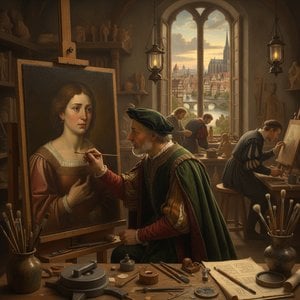
A Life Sculpted by Shadow and Light: Arnold Zadikow (1884–1943)
Arnold Zadikow’s story is one etched in the complexities of early 20th-century Europe—a testament to artistic vision flourishing amidst rising darkness. Born in Kolberg, Pomerania, in 1884, his path led him from classical training to a uniquely modernist expression deeply informed by Jewish identity and tragically curtailed by the horrors of the Second World War. Zadikow wasn’t merely a sculptor; he was a chronicler of his time, translating personal experiences and societal anxieties into powerful forms that resonated with both beauty and foreboding. His early education under Heinrich Waderé instilled in him a mastery of neoclassical techniques, providing a solid foundation upon which he would later build his distinctive style. However, Zadikow quickly moved beyond strict imitation, seeking to infuse his work with the emotional weight of the modern era.From Busts to Biblical Echoes: The Evolution of an Artistic Voice
Initially focused on portrait busts and commemorative plaques—a common practice for sculptors of his generation—Zadikow’s artistic trajectory shifted dramatically following his experiences during World War I. Serving on the Western Front, he endured combat injuries in 1917, leading to a period of captivity in a British prisoner-of-war camp. This trauma profoundly impacted his worldview and subsequently, his art. Post-war, Zadikow found himself drawn to Munich and Rome, centers of artistic activity, but also briefly explored the Parisian avant-garde scene in 1932. It was during this period that he began to explore biblical themes with increasing frequency, most notably through his sculpture of *Young David*. This wasn’t simply a rendering of a familiar subject; it became a potent symbol of Jewish resilience and defiance. Zadikow's style evolved into what is often described as simple monumentalism, characterized by strong forms and a deliberate use of space. He also incorporated Hebrew script into some of his works, adding another layer of cultural significance and personal expression. This integration wasn’t merely decorative; it was an assertion of identity in a world increasingly hostile to Jewish culture.The Statue of David: A Symbol Lost and Remembered
- A Statement of Identity: The *Young David*, unveiled at the entrance of the Berlin Jewish Museum in 1933, was more than just an artwork; it was a deliberate act of resistance. Zadikow consciously chose to depict David as a muscular, heroic figure—a counter-narrative to the antisemitic tropes prevalent at the time.
- A Prophetic Warning: As Zadikow himself stated, the statue was his “answer to Hitler and the Nazis.” It represented Jewish strength and dignity in the face of growing persecution. The sculpture’s presence served as a powerful rebuke to the regime's attempts to dehumanize and vilify the Jewish population.
- A Tragic Loss: Sadly, this potent symbol was not destined for longevity. With the rise of Nazi power, the *Young David* was deemed “degenerate” and destroyed in 1942—a devastating loss that underscored the vulnerability of Jewish art and culture.
The Shadow of War: Prague and Theresienstadt
As conditions deteriorated for Jews in Germany, Zadikow recognized the imminent danger and moved to Prague with his wife Hilda and their daughter Marianka in 1933. The city became a haven for exiled artists like Oskar Kokoschka, John Heartfield, and Thomas Theodor Heine, forming a vibrant community of creative resistance. However, this sanctuary proved temporary. Following the Nazi invasion of Czechoslovakia in 1939, persecution intensified, culminating in the Zadikows’ deportation to Theresienstadt ghetto in May 1942. Arnold Zadikow died there in 1943, a victim of the Holocaust. His wife Hilda and daughter Marianka were later transported to Auschwitz-Birkenau but miraculously survived, carrying with them the memory of their father's artistry and spirit.Legacy and Remembrance: A Sculptor for Our Time
Arnold Zadikow’s work, though fragmented by historical circumstance, continues to resonate today. His sculptures—particularly his medals—offer a poignant glimpse into the anxieties and aspirations of a generation caught between tradition and modernity. He is remembered not only as a skilled artist but also as a courageous voice who dared to challenge the prevailing ideologies of his time. The rediscovery of his work in recent decades has brought renewed attention to his unique artistic vision and his tragic fate, ensuring that his story—and the powerful messages embedded within his art—will continue to inspire and provoke reflection for generations to come. His life serves as a stark reminder of the fragility of freedom and the enduring power of art to bear witness to both beauty and brutality.Ερωτήσεις & Απαντήσεις
Από πού προέρχεται ο/η Arnold Zadikow;
Ο/Η Arnold Zadikow γεννήθηκε στην/στη Germany.
Σε ποια πόλη και χώρα γεννήθηκε ο/η Arnold Zadikow;
Ο/Η Arnold Zadikow γεννήθηκε στην/στη Koblenz, στο/στη Germany.
Πού είναι τα έργα του Arnold Zadikow οργανωμένα ανά χρώμα;
Η σελίδα Φασματική Κατάλογος οργανώνει τα έργα του/της Arnold Zadikow ανά χρώμα.
Πού μπορώ να δω τα έργα του/της Arnold Zadikow σε χρονολογική σειρά;
Η σελίδα Χρονολόγιο Έργων του καλλιτέχνη παρουσιάζει τα έργα του Arnold Zadikow ταξινομημένα ανά ημερομηνία, έτος προς έτος.
Πού μπορώ να δω τα έργα του/της Arnold Zadikow ταξινομημένα ανά ατμόσφαιρα;
Η σελίδα Δωμάτιο Αារμοнії του Arnold Zadikow είναι μια σελίδα που διατάσσει τα έργα του καλλιτέχνη ανάλογα με τη διάθεση.
Υπάρχει μια χρονολογική αναδρομή για τον/την Arnold Zadikow;
Μια χρονολογική καταγραφή του έργου του/της Arnold Zadikow είναι διαθέσιμη στη σελίδα Χρονικό, όπου τα έργα παρουσιάζονται με σειρά δημιουργίας, κεφάλαιο προς κεφάλαιο.
Μπορώ να περιηγηθώ στα έργα του/της Arnold Zadikow ανά καλλιτεχνικό κίνημα;
Τα έργα του/της Arnold Zadikow μπορούν να περιηγηθούν ανά καλλιτεχνικό κίνημα στη σελίδα των καλλιτεχνικών κινημάτων για τον/την Arnold Zadikow (Όλα τα Ρευmatά).
Πού μπορώ να δω όλα τα έργα του/της Arnold Zadikow;
Κάθε έργο του/της Arnold Zadikow στο αυτή η ιστοσελίδα μπορεί να περιηγηθεί από την σελίδα των όλων των έργων του/της (Όλα τα έργα τέχνης).