The Weight of Form and Color
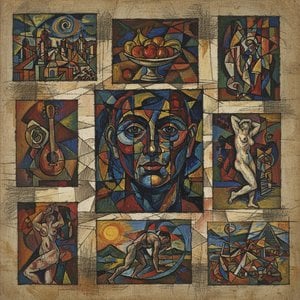
Aart Roos did not merely paint; he occupied space. His work, characterized by a shift from figurative roots toward abstract expressionism, carries a physical presence that demands attention. Born in Zaandam, his early training at the Rijksakademie van Beeldende Kunsten in Amsterdam between 1941 and 1944 provided the technical foundation for a career defined by monumental scale. He moved beyond the simple depiction of subjects to explore the raw tension found in interpersonal relationships and the chaotic energy of the natural world. His canvases are not passive objects; they are sites of dramatic struggle.
The evolution of his style was a deliberate departure from the traditional. While his early years were spent mastering portraiture and model drawing, the post-war era pushed him toward a more aggressive, expressive language. He sought to capture movement and emotion through a variety of media, proving his versatility through:
A Legacy of Scale and Substance
Roos understood that art could function as an architectural element. His reputation was built largely on his ability to handle monumental commissions, moving seamlessly between the intimacy of a drawing and the massive scale of a public mural. His 1962 mural, Vogels en Bloemen (Birds and Flowers), located in the former Timor School in Amsterdam, remains a significant marker of his ability to command a fifteen-meter expanse. This capacity for large-scale work led to his tenure as a teacher of monumental art at the Koninklijke Academie voor Beeldende Kunsten in Den Haag from 1968 to 1980.
His influence was felt in the way he bridged the gap between individual expression and public space. The Stedelijk Museum Amsterdam holds 19 of his works, and the National Collection contains 20, ensuring his presence in the Dutch canon. He was not a painter of quietude. His work reflects the influence of figures like Willem de Kooning and Robert Motherwell, favoring a colorful, often turbulent approach to composition. Even when his physical ability to paint was curtailed by a cerebral haemorrhage in 1995, the impact of his visual language remained established.
Ερωτήσεις και Απαντήσεις
Μπορώ να ταξινομήσω τα έργα του/της Aart Roos ανά χρώμα;
Τα έργα του Aart Roos μπορούν να εξερευνηθούν ανά χρώμα στη σελίδα Δείκτης Χρώματος του καλλιτέχνη.
Πού μπορώ να βρω τα έργα του/της Aart Roos ομαδοποιημένα ανά τεχνική;
Μπορείτε να περιηγηθείτε στα έργα του/της Aart Roos ανά τεχνική στη σελίδα των δημιουργημάτων ανά τεχνική του/της Aart Roos (Κατά Τεχνική).
Πόσα έργα του/της Aart Roos είναι διαθέσιμα για περιήγηση;
Μπορείτε να περιηγηθείτε σε 2 έργα τέχνης έργα του Aart Roos στη σελίδα Όλα τα έργα.
Πού ομαδοποιούνται τα έργα του Aart Roos με βάση λέξεις-κλειδιά;
Στη σελίδα Με Λέξεις-Κλειδιά του Aart Roos, τα έργα του καλλιτέχνη ομαδοποιούνται ανά λέξεις-κλειδιά.