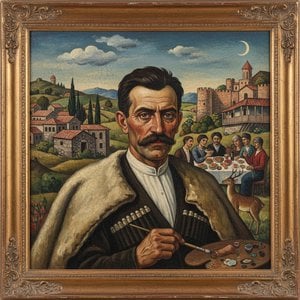
early life and education
Vladimir Lado Gudiashvili, a pivotal figure in Georgian art history, was born on March 30, 1896, in Tbilisi (then Tiflis), Georgia—a city brimming with artistic fervor during his formative years. His father, David Gudiashvili, served as a railway engineer, instilling in him an appreciation for precision and craftsmanship that would later permeate his artistic endeavors. Elizabeth Gudiashvili, his mother, nurtured his intellectual curiosity and fostered a love for literature and culture. From 1910 to 1914, Gudiashvili embarked on his formal artistic journey at the Tbilisi School of Sculpture and Fine Art, where he honed his skills under the tutelage of Alexander Bazhbeuk-Melikyan—a fellow Armenian artist whose teachings profoundly shaped his aesthetic sensibilities. This encounter marked the beginning of a lifelong collaboration with Bazhbeuk-Melikyan, fostering mutual respect for artistic innovation and tradition.artistic influences and style
Gudiashvili’s artistic vision was indelibly imprinted by Niko Pirosmani—a Georgian iconoclast celebrated for his groundbreaking blend of traditional folklore motifs and modernist techniques. Pirosmani's expressive brushstrokes and symbolic imagery served as a guiding light, inspiring Gudiashvili to explore the interplay between visual representation and emotional resonance. His distinctive style, characterized by grotesque realism combined with poetic mystery, encapsulates this influence—a deliberate departure from academic conventions that championed idealized beauty. This stylistic choice reflected a broader trend within Georgian art during the early 20th century, signaling a rejection of established norms in favor of experimentation and psychological depth. He attended Ronson’s Private Academy in Paris from 1919 to 1926, furthering his artistic horizons and immersing himself in the vibrant intellectual milieu of Parisian avant-garde circles.the parisian period
Gudiashvili's relocation to Paris proved transformative—a catalyst for artistic maturation and a crucible of creative experimentation. Surrounded by luminaries of European art and literature—including André Derain, Pablo Picasso, Fernand Léger, Henri Matisse, Tsuguharu Foujita, Ilya Ehrenburg, Maurice Raynal, Pierre Worms, and André Salmon—he engaged in spirited debates about artistic theory and practice. His studio became a hub for intellectual exchange, fostering collaborations with fellow artists and writers who challenged conventional ideas about art’s role in society. Notably, he befriended Sergei Sudeikin, a Russian poet and artist who championed the expressive power of color and form. Gudiashvili's Parisian years witnessed a prolific output of paintings—bold landscapes infused with symbolic imagery and portraits imbued with psychological nuance—establishing him as one of Georgia’s foremost modernist painters.major achievements
Among his most celebrated works is “The Execution of Berika”—a monumental fresco commissioned for the Tbilisi Opera House, which embodies Gudiashvili's mastery of mural painting technique and his commitment to conveying profound emotional narratives. This ambitious project cemented his reputation as a visionary artist capable of transforming architectural spaces into immersive artistic experiences—a testament to his technical prowess and conceptual daring. Furthermore, he contributed significantly to theater decoration, crafting evocative sets that enhanced the dramatic impact of theatrical productions. His involvement in film production underscored his versatility as an artist—demonstrating his ability to adapt his creative skills to diverse mediums.legacy
Vladimir Lado Gudiashvili passed away on July 20, 1980, in Tbilisi, leaving behind a legacy that continues to inspire Georgian artists and scholars alike. His oeuvre—characterized by its distinctive stylistic blend of grotesque realism and poetic mystery—remains an enduring emblem of Georgian modernist art. Today, his paintings reside prominently within the Tbilisi Fine Arts Museum’s collection—a tangible reminder of his artistic genius and his indelible contribution to Georgia's cultural heritage. Gudiashvili’s influence extends beyond his own artworks; he mentored younger artists, fostering a tradition of experimentation and innovation that persists to this day.Fragen & Antworten
Unter welchen Pseudonymen oder Alternativnamen ist Vladimir Lado Gudiashvili bekannt?
Vladimir Lado Gudiashvili ist auch unter dem Namen Lado Gudiashvili bekannt.
Kann ich die Werke von Vladimir Lado Gudiashvili nach Kunstrichtung durchsuchen?
Die Stilrichtungen, in denen Vladimir Lado Gudiashvili tätig war, finden Sie auf der Alle Stilrichtungen-Seite des Künstlers, auf der die Kunstwerke nach Stilrichtung gruppiert sind.
Kann ich die Werke von Vladimir Lado Gudiashvili nach Farben sortiert entdecken?
Auf der Seite Farbindex sind die Kunstwerke von Vladimir Lado Gudiashvili nach Farben sortiert.