


 In echtem Maßstab anzeigen
 Versenden als Grußkarte
 Teilen
 Details anzeigen
 Leitfaden öffnen

 Herunterladen
 Ähnliche Objekte
 Röntgenaufnahme
 Diashow
 Besucherstatistiken
Julia Reading


 Mehr anzeigen
Handgefertigte Ölreproduktion
Handgemaltes Ölgemälde auf Leinwand in Ihrer Wunschgröße und mit Rahmen, auf Bestellung von unseren Künstlern angefertigt. ( Zum Druck wechseln Zum digitalen Bild wechseln)




P118B €10

P118H €10

P118W €10

P438Z €10

P508JH €12

P508YH €12

P805H €10

P805Z €10

P919BZ €10

P919G €10

P919XJ €10

P959ZH €10

P968JZ €12

W106C €8

W218G €10

W218JH €8

W218Y €10

W307PJ €10

W316G €10

W316PJ €8

W316Y €10

W398PJ €8

W4111J €10

W500HY €15

W500JH €15

W692G €12

W849H €8

W940BG €15

W953PJ €8




Wählen Sie aus unseren vordefinierten Formaten, die den ursprünglichen Proportionen des Kunstwerks entsprechen.

Geben Sie die Breite und die Höhe an, die Sie für Ihren Rahmen oder Ihre Wand benötigen. Da dieses Werk handgemalt ist, kann der Künstler bei einer anderen Form etwas mehr um das Bild herum malen oder etwas abschneiden – Sie entscheiden. Wir senden Ihnen ein digitales Mockup zur Freigabe, bevor mit dem Malen begonnen wird. Das auf dieser Seite gezeigte Bild stellt nicht das tatsächliche Ergebnis dar – dies tut nur das Mockup.
Nach der Bestellung wird das ArtsDot.com-Team dem Kunden Anweisungen per E-Mail zusenden und eine Mockup-Vorschau bereitstellen.
Weltweiter Versand () in nur 3 bis 4 Wochen statt der üblichen 5 Wochen. (23 Oktober). Keine Kompromisse bei der Qualität.

Kostenloser weltweiter Expressversand

Hochwertige Leinenleinwand

Vollständiger Versicherungsschutz beim Versand

Zollgebühren-Rückerstattungsgarantie

Garantie für exakte Farbtreue

100-tägiges Rückgaberecht (nur bei Mängeln)

100% Geld-zurück-Garantie

Angebot für Mengenrabatt
 Die Glasoption ist nur für Größen unter 110 cm verfügbar.

Julia Reading
Reproduktionsmedium
Format der Reproduktion
-


Gesamtpreis
€ 231
A Snapshot of Urban Life: Unveiling "Julia Reading"
William James Glackens’ “Julia Reading,” painted in 1916, isn't merely a portrait; it’s a meticulously crafted window into the burgeoning dynamism and subtle social currents of early 20th-century New York City. Born during the height of the Ashcan School movement, Glackens rejected the idealized depictions favored by the National Academy of Design, instead choosing to capture the gritty reality of everyday life – the bustling streets, the casual interactions, and the quiet moments within a rapidly changing metropolis. “Julia Reading” exemplifies this approach, offering a glimpse into a specific scene that simultaneously feels intimate and profoundly connected to the larger urban narrative.
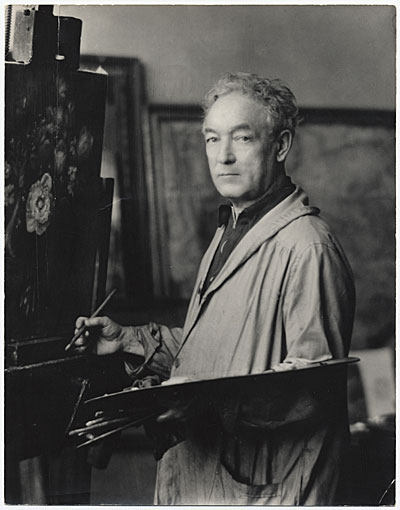
The painting immediately draws the eye to its central figure, a woman engrossed in a book. Her posture – slightly turned towards the viewer, her hand resting delicately on the page – conveys a sense of quiet contemplation amidst the implied activity around her. Glackens’ masterful use of light and shadow establishes a strong focal point, directing our gaze to Julia's face and highlighting the subtle details of her expression. The inclusion of two other individuals—a man standing behind her and another seated further back—adds layers of narrative complexity without disrupting the primary focus. These figures, though less defined, contribute to the sense of a shared space, a moment captured within the larger tapestry of urban life.
The Ashcan School: A Rejection of Tradition
Glackens was a key figure in the Ashcan School, a movement that challenged the established norms of American art. Rejecting the polished surfaces and grand narratives of academic painting, the Ashcan artists sought to depict the realities of urban life with honesty and immediacy. They favored working-class subjects, unvarnished scenes, and often employed a darker palette—a deliberate choice reflecting the sometimes bleak conditions of city living. “Julia Reading” embodies this spirit perfectly; it’s not a romanticized vision of New York, but rather a realistic portrayal of a woman finding solace in literature within its crowded streets.
The painting's style is characterized by loose brushstrokes and an emphasis on capturing the essence of the scene. Glackens employed a technique reminiscent of Impressionism, using broken color and subtle gradations to create a sense of movement and atmosphere. The composition itself—a slightly off-center arrangement with overlapping planes—adds to the painting’s dynamism and invites the viewer to become part of the scene.
Symbolism and Context: A Moment in Time
The book Julia is reading likely symbolizes escape, knowledge, or perhaps simply a moment of respite from the demands of city life. It's a small detail that speaks volumes about the human desire for intellectual stimulation amidst the chaos of urban existence. The setting itself—a public space filled with implied activity—suggests a sense of anonymity and connection within a large population. “Julia Reading” was painted during a period of rapid industrialization and urbanization in America, a time of significant social and economic change. The painting reflects this transformation, capturing the spirit of a city grappling with modernity while still retaining its inherent human qualities.
A Legacy of Realism: Glackens' Enduring Influence
William James Glackens’ work continues to resonate today because it offers a powerful and honest portrayal of American life. “Julia Reading” stands as a testament to his skill as an artist and his commitment to capturing the realities of the urban experience. His legacy extends beyond individual paintings; he helped pave the way for future generations of artists who sought to depict America with greater authenticity and social awareness. Reproductions of this evocative piece offer a valuable window into a bygone era, inviting viewers to contemplate the timeless themes of human connection, solitude, and the enduring power of art.
Fragen & Antworten
Welcher Phase der Karriere von William James Glackens ist „Julia Reading“ (1916) zuzuordnen?
"Julia Reading", entstanden im Jahr 1916, stammt aus der Early Period von William James Glackens.
Wie finde ich Kunstwerke, die "Julia Reading" von William James Glackens ähneln?
Kunstwerke, die "Julia Reading" von William James Glackens ähneln, sind auf der Ähnliche Werke-Seite des Kunstwerks zusammengefasst.
Welche Technik wurde für "Julia Reading" von William James Glackens verwendet?
William James Glackens verwendete die Technik der Acrylic On Canvas für „Julia Reading“. Die Technik bestimmt die materielle Beschaffenheit des Originalwerks.
Ähnliche Kunstwerke


Biografie des Künstlers
Ein Pionier der Ashcan School
William James Glackens, eine bedeutende Figur in der amerikanischen Kunst, hinterließ mit seinen fesselnden realistischen Gemälden einen bleibenden Eindruck auf die Leinwand der Geschichte. Geboren 1870 in Philadelphia, Pennsylvania, war Williams künstlerische Reise ein Beweis für seine unerschütterliche Leidenschaft, das Wesen des täglichen Lebens einzufangen.Frühes Leben und Einflüsse
Glackens' frühe Jahre waren von einer angeborenen Neigung zur Kunst geprägt, was ihn dazu veranlasste, sich an der Pennsylvania Academy of the Fine Arts einzuschreiben. Unter der Anleitung von Thomas Anshutz, einem renommierten Realisten, verfeinerte Glackens seine Fähigkeiten und wurde schließlich einer der Gründer der Ashcan School. Diese Bewegung lehnte die konventionellen Grenzen künstlerischer Schönheit ab und konzentrierte sich stattdessen auf die rauen Realitäten des städtischen Lebens.Künstlerische Laufbahn
Glackens' Werk zeichnet sich durch seine dunkel getönten, lebhaft gemalten Straßenszenen und Darstellungen des täglichen Lebens im vorwendezeitlichen New York und Paris aus. Seine späteren Werke, die von Renoir beeinflusst waren, zeigten einen helleren Ton, der sein Wachstum als Künstler widerspiegelte. Bemerkenswert ist, dass Glackens auch als Illustrator für Zeitungen und Zeitschriften in Philadelphia und New York City arbeitete.- View of Haarlem with Bleaching Grounds, ein Gemälde von Jacob Isaakszoon van Ruisdael (Ruisdael), veranschaulicht das Maß an Detailgenauigkeit und Handwerkskunst, das Glackens' Werk definiert. Dieses Stück befindet sich jetzt in der Sammlung des Chrysler Museum of Art.
- Glackens' eigenes Meisterwerk, The Shoppers, ist ein Beweis für seine Fähigkeit, das Wesen des Stadtlebens einzufangen. Dieses Gemälde befindet sich in der New Realism-Kollektion auf ArtsDot.com.
Vermächtnis und Bedeutung
Glackens' Beiträge zur amerikanischen Kunst sind vielschichtig und gehen über seine eigenen Werke hinaus. Er spielte eine entscheidende Rolle bei der Unterstützung von Albert C. Barnes beim Ankauf europäischer Gemälde für die Barnes Foundation in Philadelphia. Diese Sammlung ist zu einem Eckpfeiler der amerikanischen Kunstgeschichte geworden. Wichtige Werke und Sammlungen: * The Shoppers (New Realism, Öl auf Leinwand, Chrysler Museum of Art) * View of Haarlem with Bleaching Grounds (Ruisdael, Sforza Castle, Mailand, Italien) Empfohlene Lektüre: * [https://ArtsDot.com/@/william-james-glackens](https://ArtsDot.com/@/william-james-glackens) - Entdecken Sie die umfangreiche Sammlung von Glackens' Werken auf ArtsDot.com. * [https://en.wikipedia.org/wiki/william_glackens](https://en.wikipedia.org/wiki/william_glackens) - Tauchen Sie ein in die detaillierte Biografie von William James Glackens auf Wikipedia.
William James Glackens
1870 - 1938 , Vereinigte Staaten von Amerika
Eckdaten zum Künstler
- Bemerkenswerte Kunstwerke:
- The Shoppers
- View of Haarlem with Bleaching Grounds
- Geburtsdatum: 1870
- Geburtsort (Stadt Und Land): Philadelphia, USA
- Künstler Oder Bewegungen, Von Denen Dieser Künstler Beeinflusst Wurde: ['Ashcan School']
- Künstler, Die Diesen Künstler Beeinflussten:
- Thomas Anshutz
- Renoir
- Künstlerische Bewegung Oder Stil: Ashcan School, Realismus
- Nationalität: Amerikanisch
- Sterbedatum: 1938
- Vollständiger Name: William James Glackens
Verwandte Artikel

The Ashcan School: Realism, Urban Life & the Democratization of American Art
Explore the revolutionary Ashcan School! Discover how artists like Henri & Sloan challenged tradition with gritty realism, capturing urban life in early 20th-century America. Learn about their impact on American art history.

Amerikanischer Realismus: Die 10 Meisterwerke, die eine Ära prägten | ArtsDot
Entdecken Sie die 10 Meisterwerke des Amerikanischen Realismus! Von Edward Hopper bis Winslow Homer – erleben Sie die Geschichten, Techniken & zeitlose Schönheit. Hochwertige Kunstdrucke auf ArtsDot.com.

Grant Wood und der amerikanische Regionalismus: Identität, Mythos und die ländliche Landschaft
Entdecken Sie Grant Wood und den amerikanischen Regionalismus! Erfahren Sie mehr über 'American Gothic', Woods Leben, Einflüsse und sein Vermächtnis in der Kunstgeschichte. Expertenwissen & hochwertige Reproduktionen.

American Realism: Social Commentary & Artistic Representation in Early 20th-Century Painting
Explore the powerful social commentary & artistic representation of American Realism. Discover key artists like Bellows & Sloan, and understand the movement's lasting impact on 20th-century art history.
William Glackens und die Erfassung des modernen amerikanischen Lebens im Stil des Ashcan-Realismus
Entdecken Sie William Glackens und den Ashcan Realismus! Erfahren Sie mehr über die revolutionäre amerikanische Kunstbewegung, ihre Künstler und die Darstellung des modernen Lebens in New York. Expertenwissen auf ArtsDot.


