

 Vorschau anzeigen
 Versenden
 Teilen
 Details anzeigen
 Leitfaden

 Herunterladen
 Ähnliche Objekte
 Röntgenaufnahme
 Diashow
 Fragen & Antworten
 Statistiken
Der Marktstand

- 42.0 x 36.0 cm


 Weiterlesen
Giclée / Kunstdruck
Giclée- oder Leinwanddruck in Museumsqualität mit schneller Produktion und flexiblen Veredelungsoptionen. ( Handgemalte Reproduktion bestellen Zum digitalen Bild wechseln)




P118B €10

P118H €10

P118W €10

P438Z €10

P508JH €12

P508YH €12

P805H €10

P805Z €10

P919BZ €10

P919G €10

P919XJ €10

P959ZH €10

P968JZ €12

W106C €8

W218G €10

W218JH €8

W218Y €10

W307PJ €10

W316G €10

W316PJ €8

W316Y €10

W398PJ €8

W4111J €10

W500HY €15

W500JH €15

W692G €12

W849H €8

W940BG €15

W953PJ €8




Wählen Sie aus unseren vordefinierten Formaten, die den ursprünglichen Proportionen des Kunstwerks entsprechen.

Geben Sie die benötigte Breite und Höhe an, damit der Druck perfekt in Ihren Rahmen oder an Ihre Wand passt. Ein Druck kann nur beschnitten, aber niemals größer als das Originalbild angefertigt werden; daher verliert ein Format mit anderen Proportionen einen Teil des Bildes. Wir senden Ihnen ein digitales Mockup zur Freigabe, bevor wir den Druck ausführen. Das auf dieser Seite gezeigte Bild zeigt nicht den tatsächlichen Beschnitt – dies ist nur im Mockup ersichtlich.
Weltweiter Versand () innerhalb von 2 Wochen statt der üblichen 4/5 Wochen. (15 November)

Kostenloser weltweiter Expressversand

Hochwertige Leinenleinwand

Umfassender Versicherungsschutz beim Versand

Zollgebühren-Rückerstattungsgarantie

Garantie für exakte Farbtreue

100 Tage Rückgaberecht (nur bei Mängeln)

100% Geld-zurück-Garantie

Mengenrabatt verfügbar
 Die Glasoption ist nur für Größen unter 110 cm verfügbar.

Der Marktstand
Giclée / Kunstdruck
Format der Reproduktion
-


Endpreis
€ 56
Ein Fenster zum Marktplatz des 18. Jahrhunderts
In den stillen, akribischen Pinselstrichen von Willem van Mieris’ "Der Marktstand" werden wir weit weg von der Hektik des modernen Lebens in die intime, texturreiche Realität einer europäischen Straße des 18. Jahrhunderts versetzt. Dieses im Jahr 1730 entstandene, exquisite Ölgemälde auf Tafel ist weit mehr als nur eine Darstellung von Handel; es ist eine tiefgründige Studie menschlicher Verbindung und der Schönheit, die im Alltäglichen liegt. Die Szene entfaltet sich in den engen Grenzen einer scheinbar kopfsteingepflasterten Gasse, in der das Sonnenlicht sanft herabsinkt, um einen Moment stiller Verhandlungen zu beleuchten. Im Herzen der Komposition sind zwei Figuren in einen lautlosen Dialog vertieft – die eine gestikuliert mit der geübten Leichtigkeit eines Händlers in Richtung der Körbe mit frischem Erntegut, die andere hört mit einer konzentrierten, nachdenklichen Stille zu. Diese Interaktion fängt den eigentlichen Puls des niederländischen Soziallebens ein, in dem jede Transaktion eine Gelegenheit für das gemeinschaftliche Miteinander war.
Die Meisterschaft der Leiden fijnschilder-Technik offenbart sich hier in voller Pracht und bietet ein Fest für die Augen, das sowohl den flüchtigen Betrachter als auch den erfahrenen Sammler begeistert. Van Mieris verwendet eine anspruchsvolle Palette aus gedeckten Erdtönen – tiefe Ockerfarben, sanfte Umbra-Nuancen und subtile Cremetöne –, die dem Werk eine organische, zeitlose Qualität verleihen. Seine Fähigkeit, Licht und Schatten zu manipulieren, erzeugt eine spürbare dreidimensionale Tiefe; man meint fast, die raue Textur der Ziegelwand im Hintergrund und die kühle, feuchte Oberfläche des Fisches in den geflochtenen Körben zu fühlen. Die akribische Liebe zum Detail, vom feinen Geflecht der Behälter bis hin zum Glanz des Lichts auf einer Frucht, verkörpert die Tradition des Hyperrealismus des Goldenen Zeitalters der Niederlande und verleiht jedem Element eine schwere Präsenz und Bedeutung.
Symbolik und die Kunst des täglichen Lebens
Über ihre oberflächliche Schönheit hinaus ist "Der Marktstand" reich an der subtilen Symbolik, die für die Epoche des niederländischen Barock charakteristisch ist. Der Überfluss im Vordergrund – die überquellenden Körbe mit Gemüse und die sorgfältig arrangierten Schalen – dient als Feier des Wohlstands und der Gaben der Erde. Im Kontext des 18. und frühen 19. Jahrhunderts spiegelte eine solche Bildsprache oft ein Gefühl von Stabilität und die Belohnung ehrlicher Arbeit wider. Die Komposition selbst, die den Fokus auf den intimen Raum zwischen Käufer und Verkäufer legt, erhebt den Akt des täglichen Handels zu etwas Sakralem und Würdigem. Es herrscht ein rhythmisches Gleichgewicht in der Anordnung der Objekte, das das Auge des Betrachters durch die Erzählung führt und sicherstellt, dass kein Detail im atmosphärischen Dunst des Marktplatzes verloren geht.
Für den anspruchsvollen Innenarchitekten oder Kunstliebhaber bietet dieses Werk ein unvergleichliches Gefühl von Wärme und historischer Tiefe. Eine hochwertige Reproduktion dieses Kunstwerks schmückt nicht einfach nur eine Wand; sie verleiht einem Raum eine Aura von Erbe und stiller Raffinesse. Die Fähigkeit des Gemäldes, Nostalgie zu wecken und gleichzeitig eine zeitgemäße ästhetische Anziehungskraft zu bewahren, macht es zu einer vielseitigen Wahl für kuratierte Sammlungen oder elegante Wohnräume. Es lädt zum Gespräch ein und regt die Betrachter dazu an, bei den feinen Details zu verweilen und über die beständige Einfachheit menschlicher Interaktion nachzudenken. Ein solches Werk zu besitzen bedeutet, ein Fragment der Geschichte in den Händen zu halten – einen wunderschön bewahrten Moment aus Licht, Schatten und Leben.
Fragen & Antworten
Wo kann ich das Original von "Der Marktstand" von Willem Van Mieris sehen?
"Der Marktstand" von Willem Van Mieris wird im Fitzwilliam College, Cambridge, Vereinigtes Königreich ausgestellt. Die Museumsangabe bezieht sich auf das Originalwerk, nicht auf Reproduktionen.
Kann ich "Der Marktstand" als Vollbild-Diashow ansehen?
Eine Diashow ist verfügbar: die Seite Diashow von "Der Marktstand" von Willem Van Mieris.
Was stellt "Der Marktstand" von Willem Van Mieris dar und welche Stimmung vermittelt es?
"Der Marktstand" von Willem Van Mieris verbindet marktplatz, gespräch, fisch, gemüse, korb, wand, licht_schatten mit einer Edel und klassisch Atmosphäre.
Ähnliche Kunstwerke


Künstlerbiografie
Willem van Mieris (1662 - 1747): The Master of Elegant Detail
Willem van Mieris (1662-1747) stands as a pivotal figure in the Leiden fijnschilders’ movement, embodying the culmination of Dutch Baroque artistic ideals. Born in Leiden on June 3rd, 1662, he descended from a lineage steeped in artistic tradition—his father, Frans van Mieris the Elder (1635-1681), was himself a celebrated genre painter who had established a formidable reputation for capturing the nuances of upper-class society. This familial legacy profoundly shaped Willem’s formative years and instilled within him an unwavering dedication to upholding his father's esteemed position as Leiden’s foremost fijnschilder—a commitment that would define his entire artistic career.- Early Training & Influences:
- Frans van Mieris the Elder’s profound impact on Willem’s technique and aesthetic sensibilities cannot be overstated. Guided by the tutelage of his father, Willem honed his skills under the watchful eye of Gerrit Dou (1613-1675), a master of chiaroscuro and meticulous observation—a stylistic approach that would become synonymous with Leiden fijnschilders.
The Leiden Tradition & Pieter Post’s Vision
Willem van Mieris's artistic trajectory was inextricably linked to the broader intellectual currents of his time. The influence of Pieter Post (1659-1734), a Dutch art theoretician and humanist, proved particularly transformative. Post championed the notion that genre painters should transcend mere representation—rather, they ought to elevate their subjects through classical ideals of beauty and proportion. This conviction spurred Willem to meticulously analyze sculptural masterpieces from antiquity, incorporating their compositional principles into his paintings.A Career Defined by Patronage & Artistic Innovation
Willem’s professional life unfolded amidst a landscape of considerable artistic patronage—he secured commissions from prominent figures such as Madam Oortmans and Pieter de la Court van der Voort, cementing his reputation as one of Leiden's most sought-after artists. Notably, he served as Dean of the Guild of Saint Luke in 1693, demonstrating not only his artistic prowess but also his engagement with the intellectual and social fabric of Leiden.Style & Technique: The Pursuit of Perfection
Willem van Mieris’s distinctive style—characterized by an unparalleled attention to detail and a masterful command of chiaroscuro—represented the apex of Leiden fijnschilders' artistic ambition. Like his father, Willem meticulously studied the works of Gerrit Dou, adopting his technique and stylistic approach. He skillfully rendered textures and surfaces with remarkable accuracy, capturing subtle nuances that breathed life into his subjects. Furthermore, he frequently employed classical poses borrowed from sculptures by Francis van Bossuit—a deliberate gesture aimed at elevating genre painting to the level of monumental art.Legacy & Historical Significance
Willem van Mieris’s oeuvre comprises a vast collection of genre scenes and portraits, reflecting the tastes and sensibilities of his era. His paintings offer invaluable insights into Dutch society during the Baroque period—depicting opulent interiors, refined costumes, and psychologically astute portrayals of human character. Willem's enduring influence extends beyond his artistic achievements; he established Leiden’s Drawing Academy alongside Jacob Toorenvliet and Carel de Moor, fostering a new generation of artists committed to upholding the Leiden tradition—a legacy that continues to resonate within Dutch art history today.
Willem Van Mieris
1662 - 1747 , Niederlande
Kurzinfos
- Artistic Movement Or Style: Fijnschilders
- Artists Or Movements Influenced By This Artist: ['Antike Skulptur']
- Artists Who Influenced This Artist:
- Gerard Dou
- Frans van Mieris der Ältere
- Date Of Birth: Leiden, Niederlande (1662)
- Date Of Death: 1747
- Full Name: Willem van Mieris
- Nationality: Niederländisch
- Notable Artworks:
- Die Kartoffelesser
- Allegorie der Vergänglichkeit
- Place Of Birth: Leiden
Ähnliche Artikel

Transactions on Canvas: Exploring the Intersection of Commerce and Fine Art
Explore the evolution of art commerce from Pissarro to digital auctions. Discover how trade shapes history and start your collection today.

Abraham Hendricksz van Beyeren: Pioneering Dutch Still Life & the Banquet Tradition
Explore the captivating world of Dutch Golden Age still life with Abraham van Beyeren. Discover his innovative techniques, symbolic banquet scenes & lasting influence on art history. Learn about collecting these masterpieces.

Jacob Henricus Maris: Meister des niederländischen Stimmungsrealismus und der intimen Landschaft
Entdecken Sie das Werk von Jacob Henricus Maris, einem Meister des niederländischen Stimmungsrealismus! Erfahren Sie mehr über seine Landschaftsmalerei, Einflüsse und berühmte Gemälde. Jetzt lesen & inspirieren lassen!
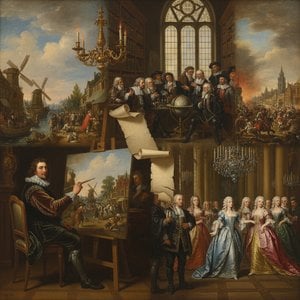
Illuminating a Century of Change: Artistic Expression & Societal Shifts in 17th-Century Europe
Explore the artistic brilliance of the 17th-century Dutch Golden Age & Baroque period. Discover Rembrandt, genre painting, and chiaroscuro techniques. Expert insights for art lovers & collectors.

Die 10 Meisterwerke der niederländischen Barockmalerei – Kunst für Ihr Zuhause | ArtsDot
Entdecken Sie die 10 prägendsten Meisterwerke der niederländischen Barockmalerei! Von Rembrandt bis Vermeer – erleben Sie Kunstgeschichte, Techniken & Emotionen. Hochwertige Reproduktionen für Ihr Zuhause auf ArtsDot.com.


