Vorschau anzeigen
 Versenden
 Teilen
 Details anzeigen
 Leitfaden

 Herunterladen
 Ähnliche Objekte
 Röntgenaufnahme
 Diashow
 Q&A
Q&A Statistiken
Pink Lady

- 61.0 x 48.0 cm


 Weiterlesen
Die auf dieser Seite dargestellten Kunstwerke sind urheberrechtlich geschützt, was bedeutet, dass wir keine identische Reproduktion rechtmäßig erstellen oder verkaufen dürfen. Dieser Schutz wird durch internationale Abkommen wie die Berner Übereinkunft und durch nationale Gesetze, einschließlich derer, die von den US-Urheberrecht – Titel 17.
Diese Methode entspricht vollumfänglich den Urheberrechtsbestimmungen, da sie keine Kopie oder Vervielfältigung des geschützten Kunstwerks darstellt. Stattdessen handelt es sich um eine kreative Neuinterpretation – ein neues Gemälde, das vom Original inspiriert, aber nicht identisch mit ihm ist.
Giclée / Kunstdruck
Giclée- oder Leinwanddruck in Museumsqualität mit schneller Produktion und flexiblen Veredelungsoptionen. ( Handgemalte Reproduktion bestellen Zum digitalen Bild wechseln)




P118B €10

P118H €10

P118W €10

P438Z €10

P508JH €12

P508YH €12

P805H €10

P805Z €10

P919BZ €10

P919G €10

P919XJ €10

P959ZH €10

P968JZ €12

W106C €8

W218G €10

W218JH €8

W218Y €10

W307PJ €10

W316G €10

W316PJ €8

W316Y €10

W398PJ €8

W4111J €10

W500HY €15

W500JH €15

W692G €12

W849H €8

W940BG €15

W953PJ €8




Wählen Sie aus unseren vordefinierten Formaten, die den ursprünglichen Proportionen des Kunstwerks entsprechen.

Geben Sie die benötigte Breite und Höhe an, damit der Druck perfekt in Ihren Rahmen oder an Ihre Wand passt. Ein Druck kann nur beschnitten, aber niemals größer als das Originalbild angefertigt werden; daher verliert ein Format mit anderen Proportionen einen Teil des Bildes. Wir senden Ihnen ein digitales Mockup zur Freigabe, bevor wir den Druck ausführen. Das auf dieser Seite gezeigte Bild zeigt nicht den tatsächlichen Beschnitt – dies ist nur im Mockup ersichtlich.
Weltweiter Versand () innerhalb von 2 Wochen statt der üblichen 4/5 Wochen. (2 November)

Kostenloser weltweiter Expressversand

Hochwertige Leinenleinwand

Umfassender Versicherungsschutz beim Versand

Zollgebühren-Rückerstattungsgarantie

Garantie für exakte Farbtreue

100 Tage Rückgaberecht (nur bei Mängeln)

100% Geld-zurück-Garantie

Mengenrabatt verfügbar
 Die Glasoption ist nur für Größen unter 110 cm verfügbar.

Pink Lady
Giclée / Kunstdruck
Format der Reproduktion
-


Endpreis
€ 55
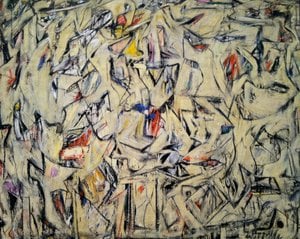
A Portrait of Turbulent Emotion: Willem de Kooning’s “Pink Lady”
The painting "Pink Lady," created by Willem de Kooning in 1965, stands as a cornerstone of Abstract Expressionism and embodies the movement's preoccupation with raw emotion and spontaneous gesture. More than just a depiction of a woman—though undeniably present—it’s an exploration of psychological complexity rendered through a masterful blend of color and form that continues to captivate viewers decades after its creation. This striking artwork offers a glimpse into De Kooning’s artistic vision during his most prolific period, reflecting the anxieties and uncertainties of the Cold War era while simultaneously pushing boundaries of representational art.The Style and Technique: Embracing Gestural Abstraction
De Kooning's approach to painting was fundamentally antithetical to traditional academic conventions. He rejected meticulous detail in favor of a gestural style characterized by bold brushstrokes, drips, and smears—techniques that prioritized feeling over precise observation. “Pink Lady” exemplifies this ethos perfectly. The woman’s figure isn’t rendered with anatomical accuracy; instead, it's fragmented into amorphous shapes – swirls, patches, and angular protrusions – which convey a sense of dynamism and instability. These forms are layered with vibrant shades of pink—ranging from delicate blush tones to intense crimson hues—creating an illusion of skin texture and emphasizing the artist’s deliberate disregard for conventional realism. The yellow background serves as a counterpoint to the pink, amplifying the painting's emotional intensity and contributing to its overall visual impact.Historical Context: Navigating Anxiety in the Mid-Century
Painted during the height of the Cold War, “Pink Lady” reflects the pervasive anxieties surrounding geopolitical tensions and societal upheaval. De Kooning’s work aligns with a broader artistic impulse to confront uncomfortable truths about human experience—fear, aggression, and vulnerability—rather than offering comforting illusions. The painting's unsettling depiction of femininity speaks to anxieties about gender roles and identity during this period, mirroring broader cultural debates concerning female empowerment and psychological complexity. Furthermore, De Kooning’s stylistic choices can be interpreted as a reaction against the perceived sterility of postwar European art, asserting instead an uncompromising commitment to expressive freedom.Symbolism: Exploring Inner Landscape
While ostensibly portraying a woman, “Pink Lady” transcends literal representation, delving into realms of psychological symbolism. The pink skin tone itself is significant—often associated with femininity and vulnerability but also imbued with connotations of erotic desire and primal instinct. The fragmented form of the figure symbolizes the disintegration of identity and the struggle to maintain composure amidst turbulent emotions. Critics have noted parallels between De Kooning’s painting and Freud's theories on psychoanalysis, suggesting that “Pink Lady” represents an unconscious confrontation with repressed desires and anxieties.Emotional Impact: A Resonance of Raw Feeling
Ultimately, "Pink Lady" succeeds in conveying a profound emotional resonance. Its unsettling beauty stems from its refusal to sanitize or sentimentalize human experience. The painting compels viewers to confront uncomfortable truths about the complexities of emotion—passion, rage, despair—and invites contemplation on the nature of selfhood and psychological vulnerability. It’s a piece that lingers in the mind long after viewing, prompting reflection on themes of trauma, resilience, and the enduring power of art to express the deepest recesses of human consciousness. Its vibrant colors and energetic brushstrokes capture not just an image but also a palpable sense of unease—a testament to De Kooning's unparalleled ability to translate inner turmoil into visual form.Fragen & Antworten
In welchem Alter schuf Willem de Kooning „Pink Lady"?
Willem de Kooning schuf „Pink Lady“ im Alter von 61. Der Künstler wurde 1904 geboren, und das Werk datiert auf 1965.
Welche Form und welche Maße hat "Pink Lady" von Willem de Kooning?
"Pink Lady" von Willem de Kooning hat die Proportionen eines Portrait-Werks mit einer Größe von 61 x 48 cm.
Verwendet "Pink Lady" von Willem de Kooning starke Kontraste oder sanfte Harmonien?
Die Farbkomposition von "Pink Lady" von Willem de Kooning vereint einen Serene Kontrast mit einer Unified Palette Harmonie.
Ähnliche Kunstwerke


Künstlerbiografie
frühes Leben und Karriere
Willem de Kooning, ein renommierter niederländisch-amerikanischer abstrakter Expressionist, wurde am 24. April 1904 in Rotterdam, Niederlande, geboren. Seine Eltern, Leendert de Kooning und Cornelia Nobel, trennten sich 1907, und Willem de Kooning lebte zunächst mit seinem Vater, bevor er in die Obhut seiner Mutter überging. Er verließ die Schule 1916 und arbeitete als Lehrling in einer Werbeagentur.Künstlerische Entwicklung
De Kooning besuchte von 1916 bis 1924 Abendkurse an der Akademie für Bildende Künste und Technische Wissenschaften in Rotterdam. Im Jahr 1927 zog er nach New York City, wo er als Hausmaler arbeitete und seinen einzigartigen künstlerischen Stil entwickelte.Abstrakter Expressionismus
De Koonings Werk verschob sich in den späten 1950er Jahren hin zum abstrakten Expressionismus, der durch kräftige Pinselstriche und leuchtende Farben gekennzeichnet ist. Sein Gemälde Woman I (1950-1952) ist ein wegweisendes Werk dieser Bewegung, das Figuration mit Spontaneität und emotionaler Intensität verbindet.Bekannte Werke und Sammlungen
* The Glazier (137 x 112 cm, Öl auf Leinwand): Ein düsteres, erdtoniges Gemälde, inspiriert von den Fresken von Boscoreale. * Door to the River (Abstrakter Expressionismus): Ein breitschichtiges Gemälde, das an seine Tätigkeit als Hausmaler erinnert. * Standing Man (Abstrakter Expressionismus): Ein charakteristisches Beispiel für De Koonings abstrakten Expressionismus.Museen und Sammlungen
* Museum Boijmans van Beuningen, Rotterdam, Niederlande: Bietet eine beeindruckende Sammlung von über 151.000 Kunstwerken. * Universitätsbibliothek Leiden, Niederlande: Ein bedeutendes Kulturzentrum mit über 5.200.000 Büchern und 1.000.000 E-Books. Willem de Koonings Vermächtnis inspiriert weiterhin Künstler und Kunstliebhaber gleichermaßen und festigt seinen Platz als Pionier des abstrakten Expressionismus.
Willem de Kooning
1904 - 1997 , Niederlande
Kurzinfos
- Beeinflusste Künstler: ['Arshile Gorky']
- Bemerkenswerte Werke:
- Frau I
- The Glazier
- Excavation
- Geburtsdatum: 24. April 1904
- Geburtsort: Rotterdam, Niederlande
- Künstlerische Bewegung: Abstrakter Expressionismus
- Nationalität: Niederländisch-Amerikanisch
- Todatum: 1997
- Vollständiger Name: Willem de Kooning
Ähnliche Artikel

Abstrakter Expressionismus: Die 10 Meisterwerke, die eine Kunstbewegung prägten |
Entdecken Sie die 10 Meisterwerke des Abstrakten Expressionismus! Von Jackson Pollock bis Mark Rothko – erfahren Sie die Geschichten hinter ikonischen Gemälde und finden Sie hochwertige Reproduktionen für Ihr Zuhause. Jetzt bei entdecken!

Meister der Abstraktion: Die 25 ikonischsten Werke von Wassily Kandinsky
Entdecken Sie die 25 Meisterwerke Kandinskys und die Magie der Abstraktion. Erleben Sie die volle Sammlung auf ArtsDot.com.

Meister der Schatten: Die 25 eindrucksvollsten Kunstwerke von Francisco Goya
Erleben Sie Goyas Meisterwerke von Romantik bis Schatten. Entdecken Sie alle Klassiker auf ArtsDot.com.

Willem de Kooning: Abstraktion, Geste und die Entwicklung der Nachkriegsamerikanischen Malerei
Entdecken Sie Willem de Koonings revolutionäre Kunst und die Entwicklung des Abstrakten Expressionismus. Expertenanalyse, Investitionspotenzial & Sammlerwert – erfahren Sie mehr auf ArtsDot.

Beyond Representation: Exploring the Emotional Landscape of Abstract Expressionism
Explore the profound emotional world of Abstract Expressionism with ArtsDot. Discover key artists like Pollock & Rothko, learn about collecting, and find museum-quality reproductions to inspire your space.