

 Vorschau anzeigen
 Versenden
 Teilen
 Details anzeigen
 Leitfaden

 Herunterladen
 Ähnliche Objekte
 Röntgenaufnahme
 Diashow
 Q&A
Q&A Statistiken
Self-Portrait


 Weiterlesen
Giclée / Kunstdruck
Giclée- oder Leinwanddruck in Museumsqualität mit schneller Produktion und flexiblen Veredelungsoptionen. ( Handgemalte Reproduktion bestellen Zum digitalen Bild wechseln)




P118B €10

P118H €10

P118W €10

P438Z €10

P508JH €12

P508YH €12

P805H €10

P805Z €10

P919BZ €10

P919G €10

P919XJ €10

P959ZH €10

P968JZ €12

W106C €8

W218G €10

W218JH €8

W218Y €10

W307PJ €10

W316G €10

W316PJ €8

W316Y €10

W398PJ €8

W4111J €10

W500HY €15

W500JH €15

W692G €12

W849H €8

W940BG €15

W953PJ €8




Wählen Sie aus unseren vordefinierten Formaten, die den ursprünglichen Proportionen des Kunstwerks entsprechen.

Geben Sie die benötigte Breite und Höhe an, damit der Druck perfekt in Ihren Rahmen oder an Ihre Wand passt. Ein Druck kann nur beschnitten, aber niemals größer als das Originalbild angefertigt werden; daher verliert ein Format mit anderen Proportionen einen Teil des Bildes. Wir senden Ihnen ein digitales Mockup zur Freigabe, bevor wir den Druck ausführen. Das auf dieser Seite gezeigte Bild zeigt nicht den tatsächlichen Beschnitt – dies ist nur im Mockup ersichtlich.
Weltweiter Versand () innerhalb von 2 Wochen statt der üblichen 4/5 Wochen. (2 November)

Kostenloser weltweiter Expressversand

Hochwertige Leinenleinwand

Umfassender Versicherungsschutz beim Versand

Zollgebühren-Rückerstattungsgarantie

Garantie für exakte Farbtreue

100 Tage Rückgaberecht (nur bei Mängeln)

100% Geld-zurück-Garantie

Mengenrabatt verfügbar
 Die Glasoption ist nur für Größen unter 110 cm verfügbar.

Self-Portrait
Giclée / Kunstdruck
Format der Reproduktion
-


Endpreis
€ 55
A Gaze Through Time: The Introspective Soul of Millais
In the quiet intensity of this Self-Portrait, we encounter not just the face of an artist, but the very essence of a man caught in a moment of profound contemplation. Sir John Everett Millais, a prodigy who would go on to redefine the Victorian era through the Pre-Raphaelite movement, presents us with a visage marked by a stern, unwavering gaze. The subject, adorned with a meticulously rendered beard and mustache, stares into the distance with an expression that oscillates between defiance and deep introspection. This is not merely a record of physical features; it is a psychological landscape. The formal attire—a sharp suit and tie—anchors the composition in the dignified traditions of nineteenth-century portraiture, yet the underlying tension suggests a spirit far more restless than his polished exterior might imply.
The composition breathes with a subtle, layered complexity that invites the viewer to linger. While the man remains the undeniable focal point, the presence of figures in the periphery and the quiet detail of a book resting near the bottom corner suggest a world teeming with intellectual and social depth. This arrangement creates a sense of narrative mystery, as if we have stumbled upon a private moment within a larger, bustling studio or salon. For the collector or interior designer, this piece offers a profound sense of gravity and presence, making it an ideal centerpiece for spaces that demand a touch of historical weight and intellectual sophistication.
Mastery of Realism and the Pre-Raphaelite Legacy
To understand this portrait is to understand the technical revolution Millais spearheaded. His approach was rooted in an almost photographic fidelity, a commitment to truth to nature that rejected the idealized, soft-focus conventions of his predecessors. In this work, every texture—from the coarse hair of his beard to the crisp fabric of his collar—is rendered with breathtaking precision. The technique is characterized by a controlled use of light and shadow that sculpts the face, giving it a three-dimensional vitality that feels remarkably modern even a century later.
The emotional impact of the painting lies in this very realism; because the details are so tangible, the emotion becomes equally palpable. There is a weight to the brushstrokes, a deliberate density that conveys the seriousness of the artist's intent. For those seeking to adorn a home with high-quality reproductions, this artwork serves as more than decoration; it acts as a window into the Victorian soul. It brings into a contemporary room the disciplined beauty and the dramatic, emotive power of an era defined by its search for truth through art.
Fragen & Antworten
Kann ich "Self-Portrait" von Sir John Everett Millais vor der Bestellung in einer Vorschau ansehen?
Um eine Vorschau einer Reproduktion von "Self-Portrait" von Sir John Everett Millais zu erhalten, öffnen Sie die Vorschau im Raum-Seite des Kunstwerks.
Aus welcher Schaffensperiode von Sir John Everett Millais stammt "Self-Portrait"?
Innerhalb der Schaffensperiode von Sir John Everett Millais lässt sich „Self-Portrait“ der Pre-Raphaelite Period zuordnen. Diese Phase ermöglicht einen Vergleich mit anderen Werken des Künstlers.
Wie spiegeln sich Stilrichtung und Epoche in "Self-Portrait" von Sir John Everett Millais wider?
In "Self-Portrait" von Sir John Everett Millais trifft die Pre-Raphaelite-Strömung auf die Ära der – 19. Jahrhundert.
Ähnliche Kunstwerke


Künstlerbiografie
Frühes Leben und Ausbildung
Sir John Everett Millais, ein renommierter englischer Maler und Illustrator, wurde am 8. Juni 1829 in Southampton, England, geboren. Als Wunderkind wurde er bereits im Alter von elf Jahren zum jüngsten Schüler der Royal Academy Schools zugelassen.Gründung der Präraffaeliten
Im September 1848 gründeten Sir John Everett Millais, zusammen mit William Holman Hunt und Dante Gabriel Rossetti, die Präraffaeliten in seinem Familiendomizil in Gower Street, London. Diese Bewegung strebte danach, den Stil der frühen italienischen Renaissance wiederzubeleben.Bedeutende Werke
Zu Sir John Everett Millais' bedeutendsten Werken zählen:- Christ in der Werkstatt seines Vaters (1849-1850), ein höchst kontroverses Werk, das seine realistische Darstellung einer Arbeiterfamilie als Heilige Familie zeigte.
- Ein hugenottisches Paar (1851-1852), das ein junges Paar darstellt, das aufgrund religiöser Konflikte voneinander getrennt werden soll.
- Ophelia (1851-1852), ein Gemälde, das seine dichten und elaborierten bildlichen Oberflächen demonstrierte, oft konzentriert auf die Schönheit und Komplexität der Naturwelt.
- Mariana (1850-1851), basierend auf dem Stück "Was ihr wollt" von William Shakespeare und dem Gedicht gleichen Namens von Alfred Lord Tennyson.
Einfluss und Spätere Werke
Sir John Everett Millais' spätere Werke wurden von seiner Frau Effie beeinflusst, die zuvor mit dem Kritiker John Ruskin verheiratet war. Sein Stil entwickelte sich zu einer breiteren Form des Realismus, der zunächst von Ruskin kritisiert wurde, aber später als bedeutender Beitrag zur Kunstwelt anerkannt wurde.Museen und Sammlungen
Werke Sir John Everett Millais' finden sich in verschiedenen Museen, darunter:- Die Tate Britain in London, die The Order of Release (1853) und Ophelia (1852) zeigt.
- Das Ashmolean Museum in Oxford, das The Return of the Dove to the Ark (1851) ausstellt.
Vermächtnis
Sir John Everett Millais' Vermächtnis geht über seine Kunst hinaus. Er war ein Pionier der Präraffaelitenbewegung und eine bedeutende Figur in der Entwicklung der britischen Kunst.- Erfahren Sie mehr über Sir John Everett Millais auf ArtsDot.com.
- Erkunden Sie die Präraffaelitenbewegung und ihren Einfluss auf die britische Kunst bei Wikipedia.

Sir John Everett Millais
1829 - 1896 , Vereinigtes Königreich
Kurzinfos
- Beeinflusste Künstler: ['Dante Gabriel Rossetti']
- Bemerkenswerte Werke:
- Christ in der Elternhaus
- Ein hugenottisches Paar
- Ophelia
- Mariana
- Einflüsse: ['Frührenaissance Italien']
- Geburtsdatum: 8. Juni 1829
- Geburtsort: Southampton, Vereinigtes Königreich
- Künstlerische Bewegung: Präraffaeliten
- Nationalität: Britisch
- Todatum: 13. August 1896
- Vollständiger Name: Sir John Everett Millais
Ähnliche Artikel

Arthur Hughes: Pre-Raphaelite Visions of Beauty & Melancholy
Explore the captivating world of Arthur Hughes (1832-1915), a leading Pre-Raphaelite painter. Discover his dreamy landscapes, poetic narratives & iconic Victorian artworks. Learn about his life, style & collecting today.

25 Meisterwerke von Dante Gabriel Rossetti: Die Seele der Präraffaeliten
Entdecke 25 Meisterwerke von Dante Gabriel Rossetti und die Preraffaeliten. Erlebe zeitlose Kunst auf ArtsDot.com.
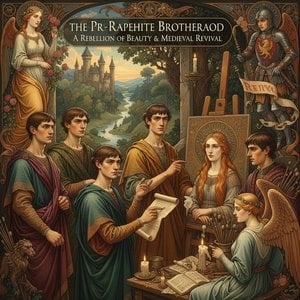
The Pre-Raphaelite Brotherhood: A Rebellion of Beauty & Medieval Revival
Explore the captivating world of the Pre-Raphaelite Brotherhood! Discover their rebellion against academic art, iconic masterpieces, and lasting influence on Victorian aesthetics. Learn about Rossetti, Burne-Jones & more.

The Pre-Raphaelite Brotherhood: Rebellion, Romance & Medieval Revival
Explore the captivating world of the Pre-Raphaelite Brotherhood! Discover their rebellious spirit, iconic masterpieces & lasting influence on art history. Learn about Rossetti, Millais & more.

Sir John Everett Millais: Präraffaelitische Revolution und viktorianische Erzählkunst
Entdecken Sie das Leben und Werk von Sir John Everett Millais, einem Pionier der Präraffaeliten! Detaillierte Analysen seiner Gemälde, Einblicke in die viktorianische Kunstszene und seine bleibende Bedeutung. Jetzt lesen!


