


 Vorschau anzeigen
 Versenden
 Teilen
 Details anzeigen

 Herunterladen
 Ähnliche Objekte
 Röntgenaufnahme
 Diashow
untitled (2854)

 Weiterlesen
Giclée / Kunstdruck
Giclée- oder Leinwanddruck in Museumsqualität mit schneller Produktion und flexiblen Veredelungsoptionen. ( Handgemalte Reproduktion bestellen Bild kaufen)




P118B $10

P118H $10

P118W $10

P438Z $10

P508JH $12

P508YH $12

P805H $10

P805Z $10

P919BZ $10

P919G $10

P919XJ $10

P959ZH $10

P968JZ $12

W106C $8

W218G $10

W218JH $8

W218Y $10

W307PJ $10

W316G $10

W316PJ $8

W316Y $10

W398PJ $8

W4111J $10

W500HY $15

W500JH $15

W692G $12

W849H $8

W940BG $15

W953PJ $8




Wählen Sie aus unseren vordefinierten Formaten, die den ursprünglichen Proportionen des Kunstwerks entsprechen.

Sie können Ihre eigenen Maße eingeben, um ein bestimmtes Format oder einen speziellen Platz einzupassen. Wenn das von Ihnen gewählte Format nicht den Proportionen des Originalbildes entspricht, werden wir das Kunstwerk entweder beschneiden oder das Bild mit einem gespiegelten oder einfarbigen Rand erweitern. Ein digitaler Entwurf wird Ihnen zur Genehmigung zugesandt, bevor die Produktion beginnt.
Bitte beachten Sie, dass die Vorschau auf dem Bildschirm nicht den tatsächlichen Zuschnitt oder die Erweiterung widerspiegelt. Nur der Entwurf zeigt die endgültige Komposition präzise an.
Obwohl Sondermaße verfügbar sind, empfehlen wir die Auswahl eines Maßes aus der vordefinierten Liste, um die ursprünglichen Proportionen zu bewahren.
Weltweiter Versand () innerhalb von 2 Wochen statt der üblichen 4/5 Wochen. (18 August)

Kostenloser weltweiter Expressversand

Hochwertige Leinenleinwand

Umfassender Versicherungsschutz beim Versand

Zollgebühren-Rückerstattungsgarantie

Garantie für exakte Farbtreue

60 Tage Rückgaberecht (nur bei Mängeln)

100% Geld-zurück-Garantie

Mengenrabatt verfügbar
 Die Glasoption ist nur für Größen unter 110 cm verfügbar.

untitled (2854)
Giclée / Kunstdruck
Format der Reproduktion
-


Gesamtpreis
$ 62
Sammlerstück-Beschreibung
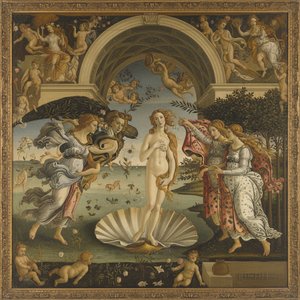
A Gathering Beneath an Uncertain Sky: Botticelli’s ‘Untitled (2854)’
Sandro Botticelli's “Untitled (2854),” a captivating depiction of figures huddled before an arched building, offers a glimpse into the vibrant social and artistic life of Renaissance Florence. Dating from around 1490 – a period marked by both burgeoning optimism and underlying political tension – this painting transcends mere representation; it’s a tableau brimming with narrative potential and imbued with a quiet, contemplative atmosphere. The scene unfolds beneath a sky hinting at impending rain, an element that immediately establishes a mood of intimacy and shared experience. The figures, dressed in clothing reminiscent of the late 15th century – a blend of practicality and subtle ornamentation – suggest a gathering of friends, perhaps merchants or members of a local guild, engaged in conversation and respite from the bustling city.
Botticelli’s masterful technique is immediately apparent. He employs a delicate *tempera* on wood panel, a medium favored for its luminosity and ability to capture subtle details. Notice how he renders the folds of fabric with an almost sculptural quality – each crease and pleat meticulously defined yet imbued with a sense of movement. The figures themselves are portrayed with a graceful elegance characteristic of Botticelli’s style, their poses relaxed and naturalistic, avoiding the rigid formality often found in earlier Renaissance works. The artist's use of color is restrained but effective; muted earth tones dominate, punctuated by the brighter hues of the umbrellas scattered throughout the scene – splashes of red, blue, and yellow that draw the eye and add a touch of visual interest.
Symbolism and Context: Florence in Transition
The setting itself—a building with prominent arches—is significant. Such architectural elements were common in Florentine civic buildings and churches, suggesting a public space or perhaps a gathering place for a specific community. The presence of the umbrellas isn’t merely decorative; it speaks to the unpredictable nature of Florentine weather – a recurring theme throughout Botticelli's work, often used to symbolize transience and the fragility of life. Furthermore, the clothing worn by the figures offers clues about their social standing and profession. The variety in attire hints at a diverse group, reflecting the complex social fabric of Renaissance Florence.
Botticelli’s artistic output during this period reflects the broader cultural shifts occurring in Italy. The early Renaissance was characterized by a renewed interest in classical antiquity, but also by a growing sense of individualism and secularism. His mythological paintings, such as “The Birth of Venus” and “Primavera,” demonstrate this fascination with classical themes while simultaneously exploring human emotions and experiences. "Untitled (2854)" can be viewed within this context – it’s not simply a portrait of a group of people; it's an exploration of social interaction, community, and the fleeting beauty of everyday life.
The Emotional Resonance: A Moment Frozen in Time
Despite its seemingly simple composition, “Untitled (2854)” possesses a remarkable emotional depth. The figures’ engaged expressions – smiles, thoughtful gazes, gestures of conversation – invite us to imagine their stories and connect with them on a human level. There's a sense of warmth and camaraderie in the scene, suggesting a shared moment of connection amidst the uncertainties of life. The muted palette and soft lighting contribute to this feeling of intimacy, creating an atmosphere that is both serene and evocative.
Botticelli’s ability to capture such nuanced emotions through his art is what makes “Untitled (2854)” so compelling. It's a painting that invites contemplation and offers a glimpse into the lives of ordinary people in Renaissance Florence – a world of beauty, intrigue, and profound human experience. A reproduction of this work would bring a touch of timeless elegance and quiet sophistication to any interior space, serving as a constant reminder of the enduring power of art to capture the essence of humanity.
Technical Details & Reproduction Considerations
As with many works by Botticelli, precise details regarding the dimensions and original materials used in “Untitled (2854)” remain somewhat elusive. ArtsDot’s meticulous hand-painted reproductions strive to faithfully recreate the painting's delicate *tempera* technique and subtle color palette. We utilize archival-quality pigments and canvas to ensure that our reproductions possess a remarkable level of detail and longevity, mirroring the original artwork as closely as possible.
The choice of canvas size is carefully considered to maintain the proportions and visual impact of the original painting. Our skilled artisans pay close attention to Botticelli’s characteristic brushstrokes and layering techniques, ensuring that each reproduction captures the artist's unique style and artistic vision. Whether you are a seasoned art collector or simply seeking a beautiful piece of artwork for your home, ArtsDot’s hand-painted reproductions offer an unparalleled opportunity to own a stunning representation of this iconic Renaissance masterpiece.
Ähnliche Kunstwerke


Über den Künstler
frühes Leben und Ausbildung
Sandro Botticelli, geboren Alessandro di Mariano di Vanni Filipepi um 1445, war eine zentrale Figur im frühen italienischen Frührenaissance der Malerei. Zunächst posthumig vernachlässigt, wurde Botticellis Werk im späten 19. Jahrhundert von den Präraffaeliten revitalisiert und führte zu einer Neubewertung seiner künstlerischen Beiträge. Botticelli wurde in Florenz, Italien, geboren und lebte sein ganzes Leben im selben Viertel. Seine Familie, darunter sein Vater Mariano di Vanni d’Amedeo Filipepi, war in verschiedene Berufe involviert, was sie mit Künstlern in Kontakt brachte. Giorgio Vasari berichtete, dass Botticelli zunächst als Goldschmied ausgebildet wurde.Künstlerischer Stil und bemerkenswerte Werke
Botticellis Werk ist durch elegante Linearität gekennzeichnet, die die Lücke zwischen der späten italienischen Gotik und dem frühen Frührenaissance schließt. Seine berühmtesten Werke, die Geburt des Venus und Primavera, werden in der Uffizialleerie in Florenz ausgestellt, die eine bedeutende Sammlung seiner Kunst beherbergt. * die Geburt des Venus (ansicht auf ArtsDot) * Primavera (Sandro Botticellis Kunst erkunden auf ArtsDot) * Mystische Geburt (Nationalgalerie, London), datiert 1501, ist das einzige Werk von Botticelli mit einem klaren Datum.Vermächtnis und Einfluss
Botticellis Stil entwickelte sich in den 1490er Jahren zu einem persönlicheren Ansatz und unterschied sich von Zeitgenossen wie Leonardo da Vinci und dem aufkommenden Hochrenaissance-Stil. Sein Werk wurde als bedeutende Beiträge zur italienischen Renaissance Kunstbewegung anerkannt. * Die italienische Renaissance Kunstbewegung * Sandro Botticelli auf Wikipedia- Bekannte Künstler der italienischen Renaissance umfassen Sandro Botticelli, Leonardo da Vinci, Michelangelo und Tizian.
- Die Uffizialleerie in Florenz beherbergt eine bedeutende Sammlung von Botticellis Kunst.
- Botticellis Werk wurde als eine zentrale Figur im frühen italienischen Frührenaissance der Malerei anerkannt.

Sandro Botticelli
1445 - 1510 , Italien
Kurzinfos
- Beeinflusste Künstler: ['Präraffaeliten']
- Bemerkenswerte Werke:
- Die Geburt der Venus
- Primavera
- Mystische Geburt
- Einflussreiche Künstler:
- Fra Angelico
- Paolo Uccello
- Geburtsdatum: ca. 1445
- Geburtsort: Florenz, Italien
- Künstlerische Bewegung: Frührenaissance
- Nationalität: Italienisch
- Sterbedatum: 1510
- Vollständiger Name: Sandro Botticelli
Ähnliche Artikel
Sandro Botticelli: Die 25 Meisterwerke des Renaissance-Genies – Kunst für Ihr Zuhause
Entdecken Sie die 25 schönsten Meisterwerke von Sandro Botticelli! Erleben Sie die Renaissance-Kunst mit 'Geburt der Venus', 'Primavera' & mehr. Hochwertige Reproduktionen für Ihr Zuhause – jetzt auf ArtsDot.com!

Die 25 Meisterwerke der Uffizien: Kunstgeschichte für Ihr Zuhause | ArtsDot
Entdecken Sie die 25 berühmtesten Meisterwerke der Uffizien, Florenz! Von Botticelli bis Leonardo da Vinci – Kunstgeschichte erleben. Hochwertige Reproduktionen & Inspiration für Ihr Zuhause auf ArtsDot.com.

Frührenaissance: Die 10 Meisterwerke, die eine Epoche prägten – Kunst für Ihr Zuhause
Entdecken Sie die 10 prägendsten Meisterwerke der Frührenaissance! Von Giotto bis Botticelli – erleben Sie Kunstgeschichte hautnah. Hochwertige Reproduktionen für Ihr Zuhause auf .

Meisterwerke der Temperamalerei: 10 Panelbilder, die Kunstgeschichte schrieben | ArtsDot
Entdecken Sie die 10 legendärsten Meisterwerke der Temperamalerei auf Holz! Von Giotto bis Botticelli – erfahren Sie die Geschichten hinter ikonischen Panelbildern und lassen Sie sich von Renaissance-Kunst inspirieren. Hochwertige Reproduktionen finden Sie auf ArtsDot.com.

Die Morgendämmerung einer neuen Vision: Künstlerische Innovationen der frühen Renaissance
Entdecken Sie die bahnbrechenden Innovationen der Frührenaissance! Erfahren Sie mehr über Künstler wie Brunelleschi, Masaccio und Donatello sowie die humanistischen Ideale, die diese Epoche prägten. Expertenwissen von ArtsDot.



