

 Vorschau anzeigen
 Versenden
 Teilen
 Details anzeigen

 Herunterladen
 Ähnliche Objekte
 Röntgenaufnahme
 Diashow
Desk calendar
 Acrylic On Canvas
- WallArt
- Pop Art
 1962
1962 123.0 x 173.0 cm
 Weiterlesen
Giclée / Kunstdruck
Giclée- oder Leinwanddruck in Museumsqualität mit schneller Produktion und flexiblen Veredelungsoptionen. ( Handgemalte Reproduktion bestellen Bild kaufen)




P118B $10

P118H $10

P118W $10

P438Z $10

P508JH $12

P508YH $12

P805H $10

P805Z $10

P919BZ $10

P919G $10

P919XJ $10

P959ZH $10

P968JZ $12

W106C $8

W218G $10

W218JH $8

W218Y $10

W307PJ $10

W316G $10

W316PJ $8

W316Y $10

W398PJ $8

W4111J $10

W500HY $15

W500JH $15

W692G $12

W849H $8

W940BG $15

W953PJ $8




Wählen Sie aus unseren vordefinierten Formaten, die den ursprünglichen Proportionen des Kunstwerks entsprechen.

Sie können Ihre eigenen Maße eingeben, um ein bestimmtes Format oder einen speziellen Platz einzupassen. Wenn das von Ihnen gewählte Format nicht den Proportionen des Originalbildes entspricht, werden wir das Kunstwerk entweder beschneiden oder das Bild mit einem gespiegelten oder einfarbigen Rand erweitern. Ein digitaler Entwurf wird Ihnen zur Genehmigung zugesandt, bevor die Produktion beginnt.
Bitte beachten Sie, dass die Vorschau auf dem Bildschirm nicht den tatsächlichen Zuschnitt oder die Erweiterung widerspiegelt. Nur der Entwurf zeigt die endgültige Komposition präzise an.
Obwohl Sondermaße verfügbar sind, empfehlen wir die Auswahl eines Maßes aus der vordefinierten Liste, um die ursprünglichen Proportionen zu bewahren.
Weltweiter Versand () innerhalb von 2 Wochen statt der üblichen 4/5 Wochen. (18 August)

Kostenloser weltweiter Expressversand

Hochwertige Leinenleinwand

Umfassender Versicherungsschutz beim Versand

Zollgebühren-Rückerstattungsgarantie

Garantie für exakte Farbtreue

60 Tage Rückgaberecht (nur bei Mängeln)

100% Geld-zurück-Garantie

Mengenrabatt verfügbar
 Die Glasoption ist nur für Größen unter 110 cm verfügbar.

Desk calendar
Giclée / Kunstdruck
Format der Reproduktion
-


Gesamtpreis
$ 62
Sammlerstück-Beschreibung
A Snapshot of Routine: Roy Lichtenstein’s ‘Desk Calendar’
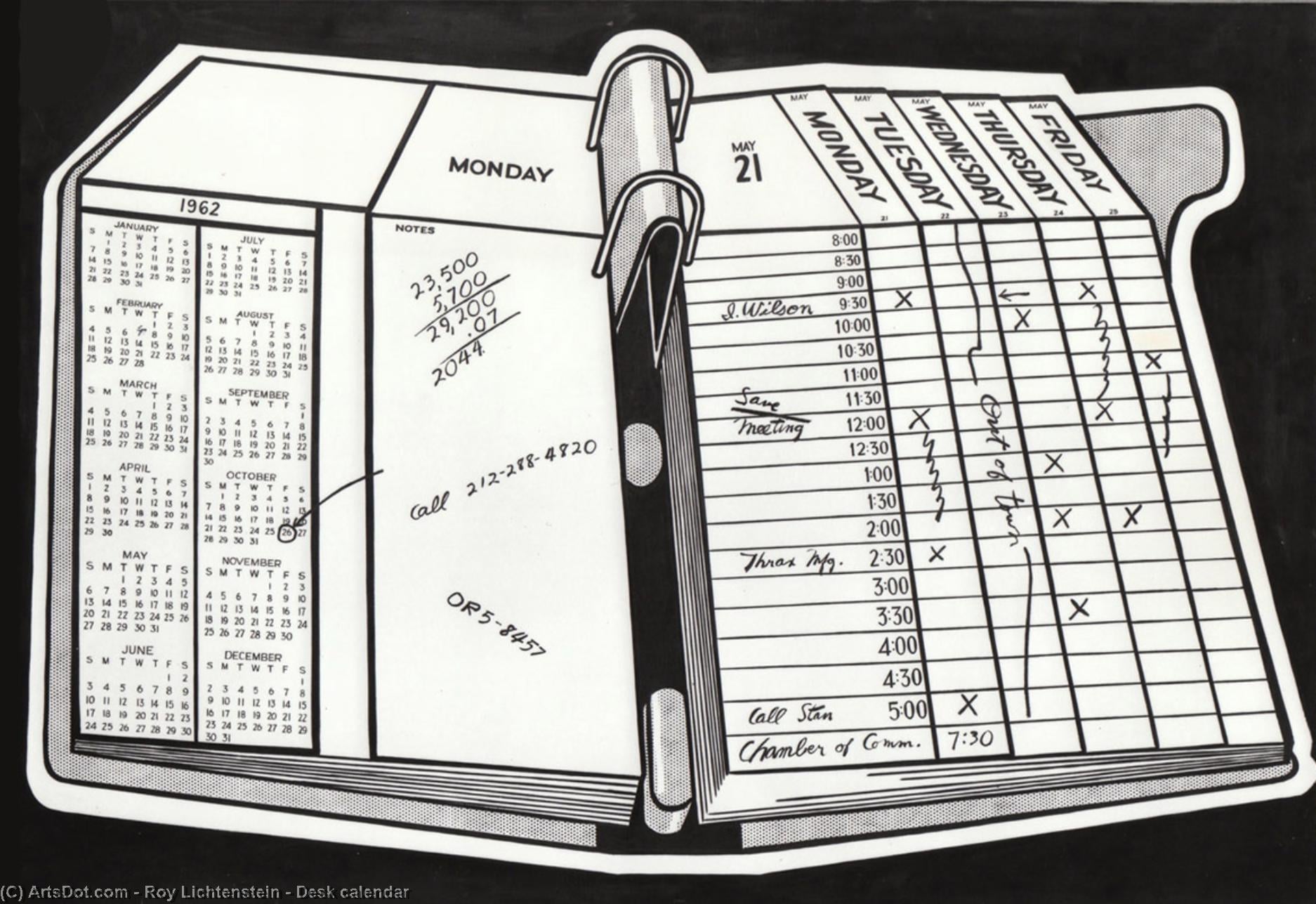
Roy Lichtenstein's “Desk Calendar,” painted in 1962, isn’t merely a depiction of an office calendar; it’s a carefully constructed meditation on the banality of modern life and the burgeoning Pop Art movement’s challenge to traditional artistic boundaries. This deceptively simple work, rendered in stark black and white with subtle tonal shifts, captures a moment of quiet domesticity – or perhaps, a silent testament to the relentless demands of a busy schedule – within the confines of an American office. The piece immediately draws the eye to its central subject: an open calendar, partially obscured by a dark binder overflowing with papers, suggesting a world perpetually in motion and demanding attention.
Lichtenstein’s signature Pop Art style is instantly recognizable. Bold outlines define every element – from the crisp edges of the calendar pages to the assertive lines of the handwritten notes. The meticulous detail, achieved through a technique reminiscent of commercial printing processes (likely oil paint or acrylic on canvas), mimics the look and feel of a printed schedule. The use of ‘Ben-Day dots,’ though not explicitly visible in this particular image, is a key element of Lichtenstein’s aesthetic, creating a textured, graphic effect that evokes the halftone patterns found in comic books and advertising – a deliberate nod to the mass-produced imagery dominating American culture at the time.
Decoding the Details: Composition and Symbolism
The composition itself is remarkably restrained. The calendar dominates the scene, its grid of dates and appointments acting as a visual anchor. The handwritten notes, scrawled in varying sizes and styles, hint at the pressures and obligations of daily life. The inclusion of scissors protruding from the binder adds an element of urgency or perhaps even frustration – suggesting a task interrupted, a deadline looming. Even the lighting, seemingly uniform across the scene, contributes to the overall sense of order and control, subtly contrasting with the implied chaos within the binder.
Beyond its surface appearance, “Desk Calendar” carries layers of symbolic meaning. The mundane subject matter – an office calendar – is elevated through Lichtenstein’s artistic treatment, transforming it into a potent commentary on consumer culture and the homogenization of experience. The repetition of dates and appointments speaks to the regimented nature of modern life, while the handwritten notes represent individual attempts to impose order upon that structure. The very act of documenting time becomes an artful gesture, questioning the value we place on schedules and routines.
A Pop Art Pioneer: Context and Legacy
Created in 1962, “Desk Calendar” firmly establishes Lichtenstein as a leading figure within the Pop Art movement. Emerging from the post-war artistic landscape, Pop Art sought to break down the barriers between ‘high’ art and ‘low’ culture, embracing imagery derived from advertising, comic books, and everyday objects. Artists like Lichtenstein deliberately blurred these distinctions, challenging traditional notions of beauty and taste.
Roy Fox Lichtenstein (1923-1997), born in Manhattan, initially pursued a career as a realist painter before being drawn to the vibrant energy of Pop Art. His early influences included jazz music and museum visits, shaping his keen eye for detail and his interest in capturing the spirit of contemporary America. “Desk Calendar” exemplifies Lichtenstein’s ability to distill complex ideas into visually arresting compositions – a testament to his enduring legacy as one of the 20th century's most influential artists.
Collecting and Experiencing ‘Desk Calendar’
Reproductions of “Desk Calendar” offer a captivating glimpse into Lichtenstein’s artistic vision. The bold graphic style, combined with the subtle tonal variations, creates a dynamic image that is both visually stimulating and intellectually engaging. Whether displayed in a contemporary art gallery or incorporated into an interior design scheme, this work serves as a reminder of Pop Art's enduring influence on our visual culture – a celebration of everyday life transformed by artistic ingenuity.
Ähnliche Kunstwerke


Über den Künstler
frühes Leben und Ausbildung
Roy Fox Lichtenstein, ein prominenter amerikanischer Pop-Künstler, wurde am 27. Oktober 1923 in New York City geboren. Er wuchs in einer wohlhabenden jüdischen Familie auf, mit seinem Vater als Immobilienmakler und seiner Mutter als Hausfrau. Lichtensteins Interesse an Kunst und Design begann während seiner Schulzeit als Hobby.Künstlerische Karriere
Nach Abschluss seiner Schulausbildung am Dwight School im Jahr 1940 besuchte Lichtenstein die Art Students League of New York unter der Anleitung von Reginald Marsh. Er studierte anschließend einen Abschluss in Fine Arts an der Ohio State University, der durch eine dreijährige Verlegung in das Militär während des Zweiten Weltkriegs unterbrochen wurde.- Look Mickey (1961, National Gallery of Art, Washington, D.C.), eines von Lichtensteins frühesten Pop-Kunstwerke, markierte den Beginn seiner einflussreichen Karriere.
- Seine Arbeit war stark von Werbe- und Comic-Stilen beeinflusst, darunter bedeutende Werke wie Wham!, Drowning Girl und Oh, Jeff...I Love You Too...But...
- Lichtensteins teuerstes Werk, Masterpiece, wurde im Januar 2017 für 165 Millionen Dollar verkauft.
Lehre und Einflüsse
Lichtenstein lehrte an verschiedenen Institutionen, darunter die State University of New York at Oswego und die Rutgers University. Seine Arbeit war von Allan Kaprow beeinflusst, einem Kollegen an der Rutgers University, der sein Interesse an proto-Pop-Bildern wiederbelebte. Bekannte Ausstellungen:- The Museum Chambre de Commerce (Toulouse, Frankreich), das verschiedene Kunstwerke aus der Pop-Art-Bewegung zeigte.
- Lichtensteins Werk wurde in der Leo Castelli Gallery in New York City ausgestellt, wobei seine erste Einzelausstellung 1962 vor der Eröffnung vollständig von einflussreichen Sammlern gekauft wurde.
Vermächtnis und Einfluss
Roy Lichtenstein starb am 29. September 1997 und hinterließ ein Vermächtnis als eine führende Figur in der Pop-Art-Bewegung. Seine Arbeit wird weiterhin für ihre innovative Verschmelzung von Hoch- und Populärkultur gefeiert, wodurch sie einem breiteren Publikum zugänglich gemacht wird.- Entdecken Sie mehr von Lichtensteins Kunstwerke auf ArtsDot.com
- Erfahren Sie die Welt der Pop-Art und ihrer einflussreichen Künstler auf Pop Art und darüber hinaus: Navigieren Sie mit ArtsDot.com durch zeitgenössische Stile

Roy Lichtenstein
1923 - 1997 , Vereinigte Staaten von Amerika
Kurzinfos
- Beeinflusste Künstler:
- Reginald Marsh
- Allan Kaprow
- Bemerkenswerte Werke:
- Look Mickey
- Whaam!
- Drowning Girl
- Masterpiece
- Geburtsdatum: 27. Oktober 1923
- Geburtsort: Manhattan, USA
- Künstlerische Richtung: Pop Art
- Nationalität: Amerikanisch
- Todatum: 29. September 1997
- Vollständiger Name: Roy Lichtenstein
Ähnliche Artikel

Roy Lichtenstein: Die 25 Meisterwerke des Pop Art – Kunst für Ihr Zuhause | ArtsDot
Entdecken Sie die 25 ikonischsten Meisterwerke von Roy Lichtenstein! Tauchen Sie ein in die Welt der Pop Art, lernen Sie die Geschichten hinter den berühmten Gemälden und finden Sie perfekte Kunstreproduktionen für Ihr Zuhause. Jetzt auf ArtsDot.com entdecken!

Jenseits der Rasterpunkte: Roy Lichtensteins Pop-Art-Revolution und bleibendes Erbe
Entdecken Sie Roy Lichtensteins revolutionäre Pop Art! Expertenanalyse, Investitionspotenziale & Hintergrundinformationen für Kunstsammler. Seit 2004 Ihr Partner für hochwertige Reproduktionen und individuelle Kunstberatung.

Beyond the Dot: Unveiling the Industrial Magic of Silk Screens and Ben-Day Dots in Pop Art
Unveil the magic of Pop Art! Explore the fascinating history of Ben-Day dots and silk screens. Discover how these bold, industrial techniques transformed everyday imagery into high art—and learn how to bring that vibrant energy into your home with our premium, hand-painted reproductions.

The Psychology of the Palette: Decoding Roy Lichtenstein’s Bold Color Theory
Explore the vibrant psychology behind Roy Lichtenstein’s color theory. Discover how Ben-Day dots and primary colors revolutionized Pop Art, transforming mass media into timeless masterpieces for modern collectors and interior design enthusiasts.

Pop Art Ikonen: Die 10 Meisterwerke, die eine Kunstrevolution auslösten –
Entdecken Sie die 10 Meisterwerke der Pop Art! Von Warhol bis Lichtenstein – erfahren Sie die Geschichten hinter ikonischen Gemälden, Techniken & Farben. Museumsgalerie-Qualität bei entdecken.



