
 Oil On Canvas
- WallArt
- Cubism
 1913
1913 99.0 x 99.0 cm

The picture follows your choices: , .
Beschreibung des Sammlerstücks
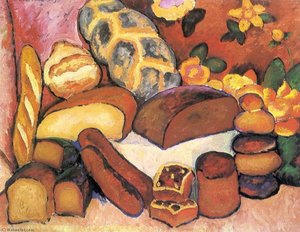
Discover Pyotr Konchalovsky's 1913 still life, Bread on the green, featuring abundant breads on a blue surface; bring this vibrant Russian masterpiece home.
 Weiterlesen
Künstlerbiografie
Entdecken Sie Pyotr Konchalowski (1876-1956), russischer Maler & Avantgarde-Künstler! Stillleben, Porträts & Landschaften im Fauvismus & sozialistischen Realismus.
Handgefertigte Ölreproduktion
Handgemaltes Ölgemälde auf Leinwand in Ihrer Wunschgröße und mit Rahmen, auf Bestellung von unseren Künstlern angefertigt. ( Zum Druck wechseln Zum digitalen Bild wechseln)
More about this painting
 Vorschau anzeigen
 Versenden
 Teilen
 Details anzeigen
 Leitfaden

 Herunterladen
 Ähnliche Objekte
 Röntgenaufnahme
 Diashow
 Q&A
Q&A Statistiken
Order your painting in four simple steps
Take your time. You can change any answer; the price in your order card follows each choice.
1 Step one of four
Which size would you like?
These sizes keep the proportions of the original painting. The drawing shows your choice on a wall, above a two-metre sofa.
Or give your own measurements
Wählen Sie aus unseren vordefinierten Formaten, die den ursprünglichen Proportionen des Kunstwerks entsprechen.

Geben Sie die Breite und die Höhe an, die Sie für Ihren Rahmen oder Ihre Wand benötigen. Da dieses Werk handgemalt ist, kann der Künstler bei einer anderen Form etwas mehr um das Bild herum malen oder etwas abschneiden – Sie entscheiden. Wir senden Ihnen ein digitales Mockup zur Freigabe, bevor mit dem Malen begonnen wird. Das auf dieser Seite gezeigte Bild stellt nicht das tatsächliche Ergebnis dar – dies tut nur das Mockup.
2 Step two of four
How should it be prepared: rolled, stretched or framed?
The prices below are for the size you chose in step one.
Choose the edges of the stretched canvas
Choose your frame

White €1

Blurside €1

Extended €1

P118B €10

P118H €10

P118W €10

P438Z €10

P508JH €12

P508YH €12

P805H €10

P805Z €10

P919BZ €10

P919G €10

P919XJ €10

P959ZH €10

P968JZ €12

W106C €8

W218G €10

W218JH €8

W218Y €10

W307PJ €10

W316G €10

W316PJ €8

W316Y €10

W398PJ €8

W4111J €10

W500HY €15

W500JH €15

W692G €12

W849H €8

W940BG €15

W953PJ €8

H24-GOLD €30

H24-SILVER €30

H36-GOLD €45

H36-SILVER €45
Gerahmt
Moulding: . Overall size with the frame: .
3 Step three of four
Would you like anything changed in the painting?
Most people answer no. Because each painting is made by hand, our artist can also adapt it for you.
After order, ArtsDot.com team will email client for instructions and provide a mockup preview
4 Step four of four
A few finishing options
All of them are optional. The answers already selected cost nothing extra.
Who paints it?
Weltweiter Versand () in nur 3 bis 4 Wochen statt der üblichen 5 Wochen. (29 Oktober). Keine Kompromisse bei der Qualität.
A nameplate, as in a museum?
Details der gravierten Bronzetafel
This elegant plaque features the artist's name and the title of the artwork, finely engraved for a timeless presentation.
It is made from bronze with a refined, elegant finish. The text is precisely laser-engraved for a sharp and permanent result. Measuring 9x2 cm, the plaque is compact yet easy to read. It's built to be durable and scratch-resistant, offering a professional, museum-quality look. Mounting is simple thanks to the included adhesive backing.
Details zur Acrylglas-Plakette (transparent)
The plaque includes essential engraved details such as the artist's name, the title of the artwork, the date it was created, the type of media used-like oil on canvas or watercolor-a brief description of the piece, and a QR code that links to the complete artwork information.
It is crafted from clear acrylic, offering a sleek, modern appearance. The text is UV-engraved in black to ensure strong visual contrast. With a size of 10x15 cm, it ensures optimal readability. It comes equipped with two metal hooks for secure wall mounting. The plaque is designed to be weather-resistant, making it suitable for various environments, and it includes interactive features that work seamlessly with smartphone scanning.
Details zur schwarzen Acryltafel
This elegant plaque includes engraved information such as the artist's name, the title of the artwork, the date it was created, the type of media used (like oil on canvas or watercolor), a short description of the artwork, and a QR code for quick access to more information.
The plaque itself is made from refined black acrylic with a premium finish. The text is laser-engraved in white for high contrast and readability. Its size is 10x15 cm, designed to be easy to read. It comes with two metal hooks for professional mounting. The design is sleek and fits any interior style. It is also weather-resistant and durable, with built-in digital integration for mobile compatibility.
A protective varnish?
When do you need it?
✓ Check and order
Your painting, as you ordered it

Bread on the green
Art der Reproduktion
Format der Reproduktion
-

Erstklassige Meisterkünstler
Mehr Detailtiefe, Raffinesse und zusätzliche Produktionszeit
-

Rahmen für Reproduktionen
-
-
Bei Kunstwerken oder Reproduktionen, die an einer Seite größer als 105 cm (ca. 41 Zoll) sind, wird der Rahmen zerlegt als Bausatz geliefert. Diese Methode gewährleistet eine sichere Zustellung und verhindert Schäden während des Transports.
Professionelle Montage erforderlich – dies ist kein DIY-Produkt.
Der Bausatz muss von einem erfahrenen professionellen Rahmenmacher zusammengebaut und die Leinwand gespannt werden. Hierfür werden Holzleim (nicht im Lieferumfang enthalten), eine Leinwandspannzange sowie Klemmen benötigt, um die Keilleisten während des Trocknungsvorgangs rechtwinklig zu halten. Eine unsachgemäße Montage oder eine ungleichmäßige Spannung der Leinwand kann das Kunstwerk dauerhaft beschädigen und ist nicht durch unsere Garantie abgedeckt.
 Bei Kunstwerken oder Reproduktionen, die an einer Seite größer als 105 cm (ca. 41 Zoll) sind, wird der Rahmen zerlegt als Bausatz geliefert. Diese Methode gewährleistet eine sichere Zustellung und verhindert Schäden während des Transports.
Alle Vollholzkomponenten sind enthalten, präzise auf Maß zugeschnitten.
Der Zusammenbau erfolgt mit den mitgelieferten Schrauben sowie Holzkleber für die Eckverbindungen, der nicht im Lieferumfang enthalten ist und vom Rahmenbauer selbst beschafft werden muss.
Professionelles Werkzeug ist erforderlich und nicht im Lieferumfang enthalten: eine Keilrahmenzange (Spannwerkzeug) sowie Klammern, um die Leisten während der Trocknungszeit des Klebers rechtwinklig zu fixieren.
Wichtiger Hinweis:
Für die Eckverbindungen wird Holzleim benötigt, die Leisten müssen mit Zwingen fixiert werden, bis der Leim vollständig getrocknet ist, und das Spannen der Leinwand auf dem fertigen Rahmen erfordert eine Keilrahmen-Zange. Keines dieser Utensilien ist im Set enthalten. Bitte stellen Sie sicher, dass ein erfahrener Rahmenmacher zur Verfügung steht, bevor Sie diese Größe bestellen.

Beschriftung
-
-

Schutzlackierung
Glanzlack (verstärkt die Farben, schützt vor Licht und Feuchtigkeit)
-

Mein Kunstwerk personalisieren
Beispiele für Anpassungsmöglichkeiten: Gesicht durch Kundenfoto ersetzen; Haustier hinzufügen (z. B. Katze durch Hund ersetzen); Versteckte Nachricht im Hintergrund einfügen; Hintergrundlandschaft oder -elemente ändern.
-

Eilt sehr
Weltweiter Versand () in nur 3 bis 4 Wochen statt der üblichen 5 Wochen. (29 Oktober). Keine Kompromisse bei der Qualität.
-
Expressversand
Weltweiter Versand () innerhalb von 5 Wochen. (5 November).
Inklusive Versand
Endpreis
€ 232
Die Glasoption ist nur für Größen unter 110 cm verfügbar.
Included with every order
- Kostenloser weltweiter Expressversand
- Hochwertige Leinenleinwand
- Umfassender Versicherungsschutz beim Versand
- Zollgebühren-Rückerstattungsgarantie
- Garantie für exakte Farbtreue
- 100 Tage Rückgaberecht (nur bei Mängeln)
- 100% Geld-zurück-Garantie
- Mengenrabatt verfügbar


A Bounty of Everyday Life: Exploring "Bread on the Green"
To gaze upon Pyotr Konchalovsky's Bread on the green from 1913 is to be invited into a moment of profound, quiet abundance. This still life transcends a mere depiction of foodstuffs; it is a celebration of sustenance, culture, and the simple rituals that anchor human existence. The composition gathers an array of breads—loaves, delicate rolls, and various pastries—arranged with meticulous care upon a striking blue surface. The sheer variety suggests a gathering, a feast awaiting its moment, transforming humble kitchen staples into objects of high artistic contemplation.
Technique and Compositional Harmony
Konchalovsky’s handling of texture is nothing short of masterful. One can almost feel the crusty exterior of the rustic loaves against the soft yielding quality of the pastries. The artist employs a rich, tactile realism that grounds the viewer in the tangible world, yet the arrangement itself possesses an inherent dynamism. Notice the inclusion of the bowl near the center-left; it acts as a subtle anchor, drawing the eye inward while simultaneously allowing the surrounding breads to spill out into a vibrant narrative across the blue plane. The interplay between the warm, earthy tones of the baked goods and the cool, saturated depth of the blue ground creates a sophisticated chromatic tension that elevates the piece beyond simple genre painting.
Historical Echoes and Artistic Context
Painted in 1913, this work emerges from a period when Russian art was undergoing intense ferment. While the subject matter—bread—is timelessly universal, the execution hints at the modernist currents of the time, even if the piece retains a strong sense of traditional craftsmanship. The mention of Cubism in relation to the painting suggests an underlying structural deconstruction; while the breads are recognizable, their placement and overlapping forms invite the viewer to consider form from multiple perspectives. It is art that honors tradition while subtly nodding toward the revolutionary spirit of modern perception.
Symbolism of Sustenance and Domesticity
Beyond its visual appeal, Bread on the green resonates with deep symbolism. Bread has always been a potent symbol—of life itself, of community, and of survival. In this context, the bounty speaks to prosperity and domestic harmony. For collectors and designers alike, owning such a piece is not merely acquiring art; it is curating an atmosphere of warmth, welcome, and enduring comfort for one's space. It suggests a home where nourishment—both physical and artistic—is paramount.
Bringing the Still Life Home
For those considering a reproduction of this magnificent work, know that you are acquiring more than just pigment on canvas; you are inviting a piece of Russian cultural history into your modern life. The rich palette and palpable texture make it an exceptional focal point for dining rooms, libraries, or any space meant to evoke thoughtful repose. It is a masterpiece of quiet grandeur, promising the viewer a moment of appreciative stillness amidst the rush of daily life.
Fragen & Antworten
Aus welcher Schaffensperiode von Pjotr Konchalowski stammt "Bread on the green"?
„Bread on the green“ entstammt der Early Modern Period von Pjotr Konchalowski. Diese Einordnung setzt das Werk in Bezug zur künstlerischen Entwicklung des Künstlers.
Wie harmonisch ist die Farbgestaltung von "Bread on the green" von Pjotr Konchalowski?
Die Farbharmonie von „Bread on the green“ wird als Discordant Palette beschrieben.
Welche Emotion vermittelt das Werk der Cubism „Bread on the green“?
"Bread on the green" vermittelt eine Calm emotionale Stimmung innerhalb der Cubism-Strömung.
Ähnliche Kunstwerke




Pjotr Konchalowski
1876 - 1956, Russland
Künstlerbiografie
Pyotr Konchalovsky: Ein Leben in der Russischen Kunst
- Geboren: 21. Februar 1876, Slavianka, Kharkov Gouvernement (heute Ukraine)
- Gestorben: 1956
Pyotr Konchalovsky war eine bedeutende Figur in der russischen Kunst, bekannt für seine umfangreiche Produktion und stilistische Vielseitigkeit. Geboren in einer künstlerischen Familie – sein Vater war Verleger von Kunstbüchern – prägte die frühe Exposition gegenüber der Welt der Kunst zweifellos seine zukünftige Karriere. Sein Leben umfasste eine Zeit immenser sozialer und politischer Veränderungen in Russland, was sowohl seine Sujets als auch seinen künstlerischen Stil beeinflusste.
Frühes Leben, Ausbildung & Künstlerische Entwicklung
- Moskauer Jahre: Die Konchalovsky-Familie zog 1889 nach Moskau, wo ihr Haus zu einem lebendigen Zentrum für die Moskauer Kunstelite wurde. Häufige Besucher waren Größen wie Valentin Serov, Mikhail Vrubel und Vasily Surikov, die dem jungen Pyotr unschätzbare Einblicke in etablierte Künstler boten.
- Formale Ausbildung: Konchalovsky besuchte während seiner Gymnasialzeit Kurse an der Moskauer Hochschule für Malerei, Bildhauerei und Architektur. Er vertiefte seine Studien 1896-1898 in Paris an der Académie Julian, bevor er 1907 an der Kaiserlichen Kunstakademie in Sankt Petersburg abschloss.
- Frühe Einflüsse: Konchalowskys frühe Werke, hauptsächlich Stillleben und Landschaften, offenbaren einen starken Einfluss von Paul Cézanne, was sich in seiner Erforschung von Form und Struktur zeigt. Er experimentierte mit verschiedenen Stilen, bevor er seine eigene unverwechselbare Stimme entwickelte.
Wichtige Bewegungen & Künstlerischer Stil
- Jack of Diamonds: Als Gründungsmitglied der einflussreichen „Jack of Diamonds“-Gesellschaft (gegründet 1909) stand Konchalovsky an vorderster Front der russischen Avantgarde-Bewegungen. Diese Gruppe plädierte für einen moderneren und experimentelleren Ansatz in der Kunst, der traditionelle akademische Stile ablehnte.
- Fauvismus & Früher Modernismus: Seine frühen Werke zeigen eine Annäherung an die Prinzipien des Fauvismus, gekennzeichnet durch kühne, nicht-naturalistische Farben und expressive Pinselstriche. Beispiele hierfür sind "Stillleben mit einer Kaffeekanne" (1919) und "Die Landschaft. Küste Frankreichs" (1908).
- Sozialistischer Realismus: Mit dem Fortschreiten der Sowjetära verlagerte sich Konchalowskys Stil hin zum sozialistischen Realismus, was die vorherrschenden künstlerischen Anforderungen des Regimes widerspiegelte. Er wurde bekannt für die Schaffung zeremonieller Porträts, die sozialistische Ideale und prominente Persönlichkeiten feierten. Obwohl diese Verschiebung einen Bruch mit seinen früheren Avantgarde-Erkundungen darstellte, festigte sie seine Position innerhalb der russischen Kunstszene.
- Umfangreiche Produktion: Konchalovsky war bemerkenswert produktiv und hinterließ eine geschätzte Anzahl von 5.000 Werken, die vielfältige Themen wie Stillleben ("Stillleben. Pfirsiche"), Landschaften ("Kiefern") und Porträts ("Novgorodianer") umfassen.
Wichtige Errungenschaften & Vermächtnis
- Soloausstellung in der Tretjakow-Galerie: Ein wichtiger Meilenstein in seiner Karriere war seine erste Soloausstellung in der renommierten Tretjakow-Galerie im Jahr 1922, die eine breite Palette seiner künstlerischen Leistungen präsentierte.
- Künstlerfamilie: Konchalowskys Vermächtnis geht über sein eigenes Werk hinaus; er stammte aus und förderte eine Familie, die sich intensiv in der Kunst engagierte. Sein Sohn Mikhail Petrovich Konchalovsky wurde ein renommierter Filmregisseur, und seine Tochter Natalia Konchalovskaya war ebenfalls eine talentierte Künstlerin.
- Beitrag zur Russischen Kunst: Pyotr Konchalowskys Beitrag zur russischen Kunst ist unbestreitbar. Er navigierte durch verschiedene künstlerische Bewegungen, von der Avantgarde bis zum sozialistischen Realismus und hinterließ einen umfangreichen Werkkörper, der die sich verändernde kulturelle und politische Landschaft Russlands im 20. Jahrhundert widerspiegelt. Seine Fähigkeit, sich anzupassen und gleichzeitig einen unverwechselbaren Stil zu bewahren, festigte seinen Platz als Schlüsselfigur in der russischen Kunstgeschichte.
Historische Bedeutung
Konchalowskys Karriere bietet wertvolle Einblicke in die Entwicklung der russischen Kunst während einer turbulenten Zeit. Er repräsentiert sowohl den dynamischen Charakter des frühen Modernismus als auch die Beschränkungen, die durch sowjetische Kunstpolitik auferlegt wurden. Sein Werk ist ein Beweis für die Widerstandsfähigkeit und Anpassungsfähigkeit von Künstlern bei der Bewältigung komplexer politischer Umstände und dem Streben nach kreativem Ausdruck.


Ähnliche Artikel

Ivan Bilibin: A Synthesis of Folklore, Modernism & National Identity in Russian Illustration
Explore the enchanting world of Ivan Bilibin, a master Russian illustrator who synthesized folklore, Art Nouveau & national identity. Discover his iconic fairy tale illustrations and legacy with ArtsDot.

The Enduring Legacy of Oil on Canvas: Technique, History & Aesthetic Impact
Explore the rich history & techniques of oil painting – from Renaissance masters to Impressionism. Discover pigments, layering methods, and why this timeless medium endures. Expert insights for artists & art enthusiasts.
The Allure of Azure: Exploring the Symbolic & Aesthetic Depths of Blue in Art History
Explore the rich history of blue in art! Discover its symbolism, from ancient pigments to modern masterpieces by Kandinsky & Seurat. Uncover the psychological impact and cultural meanings behind this captivating hue.