In echtem Maßstab anzeigen
 Versenden als Grußkarte
 Teilen
 Details anzeigen
 Leitfaden öffnen

 Herunterladen
 Ähnliche Objekte
 Röntgenaufnahme
 Diashow
 Besucherstatistiken
Landscape, Sunset
 Oil On Canvas
- WallArt
- Post-Impressionism
 1912
1912- 19th Century
 44.0 x 52.0 cm
 Mehr anzeigen
Handgefertigte Ölreproduktion
Handgemaltes Ölgemälde auf Leinwand in Ihrer Wunschgröße und mit Rahmen, auf Bestellung von unseren Künstlern angefertigt. ( Zum Druck wechseln Zum digitalen Bild wechseln)




P118B €10

P118H €10

P118W €10

P438Z €10

P508JH €12

P508YH €12

P805H €10

P805Z €10

P919BZ €10

P919G €10

P919XJ €10

P959ZH €10

P968JZ €12

W106C €8

W218G €10

W218JH €8

W218Y €10

W307PJ €10

W316G €10

W316PJ €8

W316Y €10

W398PJ €8

W4111J €10

W500HY €15

W500JH €15

W692G €12

W849H €8

W940BG €15

W953PJ €8




Wählen Sie aus unseren vordefinierten Formaten, die den ursprünglichen Proportionen des Kunstwerks entsprechen.

Geben Sie die Breite und die Höhe an, die Sie für Ihren Rahmen oder Ihre Wand benötigen. Da dieses Werk handgemalt ist, kann der Künstler bei einer anderen Form etwas mehr um das Bild herum malen oder etwas abschneiden – Sie entscheiden. Wir senden Ihnen ein digitales Mockup zur Freigabe, bevor mit dem Malen begonnen wird. Das auf dieser Seite gezeigte Bild stellt nicht das tatsächliche Ergebnis dar – dies tut nur das Mockup.
Nach der Bestellung wird das ArtsDot.com-Team dem Kunden Anweisungen per E-Mail zusenden und eine Mockup-Vorschau bereitstellen.
Weltweiter Versand () in nur 3 bis 4 Wochen statt der üblichen 5 Wochen. (22 Oktober). Keine Kompromisse bei der Qualität.

Kostenloser weltweiter Expressversand

Hochwertige Leinenleinwand

Vollständiger Versicherungsschutz beim Versand

Zollgebühren-Rückerstattungsgarantie

Garantie für exakte Farbtreue

100-tägiges Rückgaberecht (nur bei Mängeln)

100% Geld-zurück-Garantie

Angebot für Mengenrabatt
 Die Glasoption ist nur für Größen unter 110 cm verfügbar.

Landscape, Sunset
Reproduktionsmedium
Format der Reproduktion
-


Gesamtpreis
€ 231
A Symphony in Yellow and Crimson: Capturing the Ephemeral Glow
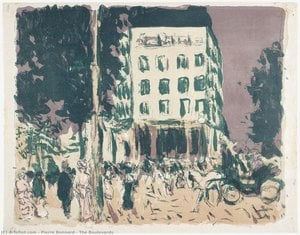
To gaze upon this depiction of a sunset is not merely to observe a change in the sky; it is to step into a moment suspended between day and night, a breath held by the very light itself. Pierre Bonnard, master chronicler of domestic intimacy and vibrant color, has gifted us a landscape that pulses with captured warmth. The dominant yellow of the setting sun washes over the scene, creating an almost palpable glow that seems to emanate from the canvas. This luminous backdrop is dramatically anchored in the foreground by the striking presence of a red building—a bold, earthy counterpoint that speaks of human habitation nestled against the vastness of nature. It is a masterful study in complementary colors, where the fiery reds and deep yellows engage in a silent, passionate dialogue.
The Human Element Within the Vista
What elevates this piece beyond a mere topographical record is Bonnard’s subtle inclusion of life. Scattered throughout the composition are figures—small, yet vital, witnesses to this grand natural spectacle. They drift through the scene, some gathered near the shelter of the red structure, others seemingly absorbed by the sweeping vista of the background mountains. These people are not portraits; they are suggestions of life, imbued with a quiet movement that lends the entire painting an undeniable sense of vitality. Bonnard possesses a unique gift for suggesting presence rather than detailing it, allowing the viewer to project their own memories and narratives onto these fleeting forms.
Bonnard's Luminous Technique and Style
Working in the spirit of late 19th and early 20th-century French modernism, Bonnard’s technique here is characterized by an intense focus on color relationships over sharp delineation. His brushwork, while suggestive of the Nabis influence toward flattening pictorial space, retains a rich textural quality that speaks to his deep engagement with paint itself. The handling of light across the mountains in the distance provides incredible depth, utilizing atmospheric perspective so that the receding peaks seem softened and ethereal against the deepening hues of the sky. It is an art steeped in color theory, where every patch of yellow, every stroke of crimson, contributes to a unified emotional resonance.
Emotional Resonance for the Modern Collector
This piece transcends simple decoration; it functions as an emotional anchor. For the collector or designer seeking to infuse a space with warmth and sophisticated narrative, this artwork offers immediate depth. It speaks to the universal human experience of finding beauty in transition—the beautiful melancholy of dusk, the comfort found in community against the backdrop of enduring nature. Reproducing such a work allows one to bring Bonnard’s signature luminosity into a contemporary setting, transforming a wall from mere surface into a portal filled with light and memory.
Fragen & Antworten
Kann ich "Landscape, Sunset" von Pierre Bonnard vor der Bestellung in einer Vorschau ansehen?
Auf der Vorschau-Seite von „Landscape, Sunset“ können Sie das Kunstwerk vor der Bestellung in einer Vorschau betrachten.
Welche Stellung nimmt „Landscape, Sunset“ unter den wiederkehrenden Motiven von Pierre Bonnard ein?
"Landscape, Sunset" stellt landscape, sunset, cityscape, people, warm colors, mountains, outdoor scene dar, während die dokumentierten Themen von Pierre Bonnard nabis influence on color, daily life parisian scenes, light and atmosphere study, intimate domestic moments sind. Ein Vergleich der beiden zeigt, wie das Werk mit den üblichen Sujets des Künstlers in Verbindung steht.
Welche Stimmung würde "Landscape, Sunset" in einen Raum bringen?
"Landscape, Sunset" von Pierre Bonnard besitzt eine Serene Atmosphäre und wird für ein Lounge empfohlen. Die Stimmung beschreibt das Gefühl, das das Werk in den umgebenden Raum bringt.
Ähnliche Kunstwerke


Biografie des Künstlers
Frühe Jahre und Karriere
Pierre Bonnard wurde am 3. Oktober 1867 in Fontenay-aux-Roses, im Département Hauts-de-Seine, geboren. Er entstammte einer wohlhabenden Familie; sein Vater war ein hoher Beamter im französischen Kriegsministerium. Bonnard zeigte früh künstlerisches Talent und besuchte zunächst das Lycée Louis-le-Grand und später das Lycée Charlemagne in Vanves. Obwohl er von seinem Vater dazu gedrängt wurde, eine Karriere im Staatsdienst anzutreten, entschied sich Bonnard für die Kunst. Er studierte Jura, um seinen Vater zufriedenzustellen, begann aber gleichzeitig mit dem Studium an der Académie Julian und der École des Beaux-Arts, wo er Freundschaften mit anderen Künstlern wie Édouard Vuillard schloss.Die Nabi-Bewegung und Postimpressionismus
Um 1891 lernte Bonnard Toulouse-Lautrec kennen und begann, seine Werke auf Ausstellungen zu zeigen. Er engagierte sich auch in der Zeitschrift *La Revue Blanche*, für die er Frontispizien entwarf. Bonnard war ein Gründungsmitglied der Nabi-Bewegung (*Les Nabis*), einer Gruppe von Künstlern, die sich gegen den Impressionismus wandten und nach neuen Ausdrucksformen suchten. Die frühen Werke Bonnards zeigen den Einfluss japanischer Holzschnitte und Paul Gauguins. Er entwickelte einen eigenen Stil, der durch eine Vereinfachung der Formen und eine Verwendung flacher Farbflächen gekennzeichnet ist.Intimität und häusliche Szenen
Bonnard bevorzugte es, aus dem Gedächtnis zu malen und nutzte Skizzen als Referenzmaterial. Dies verlieh seinen Bildern eine traumartige Qualität. Er widmete sich vor allem intimen häuslichen Szenen, oft mit seiner Frau Marthe de Meligny als Modell. Diese Darstellung des Alltäglichen und Intimen brachte ihm den Beinamen "Intimisten" ein. Bonnard konzentrierte sich auf die Wiedergabe von Lichtstimmungen und Farbkombinationen, wobei er die Perspektive oft vernachlässigte.Spätere Jahre und künstlerische Entwicklung
In den 1910er Jahren zog Bonnard nach Vernonnet in der Normandie, wo er das Haus "La Roulotte" kaufte. Hier schuf er zahlreiche Gemälde, inspiriert von der Landschaft und dem Garten. Er pflegte eine enge Freundschaft zu Claude Monet, der ebenfalls in Giverny lebte. Bonnards Farbpalette wurde zunehmend intensiver und leuchtender. Nach Monets Tod zog Bonnard nach Le Cannet an der Côte d'Azur, wo er bis zu seinem Tod am 23. Januar 1947 lebte. Er vollendete sein letztes Gemälde, *Die Mandeltraube in Blüte*, nur wenige Tage vor seinem Ableben.Bedeutung und Vermächtnis
Pierre Bonnard gilt als einer der bedeutendsten französischen Maler des frühen 20. Jahrhunderts. Sein Werk zeichnet sich durch eine einzigartige Sensibilität für Farbe und Licht aus. Er trug maßgeblich zur Entwicklung des Postimpressionismus bei und beeinflusste nachfolgende Künstlergenerationen. Bonnards Gemälde sind heute in zahlreichen renommierten Museen weltweit zu sehen, darunter das Musée Marmottan Monet in Paris und das Art Institute of Chicago.
Pierre Bonnard
1867 - 1947 , Frankreich
Eckdaten zum Künstler
- Beeinflusste Künstler/Bewegungen: ['Intimismus']
- Bemerkenswerte Werke:
- Frau in kariertem Kleid (1890)
- Die Mandeltraube in Blüte
- Einflussreiche Künstler:
- Paul Gauguin
- Hokusai
- Geburtsdatum: 03. Oktober 1867
- Geburtsort: Fontenay-aux-Roses, Frankreich
- Künstlerische Bewegung: Postimpressionismus, Nabi
- Nationalität: Französisch
- Sterbedatum: 23. Januar 1947
- Vollständiger Name: Pierre Bonnard
Verwandte Artikel
Impressionistische Landschaften: Die 10 Meisterwerke, die eine Kunstrichtung prägten | ArtsDot
Entdecken Sie die 10 Meisterwerke des Impressionismus! Von Monet bis Van Gogh – erleben Sie die Geschichten hinter berühmten Landschaftsbildern. Hochwertige Kunst Reproduktionen für Ihr Zuhause auf ArtsDot.com.

Impressionistische Landschaften: Die 10 Meisterwerke, die eine Epoche prägten | ArtsDot
Entdecken Sie die 10 Meisterwerke des Impressionismus! Von Monet bis Renoir – erleben Sie die Geschichte, Technik und zeitlose Schönheit ikonischer Landschaftsbilder. Hochwertige Kunstdrucke auf ArtsDot.com. Jetzt entdecken!

Romantische Landschaften: Die 10 Meisterwerke, die eine Epoche prägten | ArtsDot
Entdecken Sie die 10 Meisterwerke der Romantischen Landschaftsmalerei! Von Caspar David Friedrich bis Turner – erleben Sie die Kunst, Emotion & Natur. Hochwertige Reproduktionen auf ArtsDot.com

Paul Cézanne: Die 25 Meisterwerke des Impressionismus | ArtsDot
Entdecken Sie die 25 Meisterwerke von Paul Cézanne! Tauchen Sie ein in die Welt des Impressionismus und Postimpressionismus. Erfahren Sie mehr über seine Stillleben, Landschaften & berühmten Gemälde – jetzt hochwertige Kunstdrucke auf ArtsDot.com.

Evocations of Place: A Historical Journey Through Landscape Art
Explore the rich history of landscape art with ArtsDot. Discover renowned artists, movements like Impressionism & Romanticism, and expert guidance for collecting timeless pieces. Find your perfect serene escape today!