


 In echtem Maßstab anzeigen
 Versenden als Grußkarte
 Teilen
 Details anzeigen
 Leitfaden öffnen

 Herunterladen
 Ähnliche Objekte
 Röntgenaufnahme
 Diashow
 Besucherstatistiken
Junge/Mädchen
 Öl auf Leinwand
- Wandkunst
- Symbolism, Cubism
 1906
1906- Moderne
 151.0 x 93.0 cm
 Mehr anzeigen
Die auf dieser Seite dargestellten Kunstwerke sind urheberrechtlich geschützt, was bedeutet, dass wir keine identische Reproduktion rechtmäßig erstellen oder verkaufen dürfen. Dieser Schutz wird durch internationale Abkommen wie die Berner Übereinkunft und durch nationale Gesetze, einschließlich derer, die von den ... festgelegt wurden US-Urheberrecht – Titel 17.
Diese Methode entspricht vollumfänglich den Urheberrechtsbestimmungen, da sie keine Kopie oder Vervielfältigung des geschützten Kunstwerks darstellt. Stattdessen handelt es sich um eine kreative Neuinterpretation – ein neues Gemälde, das vom Original inspiriert, aber nicht identisch mit ihm ist.
Giclée / Kunstdruck
Giclée- oder Leinwanddruck in Museumsqualität mit schneller Produktion und flexiblen Veredelungsoptionen. ( Handgemalte Reproduktion kaufen Zum digitalen Bild wechseln)




P118B €10

P118H €10

P118W €10

P438Z €10

P508JH €12

P508YH €12

P805H €10

P805Z €10

P919BZ €10

P919G €10

P919XJ €10

P959ZH €10

P968JZ €12

W106C €8

W218G €10

W218JH €8

W218Y €10

W307PJ €10

W316G €10

W316PJ €8

W316Y €10

W398PJ €8

W4111J €10

W500HY €15

W500JH €15

W692G €12

W849H €8

W940BG €15

W953PJ €8




Wählen Sie aus unseren vordefinierten Formaten, die den ursprünglichen Proportionen des Kunstwerks entsprechen.

Geben Sie die Breite und die Höhe an, die Sie benötigen, damit der Druck perfekt in Ihren Rahmen oder an Ihre Wand passt. Ein Druck kann nur beschnitten werden und niemals größer als das Originalbild gemacht werden; daher verliert ein Format mit einer anderen Proportion einen Teil des Bildes. Wir senden Ihnen ein digitales Mockup zur Freigabe, bevor wir den Druck ausführen. Das auf dieser Seite gezeigte Bild zeigt nicht den tatsächlichen Beschnitt – dies ist nur im Mockup ersichtlich.
Weltweiter Versand () innerhalb von 2 Wochen statt der üblichen 4/5 Wochen. (24 Oktober)

Kostenloser weltweiter Expressversand

Hochwertige Leinenleinwand

Vollständiger Versicherungsschutz beim Versand

Zollgebühren-Rückerstattungsgarantie

Garantie für exakte Farbtreue

100-tägiges Rückgaberecht (nur bei Mängeln)

100% Geld-zurück-Garantie

Angebot für Mengenrabatt
 Die Glasoption ist nur für Größen unter 110 cm verfügbar.

Junge/Mädchen
Giclée / Kunstdruck
Format der Reproduktion
-


Gesamtpreis
€ 54
Pablo Picasso’s “Teenagers”: A Study in Innocence and Symbolism
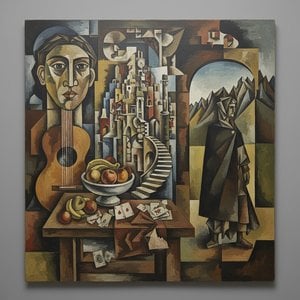
Pablo Picasso's "Teenagers" (1906), currently residing within the Lehmbruck Museum in Duisburg, Germany, is far more than a simple portrait of two young boys. It’s a poignant exploration of youth, innocence, and the burgeoning complexities of human connection, rendered through the lens of Symbolism and foreshadowing Picasso's revolutionary Cubist style. The painting immediately draws the eye with its muted palette – predominantly blues and browns – creating an atmosphere of quiet contemplation and understated emotion. The boys themselves are depicted in a remarkably naturalistic manner for a period marked by experimentation, yet their poses and expressions hint at a deeper narrative, inviting viewers to contemplate their individual stories.
The composition is deceptively simple: two young men stand side-by-side, one seated with his legs crossed, the other upright. A subtle but significant detail lies in the presence of vases – not merely decorative elements, but potent symbols within Picasso’s artistic vocabulary. These vessels represent growth, development, and the passage of time, subtly suggesting a narrative arc for these young figures. The arrangement itself feels deliberate, almost staged, as if capturing a fleeting moment from a family portrait or perhaps an artistic study. The careful positioning of each boy, coupled with the restrained use of light and shadow, contributes to a sense of intimacy and quiet observation.
Influences and Artistic Style
“Teenagers” firmly establishes Picasso’s transition into Symbolism, a movement characterized by its emphasis on subjective emotion and the use of symbolic imagery rather than literal representation. This shift is evident in his departure from purely naturalistic depictions, opting instead for a more expressive approach to form and color. The painting's roots can also be traced back to Picasso’s earlier work during the Blue and Rose Periods, particularly his exploration of themes related to childhood and adolescence. The influence of Spanish masters like Velázquez and Goya is palpable in the careful observation of anatomy and the use of light – techniques that Picasso skillfully adapted to his own unique vision.
Crucially, “Teenagers” demonstrates a nascent interest in Cubism, which Picasso would later fully develop. The fragmented forms and multiple perspectives hinted at within the painting’s composition—particularly in the way the boys are viewed from slightly different angles—are precursors to the revolutionary techniques that would define his groundbreaking work. This early experimentation with spatial relationships foreshadows the deconstruction of form and the exploration of new ways of seeing that characterize Cubism.
Historical Context and Significance
The painting’s creation coincided with a period of significant social and political upheaval in Europe, marked by the rise of nationalism and the growing tensions leading up to World War I. Picasso's work during this time often reflected these anxieties, grappling with themes of identity, displacement, and the fragility of human existence. The Lehmbruck Museum’s collection, which prominently features modern sculpture, provides a valuable context for understanding “Teenagers” within the broader landscape of 20th-century art. Picasso's exploration of youth and innocence can be seen as a counterpoint to the prevailing sense of disillusionment and uncertainty that characterized the era.
Recreating Picasso’s Vision: A High-Quality Reproduction
ArtsDot.com offers meticulously crafted oil painting reproductions of “Teenagers,” allowing art enthusiasts to bring this captivating masterpiece into their own homes. Our skilled artisans painstakingly recreate every detail, from the subtle nuances of color to the delicate brushstrokes that define Picasso’s style. These reproductions are not merely copies; they are faithful interpretations that capture the essence and emotional impact of the original painting. Investing in a reproduction is an opportunity to appreciate Picasso's genius while adding a touch of timeless elegance to your interior space. Visit /art/list/?Filter=8XYPHF-Pablo-Picasso-Teenagers for more information and to secure your own reproduction of this iconic work.
Fragen & Antworten
Welche Stimmung und welche Emotionen vereinen sich in "Junge/Mädchen"?
In "Junge/Mädchen" begleitet eine Zeitlos elegant-Stimmung eine Melancholisch Emotion.
In welcher Phase der Karriere von Pablo Picasso lässt sich „Junge/Mädchen“ angesichts seines Entstehungsdatums einordnen?
Angesichts seiner Datierung auf 1906 fällt "Junge/Mädchen" in die Symbolism, Cubism von Pablo Picasso.
Wie alt war Pablo Picasso, als „Junge/Mädchen“ geschaffen wurde?
Pablo Picasso war 25 Jahre alt, als Junge/Mädchen im Jahr 1906 geschaffen wurde. Das Alter berechnet sich aus dem Geburtsjahr des Künstlers, 1881.
Ähnliche Kunstwerke


Biografie des Künstlers
Pablo Picasso: Ein revolutionärer Künstler
Frühes Leben und Ausbildung (1881-1904)
- Geboren am 25. Oktober 1881 in Málaga, Spanien, zeigte Pablo Ruiz y Picasso von sehr jungem an sein künstlerisches Talent.
- Sein Vater, José Ruiz y Blasco, war Kunstlehrer und gab seinem Sohn eine frühe Ausbildung. Es heißt, Picassos erste Worte waren “piz, piz” – ein Versuch, ‘Bleistift’ zu sagen.
- Picasso übertraf seine Vaters Fähigkeiten schnell und zeigte bemerkenswerte Begabung in naturalistischen Darstellungen.
- Die Familie zog nach A Coruña und später nach Barcelona nach dem tragischen Verlust Picassos Schwester.
- In Barcelona besuchte er die Kunsthochschule, störte sich aber oft an der traditionellen akademischen Lehre. Er studierte kurzzeitig an der Königlichen Akademie San Fernando in Madrid und fand es beengend, bevorzugte aber das unabhängige Studium von Meistern wie Velázquez und Goya.
Die Blauen und Rosafarbenen Perioden (1901-1906)
- Die Blaue Periode (ungefähr 1901-1904) ist durch düstere Gemälde geprägt, die von Blautönen und Blaugrün dominiert werden.
- Diese Werke stellen oft marginalisierte Figuren dar – Bettler, blinde Menschen, Prostituierte – und spiegeln Melancholie und sozialen Kommentar wider. Wichtige Beispiele sind La Vie (1903) und Der alte Gitarrist (1903-1904).
- Nachfolgend entstand die Rosafarbene Periode (1904-1906) mit wärmeren Tönen – Rosa-, Orange- und Rottönen.
- Diese Periode spiegelt eine optimistischere Sichtweise wider und stellt oft Zirkusclowns, Harlekinen und Akrobaten dar. Familie der Saltimbanques (1905) ist ein Beispiel dafür.
Die revolutionären Jahre: Kubismus und darüber hinaus (1907-1919)
- 1907 markierte einen Wendepunkt mit Les Demoiselles d'Avignon, der von iberischer Skulptur und afrikanischen Masken beeinflusst wurde. Dieses Gemälde zerstörte die traditionelle Perspektive und ebnete den Weg für den Kubismus.
- Picasso arbeitete eng mit Georges Braque zusammen und gründete den Kubismus, der die Art und Weise, wie Künstler Realität darstellten, grundlegend veränderte.
- Analytischer Kubismus (1909-1912) zeichnete sich durch fragmentierte Formen, gedämpfte Farben und die Zerlegung von Objekten in geometrische Formen aus.
- Synthetischer Kubismus (1912-1919) integrierte Collagen – Zeitungsartikel, Stoffreste – um texturierte Oberflächen und neue visuelle Schichten zu schaffen.
Neoklassizismus und Surrealismus (1920er - 1930er Jahre)
- In den 1920er Jahren erkundete Picasso neoklasische Stile mit monumentalen Figuren, die klassische Formen betonten.
- Er beschäftigte sich auch mit dem Surrealismus, obwohl er sich nie vollständig mit dessen Prinzipien identifizierte. Seine Werke vermischten frühere Stile mit surrealistischer Bildsprache und verzerrten Perspektiven.
Spätere Jahre und Vermächtnis (1940-1973)
- Während des Zweiten Weltkriegs blieb Picasso in Frankreich und produzierte kraftvolle Antikriegserklärungen wie Guernica (1937), eine wirkliche Reaktion auf den Angriff auf Guernica während des Spanischen Bürgerkriegs.
- Guernica wurde zu einem bleibenden Symbol der Schrecken des Krieges und gilt als eines seiner bekanntesten Werke.
- In den 1950er und 60er Jahren experimentierte Picasso weiterhin mit verschiedenen Medien – Keramik, Skulptur, Druckgrafik – und demonstrierte bemerkenswerte Vielseitigkeit.
- Er heiratete Jacqueline Roque im Jahr 1961. Er starb am 8. April 1973 in Mougins, Frankreich.
Einflüsse und historische Bedeutung
- Picassos künstlerische Entwicklung wurde von spanischen Meistern wie Velázquez und Goya, iberischer Skulptur, afrikanischer Kunst und Henri Matisse geprägt.
- Sein Einfluss auf die Kunst des 20. Jahrhunderts ist unermesslich. Er gründete den Kubismus, pionierte Collagen und konstruktive Skulpturen und stellte traditionelle künstlerische Konventionen kontinuierlich in Frage.
- Picassos unerbittliche Experimentierfreude definierte die moderne Kunst neu und inspiriert Künstler bis heute.
- Seine fruchtbare Produktion – geschätzt auf über 50.000 Werke – festigt seine Position als einer der wichtigsten und einflussreichsten Künstler in der Geschichte.

Pablo Picasso
1881 - 1973 , Spanien
Eckdaten zum Künstler
- Beeinflusste Künstler:
- Velázquez
- Goya
- Henri Matisse
- Bemerkenswerte Werke:
- Les Demoiselles d'Avignon
- Guernica
- Der alte Gitarrist
- Familie der Saltimbanques
- Geburtsdatum: 25. Oktober 1881
- Geburtsort: Málaga, Spanien
- Künstlerische Richtung: Kubismus, Surrealismus
- Nationalität: Spanisch
- Sterbedatum: 8. April 1973
- Vollständiger Name: Pablo Picasso
- Von Künstlern Beeinflusst:
- Iberische Skulptur
- Afrikanische Kunst
Verwandte Artikel

Pablo Picasso: Eine revolutionäre Vision – Kubismus, Symbolik und bleibendes Erbe
Entdecken Sie Pablo Picassos revolutionäres Werk! Analysen zu Kubismus, Symbolik und seinem bleibenden Einfluss auf die moderne Kunst. Wertvolle Einblicke für Sammler & Kenner.
Kubismus: Die 10 Meisterwerke, die eine Revolution definierten | ArtsDot
Entdecken Sie die 10 Meisterwerke des Kubismus! Von Picasso bis Braque – erleben Sie die Revolution abstrakter Kunst. Kunstdrucke & Wandbilder für Ihr Zuhause auf ArtsDot.com.

Die 10 Meisterwerke des Kubismus: Revolutionäre Porträts für Ihr Zuhause | ArtsDot
Entdecken Sie die 10 revolutionärsten kubistischen Porträts von Picasso, Braque & Co.! Erfahren Sie die Geschichten hinter Meisterwerken der Moderne und lassen Sie sich für Ihre Wohnraumgestaltung inspirieren. Museum-Qualität bei ArtsDot.

Deconstructing Reality: Cubism's Revolutionary Impact on 20th-Century Art
Explore the revolutionary world of Cubism with ArtsDot. Discover Picasso & Braque's groundbreaking techniques, its philosophical roots, and lasting impact on modern art. Expert insights for collectors.

Die 10 Meisterwerke des Kubismus: Kunst für Ihr Zuhause | ArtsDot
Entdecken Sie die 10 bedeutendsten Meisterwerke des Kubismus von Picasso, Braque & Gris! Erfahren Sie mehr über Kunstgeschichte, Techniken und Farben. Hochwertige Kunstdrucke auf ArtsDot.com – für stilvolle Wandgestaltung.


