


 In echtem Maßstab anzeigen
 Versenden als Grußkarte
 Teilen
 Details anzeigen
 Leitfaden

 Herunterladen
 Ähnliche Objekte
 Röntgenaufnahme
 Diashow
 Besucherstatistiken
Noah und die Arche Noah's Ark
 Acryl auf Leinwand
- Wandkunst
- Surrealism
 1963
1963- Moderne
 33.0 x 28.0 cm
 Mehr anzeigen
Handgefertigte Ölreproduktion
Handgemaltes Ölgemälde auf Leinwand in Ihrer Wunschgröße und mit Rahmen, auf Bestellung von unseren Künstlern angefertigt. ( Zum Druck wechseln Zum digitalen Bild wechseln)




P118B $10

P118H $10

P118W $10

P438Z $10

P508JH $12

P508YH $12

P805H $10

P805Z $10

P919BZ $10

P919G $10

P919XJ $10

P959ZH $10

P968JZ $12

W106C $8

W218G $10

W218JH $8

W218Y $10

W307PJ $10

W316G $10

W316PJ $8

W316Y $10

W398PJ $8

W4111J $10

W500HY $15

W500JH $15

W692G $12

W849H $8

W940BG $15

W953PJ $8




Wählen Sie aus unseren vordefinierten Formaten, die den ursprünglichen Proportionen des Kunstwerks entsprechen.

Sie können Ihre eigenen Maße eingeben, um einen bestimmten Rahmen oder Platz auszufüllen. Wenn die gewählte Größe nicht den Proportionen des Originalbildes entspricht, werden wir das Kunstwerk entweder beschneiden oder das Gemälde durch zusätzliche, handgemalte Elemente erweitern. Ein digitales Mockup wird Ihnen zur Genehmigung zugesandt, bevor die Produktion beginnt.
Bitte beachten Sie, dass die Bildschirmvorschau nicht die tatsächliche Beschneidung oder Erweiterung widerspiegelt. Nur das Mockup zeigt die endgültige Komposition exakt an.
Obwohl Sondermaße verfügbar sind, empfehlen wir, eine Größe aus der vordefinierten Liste zu wählen, um die ursprünglichen Proportionen beizubehalten.
Nach der Bestellung wird das ArtsDot.com-Team dem Kunden Anweisungen per E-Mail zusenden und eine Mockup-Vorschau bereitstellen.
Weltweiter Versand () in nur 3 bis 4 Wochen statt der üblichen 5 Wochen. (22 September). Keine Kompromisse bei der Qualität.

Kostenloser weltweiter Expressversand

Hochwertige Leinenleinwand

Vollständiger Versicherungsschutz beim Versand

Zollgebühren-Rückerstattungsgarantie

Garantie für exakte Farbtreue

100-tägiges Rückgaberecht (nur bei Mängeln)

100% Geld-zurück-Garantie

Angebot für Mengenrabatt
 Die Glasoption ist nur für Größen unter 110 cm verfügbar.

Noah und die Arche Noah's Ark
Reproduktionsmedium
Format der Reproduktion
-


Gesamtpreis
$ 263
A Sanctuary of Dreams: Exploring Marc Chagall’s ‘Noah's Ark’
Marc Chagall’s ‘Noah's Ark’, painted in 1963, is not merely an illustration of the biblical tale; it’s a vibrant distillation of memory, faith, and the enduring human spirit. Measuring a delicate 33 x 28 cm, this work possesses an intimacy that belies its grand subject matter. Chagall doesn't present us with a literal depiction of the flood or the ark’s construction. Instead, he offers a dreamscape – a swirling vortex of color and form populated by animals both familiar and fantastical, all sheltered within the embrace of the vessel. The painting is a testament to his unique artistic language, born from a childhood steeped in the folklore and religious traditions of Vitebsk, Belarus. It’s a style that defies easy categorization, drawing upon elements of Cubism, Symbolism, and Fauvism, yet remaining distinctly, undeniably Chagall.The Language of Symbols: A Visual Testament
To understand ‘Noah's Ark’, one must delve into the symbolic world that Chagall so masterfully constructed throughout his career. The ark itself isn’t portrayed as a sturdy, seaworthy vessel but rather as an almost ethereal haven, overflowing with life. Animals – cows, sheep, goats, horses, birds – are not arranged realistically; they seem to float and intertwine, representing the universal salvation offered by Noah. These creatures weren't simply chosen at random; each held significance within Jewish tradition and Chagall’s personal iconography. The presence of multiple figures, some standing, others reclining, suggests a collective humanity finding refuge from impending doom. A smaller boat in the background hints at the vastness of the flood and perhaps, the enduring hope for renewal. Even the bird soaring above isn't just an avian detail; it embodies freedom, peace, and the promise of a new beginning – a recurring motif throughout Chagall’s oeuvre. The painting is not about the disaster itself but about the preservation of life and the resilience of spirit in the face of adversity.Chagall’s Technique: A Symphony of Color and Form
Chagall's technique in ‘Noah's Ark’ is as captivating as its subject matter. He employs a vibrant palette, layering colors with a delicate touch that creates a luminous quality. The pastel medium allows for a fluidity and softness that perfectly complements the dreamlike atmosphere of the scene. Forms are simplified and often distorted, prioritizing emotional expression over strict realism. This deliberate distortion isn’t a flaw but rather a key element of his style – it imbues the painting with a sense of movement and energy. Chagall's brushstrokes aren’t hidden; they contribute to the overall texture and vibrancy of the work, revealing the artist’s hand in every detail. It is this masterful manipulation of color and form that allows him to convey not just what he *sees*, but what he *feels* about the story of Noah.A Legacy of Hope: Chagall and the Biblical Narrative
Chagall's engagement with biblical themes wasn’t accidental. Born into a Hasidic Jewish family, he was deeply familiar with the stories and traditions of his faith. In his later years, particularly after witnessing the horrors of World War II, these narratives took on new resonance. He created an entire series of paintings inspired by the Bible in the 1950s and 60s, culminating in the stunning stained-glass windows for the Hadassah Hospital Synagogue in Jerusalem. ‘Noah's Ark’ is a pivotal piece within this body of work, representing Chagall’s profound belief in the enduring power of hope and redemption. It stands as a testament to his ability to transform ancient stories into timeless works of art that continue to inspire and move audiences today. The painting isn’t just a depiction of a biblical event; it’s a universal message about survival, faith, and the beauty of life itself.Exploring the Dreamscape
The artist’s decision to abandon realistic representation in favor of expressive abstraction speaks volumes about Chagall's artistic vision. He sought to capture not merely what he observed but what he experienced emotionally—a profound yearning for solace amidst chaos. The swirling colors and distorted shapes aren’t random; they are deliberate choices designed to evoke a sense of wonder and spiritual contemplation. Consider the dominant hues: blues and greens dominate, symbolizing tranquility and renewal, while bursts of reds and yellows inject energy and passion into the composition. These colors harmonize with each other, creating an overall impression of warmth and optimism—a reflection of the biblical narrative’s core message of deliverance from despair.Symbolic Figures and Their Roles
The figures inhabiting the ark are equally laden with symbolism. Chagall portrays them in a manner that transcends mere anatomical accuracy; instead, he presents them as stylized representations of humanity itself. The central figure—often interpreted as Noah—is depicted in repose, embodying humility and acceptance of divine providence. Surrounding him are other individuals, some standing upright, others reclining peacefully, symbolizing the collective human spirit united in faith. Notably, Chagall incorporates elements from Jewish folklore and mythology into his depiction of these figures, enriching the narrative’s symbolic dimension. The bird ascending above represents freedom and aspiration—a visual embodiment of the promise of a new dawn after the floodwaters recede.The Pastel Medium: Softness and Luminosity
Chagall's masterful use of pastel contributes significantly to the painting's ethereal quality. Unlike oil paints, pastels offer unparalleled softness and luminosity, allowing for subtle gradations of color and texture that heighten the dreamlike atmosphere. The artist meticulously blends pigments onto paper with soft brushes, creating a velvety surface that captures light beautifully—a technique particularly suited to conveying emotion and capturing fleeting impressions. This deliberate choice underscores Chagall’s desire to express not just visual reality but also inner feeling—a hallmark of his artistic style."Ähnliche Kunstwerke


Biografie des Künstlers
Marc Chagall: Ein Leben in Farbe und Vorstellungskraft
Frühes Leben und Einflüsse
- Geburt und Hintergrund: Marc Zakharowitsch Chagall wurde am 6. Juli 1887 (O.S. 24. Juni) in Liozna, nahe Witebsk, Weißrussland, in einer hasidischen jüdischen Familie geboren.
- Die Wirkung von Witebsk: Seine Kindheit in Witebsk, bekannt als das „Russische Toledo“, prägte seine künstlerische Vision maßgeblich. Die einzigartige Mischung aus Kulturen und die malerische Landschaft – Kirchen, Synagogen, belebte Märkte – wurden wiederkehrende Motive in seinem Werk.
- Frühes künstlerisches Talent: Trotz der bescheidenen Mittel seiner Familie zeigte Chagall schon früh ein Talent für Kunst, lernte zunächst bei einem lokalen Schilderermaler und verfolgte dann eine formale Ausbildung.
Künstlerische Entwicklung und Stil
- Frühe Ausbildung: Er studierte in St. Petersburg bei Léon Bakst und später in Paris an der Académie de la Grande Chaumière, wo er sich mit avantgardistischen Bewegungen auseinandersetzte.
- Stilistische Verschmelzung: Chagalls Stil ist eine einzigartige Synthese verschiedener Einflüsse. Er übernahm Elemente aus dem Kubismus, der Symbolik und dem Fauvismus, aber passte sich nie vollständig einer einzelnen Bewegung an und schmiedete seinen eigenen, unverwechselbaren Weg.
- Wesentliche Merkmale: Sein Werk ist durch lebendige Farben, traumhafte Bilder, fantastische Kreaturen und ein Gefühl der Nostalgie für seine Kindheit in Witebsk gekennzeichnet. Oft sind schwebende Figuren, verzerrte Perspektiven und symbolische Darstellungen zu sehen.
Wichtige Werke und Leistungen
- Frühe Meisterwerke: Gemälde wie „Ich und das Dorf“ (1911) demonstrieren seine frühe Erkundung von Erinnerung, Identität und der Beziehung zwischen dem Einzelnen und der Gemeinschaft.
- Russische Revolution & Rückkehr nach Witebsk: Nach der Russischen Revolution kehrte Chagall nach Witebsk zurück und engagierte sich in kulturellen Initiativen, gründete eine Kunstschule. Bald wurde er jedoch von den Beschränkungen des neuen Regimes enttäuscht.
- Internationale Anerkennung: Er zog schließlich nach Frankreich und etablierte sich dort erfolgreich. Bedeutende Werke dieser Zeit sind „Über Witebsk“ (1920-1922) und zahlreiche Gemälde, die von biblischen Geschichten inspiriert sind, wie z. B. „Jakobs Traum“.
- Spätere Aufträge: Chagall erhielt im späteren Leben bedeutende Aufträge, darunter das Deckenfresko des Pariser Opernhauses (1964), Fensterglasfenster für die Synagoge des Hadassah Hebrew University Medical Center in Jerusalem und die Reims Kathedrale.
Einflüsse und Vermächtnis
- Künstlerische Einflüsse: Er wurde von Künstlern wie Vladimir Lukich Borowikowski, dessen Porträts er bewunderte, sowie den breiteren Strömungen der frühen Moderne beeinflusst.
- Einfluss auf nachfolgende Künstler: Chagalls Werk hat Generationen von Künstlern mit seiner lyrischen Qualität, emotionaler Tiefe und immensen Vorstellungskraft inspiriert. Sein Einfluss ist in Surrealismus und anderen Bewegungen zu sehen, die Fantasie und Symbolik umarmten.
- Historische Bedeutung: Er gilt als eine der wichtigsten Figuren der Kunst des 20. Jahrhunderts, die den Übergang zwischen europäischer Moderne und jüdischer kultureller Identität schloss. Seine Fähigkeit, persönliche Erfahrungen, Folklore und universelle Themen zu synthetisieren, resonnieren weiterhin weltweit bei Publikum.
- Der „Typische jüdische Künstler“: Chagall wird oft als der „typische jüdische Künstler des 20. Jahrhunderts“ bezeichnet, aufgrund seiner wiederholten Auseinandersetzung mit jüdischen Themen, Traditionen und Erfahrungen in seinem Kunstwerk.
Tod und Erinnerung
- Letzte Jahre: Marc Chagall malte und schuf bis zu seinem Tod am 28. März 1985 im Alter von 97 Jahren in Saint-Paul-de-Vence, Frankreich, weiter.
- Nachhaltiges Vermächtnis: Sein Werk wird in wichtigen Museen auf der ganzen Welt ausgestellt und sichert so, dass seine lebendige und fantasievolle Vision auch für zukünftige Generationen Kunstliebhaber inspiriert und fesselt.
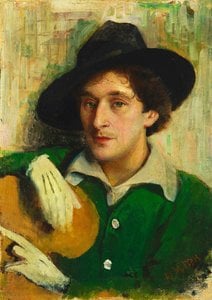
Marc Chagall
1887 - 1985 , Belarus
Eckdaten zum Künstler
- Beeinflusste Künstler: ['Surrealismus']
- Bemerkenswerte Werke:
- Ich und das Dorf
- Über Witebsk
- Jakobs Traum
- Die Schleierkistel
- Freilassung
- Erdbeeren Bella und Ida am Tisch
- Neulich verheiratete Paare mit Paris
- Tschitschikows Abschied von Manilow
- Der Hahn
- Geburtsdatum: 06. Juli 1887
- Geburtsort: Liozna, Belarus
- Künstlerische Einflüsse: ['Vladimir Lukich Borovikovsky']
- Künstlerischer Stil: Kubismus, Symbolismus, Fauvismus
- Nationalität: Russisch, Französisch
- Todatum: 28. März 1985
- Vollständiger Name: Marc Chagall
Verwandte Artikel
Kubistischer Expressionismus: Die 10 Meisterwerke, die eine Kunstrevolution prägten | ArtsDot
Entdecken Sie die 10 prägendsten Meisterwerke des Kubismus & Expressionismus! Erfahren Sie die Geschichten von Picasso, Braque und mehr. Kunstdrucke in Museumsqualiät für Ihr Zuhause – jetzt auf ArtsDot.com!

Franz Marc: Expressionismus, Spiritualität und die Tier-Symbolik eines modernen Meisters
Entdecken Sie das faszinierende Werk von Franz Marc! Erfahren Sie mehr über seine spirituelle Kunst, die Tierdarstellungen und seinen Einfluss auf den Expressionismus. Expertenanalyse & Hintergrundinformationen.
Figurative Expressionism: Emotional Intensity & Subjective Reality in 20th-Century Art
Explore the powerful world of Figurative Expressionism with ArtsDot. Discover key artists like Kirchner & Beckmann, understand its emotional depth, and learn how to collect this influential 20th-century art movement.

Deutsche Expressionismus Meisterwerke: Die 10 wichtigsten Kunstwerke für Ihr Zuhause
Entdecken Sie die 10 bedeutendsten Werke des Deutschen Expressionismus! Kirchner, Nolde & Co. – ihre Geschichten, Techniken und zeitlose Schönheit. Hochwertige Kunstdrucke auf ArtsDot.com kaufen und Ihr Zuhause mit emotionaler Kunst bereichern. Jetzt entdecken!

Unlocking Emotion: A Beginner's Guide to the Raw Power of Symbolic Expressionism Art
Discover the raw emotion of Symbolic Expressionism. Our expert guide explores how masters like Munch use color and form to convey inner feelings, offering inspiration for collectors looking to bring powerful, soulful art into their modern homes.


