

 Vorschau anzeigen
 Versenden
 Teilen
 Details anzeigen
 Leitfaden

 Herunterladen
 Ähnliche Objekte
 Röntgenaufnahme
 Diashow
 Fragen & Antworten
 Statistiken
Bacchante


 Weiterlesen
Giclée / Kunstdruck
Giclée- oder Leinwanddruck in Museumsqualität mit schneller Produktion und flexiblen Veredelungsoptionen. ( Handgemalte Reproduktion bestellen Zum digitalen Bild wechseln)




P118B €10

P118H €10

P118W €10

P438Z €10

P508JH €12

P508YH €12

P805H €10

P805Z €10

P919BZ €10

P919G €10

P919XJ €10

P959ZH €10

P968JZ €12

W106C €8

W218G €10

W218JH €8

W218Y €10

W307PJ €10

W316G €10

W316PJ €8

W316Y €10

W398PJ €8

W4111J €10

W500HY €15

W500JH €15

W692G €12

W849H €8

W940BG €15

W953PJ €8




Wählen Sie aus unseren vordefinierten Formaten, die den ursprünglichen Proportionen des Kunstwerks entsprechen.

Geben Sie die benötigte Breite und Höhe an, damit der Druck perfekt in Ihren Rahmen oder an Ihre Wand passt. Ein Druck kann nur beschnitten, aber niemals größer als das Originalbild angefertigt werden; daher verliert ein Format mit anderen Proportionen einen Teil des Bildes. Wir senden Ihnen ein digitales Mockup zur Freigabe, bevor wir den Druck ausführen. Das auf dieser Seite gezeigte Bild zeigt nicht den tatsächlichen Beschnitt – dies ist nur im Mockup ersichtlich.
Weltweiter Versand () innerhalb von 2 Wochen statt der üblichen 4/5 Wochen. (6 November)

Kostenloser weltweiter Expressversand

Hochwertige Leinenleinwand

Umfassender Versicherungsschutz beim Versand

Zollgebühren-Rückerstattungsgarantie

Garantie für exakte Farbtreue

100 Tage Rückgaberecht (nur bei Mängeln)

100% Geld-zurück-Garantie

Mengenrabatt verfügbar
 Die Glasoption ist nur für Größen unter 110 cm verfügbar.

Bacchante
Giclée / Kunstdruck
Format der Reproduktion
-


Endpreis
€ 56
A Moment of Quietude: Exploring Sorolla’s ‘Bacchante’
Joaquín Sorolla y Bastida's “Bacchante” offers a captivating glimpse into the artist’s masterful command of light and his profound understanding of the human form. This evocative painting, depicting a reclining nude woman within a richly appointed interior, is a quintessential example of Sorolla’s signature style – one characterized by an almost palpable sense of warmth, luminosity, and a deeply felt connection to the Spanish landscape. The scene, seemingly simple in its composition, unfolds with a remarkable sensitivity to texture, color, and spatial depth, inviting the viewer into a private moment of repose.
- Subject Matter: The central figure, a woman lost in slumber or quiet contemplation, embodies Sorolla’s fascination with the female nude. Unlike many depictions of the classical nude, however, this is not an idealized representation; rather, it's a portrait of vulnerability and peacefulness, suggesting a deeply personal experience.
- Technical Brilliance: Sorolla’s technique is immediately recognizable – a rapid, almost impressionistic brushstroke that captures the fleeting effects of light with breathtaking accuracy. The use of *alla prima* (wet-on-wet) painting allows for an immediacy and vibrancy rarely achieved in traditional academic styles.
- Color Palette: The dominant red background isn't merely decorative; it’s a crucial element, intensifying the warmth of the scene and creating a dramatic contrast that draws attention to the figure. Sorolla expertly employs complementary colors – the reds and blues – to heighten visual impact and create a sense of dynamism within the stillness.
The Valencia School and the Influence of Rome
Sorolla’s artistic journey was profoundly shaped by his time in Valencia and, crucially, his subsequent studies in Rome. Returning from Italy in 1889, he embraced the lessons learned from masters like Raphael and Titian, incorporating elements of classical composition and color theory into his own distinctive style. However, unlike many artists who simply replicated Italian techniques, Sorolla infused them with a distinctly Spanish sensibility – a passion for light, color, and the vibrancy of everyday life. The influence of the *macchiaioli*, a group of Florentine painters known for their loose brushwork and emphasis on direct observation, is also evident in his approach to capturing fleeting moments and atmospheric effects.
- Historical Context: “Bacchante” was painted during a period of significant artistic innovation in Spain. The *macchiaioli* movement challenged the prevailing academic style, advocating for a more direct and expressive approach to painting. Sorolla’s work exemplifies this shift, demonstrating a willingness to experiment with new techniques and subject matter.
- Roman Influence: His time in Rome exposed him to the grandeur of classical sculpture and architecture, which informed his understanding of form and composition. The careful arrangement of objects within the room – the chair, vase, and other details – reflects this influence.
Symbolism and Emotional Resonance
Beyond its technical brilliance, “Bacchante” possesses a subtle yet powerful emotional resonance. The scene evokes a sense of tranquility, intimacy, and perhaps even melancholy. The reclining figure suggests a moment of vulnerability and introspection, inviting the viewer to contemplate themes of beauty, mortality, and the fleeting nature of time. The red background, often associated with passion and vitality, here serves as a counterpoint to the quietude of the scene, adding another layer of complexity to its interpretation.
- Interior as Stage: The room itself functions almost as a stage, framing the figure and contributing to the overall atmosphere. The carefully chosen objects – the chair, vase – suggest a life of comfort and refinement, further enhancing the sense of intimacy.
- Light as Emotion: Sorolla’s masterful use of light is central to the painting's emotional impact. It doesn’t simply illuminate the figure; it imbues her with warmth, vitality, and an almost ethereal quality.
A Legacy of Light
Joaquín Sorolla’s “Bacchante” stands as a testament to his extraordinary talent and vision. This painting exemplifies his ability to capture not just the appearance of things but also their essence – the warmth, light, and emotion that make them truly beautiful. A hand-painted reproduction offers an unparalleled opportunity to experience the full impact of this masterpiece, bringing its radiant beauty into your home or studio.
Fragen & Antworten
Aus welcher Schaffensperiode von Joaquín Sorolla y Bastida stammt "Bacchante"?
„Bacchante“ entstammt der Mature Period von Joaquín Sorolla y Bastida. Diese Einordnung setzt das Werk in Bezug zur künstlerischen Entwicklung des Künstlers.
Wie wirkt die Helligkeit von "Bacchante" von Joaquín Sorolla y Bastida?
Insgesamt wird „Bacchante“ mit einer Helligkeit von bright erfasst. Die wahrgenommene Helligkeit beschreibt, wie hell oder dunkel das Werk erscheint.
Welche Farben dominieren in "Bacchante" von Joaquín Sorolla y Bastida?
Die Farbidentität von "Bacchante" von Joaquín Sorolla y Bastida: eine Dark-Palette, dominiert von Putty (#d5bb9f).
Ähnliche Kunstwerke


Künstlerbiografie
Frühes Leben und Ausbildung
Joaquín Sorolla y Bastida, ein renommierter spanischer Maler, wurde am 27. Februar 1863 in Valencia, Spanien, geboren. Er war der älteste Sohn von Joaquín Sorolla, einem Kaufmann, und Concepción Bastida. Nach dem frühen Verlust seiner Eltern im Alter von zwei Jahren wuchs er bei seiner Tante und ihrem Ehemann auf. Seine künstlerische Reise begann in seiner Heimatstadt, wo er bereits mit neun Jahren eine erste Kunstausbildung erhielt. Später studierte er unter der Leitung von Cayetano Capuz, Salustiano Asenjo und José Benlliure in Rom. Ein viereinhalbjähriges Stipendium ermöglichte ihm ein Studium des Malens in Rom, Italien, wo er stark von Francisco Pradilla beeinflusst wurde.Künstlerische Entwicklung und Stil
Sorollas Werk zeichnet sich durch einen einzigartigen Realismus aus, der Elemente des Impressionismus aufgreift. Er war bekannt für seine Fähigkeit, Licht und Farbe meisterhaft einzusetzen, um lebendige und atmosphärische Szenen zu schaffen. Seine frühen Werke zeigten Einflüsse des etablierten spanischen Malstils, während er später seinen eigenen unverwechselbaren Stil entwickelte, der sich durch eine lockere Pinselführung und eine strahlende Farbpalette auszeichnete. Er bevorzugte das Malen im Freien (plein air), um die natürlichen Lichtverhältnisse optimal zu nutzen. Sein Fokus lag oft auf Alltagsszenen, Porträts und insbesondere Strandbildern, die er mit großer Detailtreue und Lebendigkeit festhielt.Wichtige Werke und Errungenschaften
Sorolla schuf eine beeindruckende Anzahl von Werken, die seine künstlerische Meisterschaft demonstrieren. Zu seinen bekanntesten Gemälden gehören:- Italienisches Mädchen mit Blumen (Öl auf Leinwand), das Sorollas Fähigkeit zeigt, die Essenz seiner Motive einzufangen.
- Badezeit (Realismus, Öl), ein Beispiel für seine Balance aus Licht und Farbe.
- Der Sklavenhandel (Sorolla Museum, Madrid, Spanien, Öl auf Leinwand), ein seltenes Beispiel für sozialrealistische Kunst in Sorollas Werk.
Einfluss und Vermächtnis
Joaquín Sorolla gilt als einer der bedeutendsten spanischen Maler des 19. und frühen 20. Jahrhunderts. Sein Werk trug maßgeblich zur Entwicklung des spanischen Realismus und Impressionismus bei. Seine Fähigkeit, das Licht der mediterranen Sonne einzufangen und in seinen Gemälden wiederzugeben, machte ihn zu einem international gefeierten Künstler. Sorolla beeinflusste zahlreiche nachfolgende Maler und seine Werke werden heute in renommierten Museen auf der ganzen Welt ausgestellt. Das Sorolla Museum in Madrid, das sein ehemaliges Haus und Atelier beherbergt, ist ein zentraler Ort für die Bewahrung und Präsentation seines Werkes. Sein Vermächtnis lebt fort als Inspiration für Künstler und Kunstliebhaber gleichermaßen.Spätere Jahre und Tod
Obwohl Sorolla im Alter von 60 Jahren am 23. August 1923 in Cercedilla, Spanien, verstarb, hinterließ er ein beeindruckendes Œuvre und einen bleibenden Eindruck in der Kunstgeschichte. Seine Werke werden bis heute für ihre Lebendigkeit, Detailtreue und die meisterhafte Darstellung des Lichts geschätzt.
Joaquín Sorolla y Bastida
1863 - 1923 , Spanien
Kurzinfos
- Bemerkenswerte Werke:
- Italienisches Mädchen mit Blumen
- Badezeit (Realismus)
- Der weiße Sklavenhandel
- Strand bei Biarritz
- Das Gelbe Rosenbusch
- Einflussreiche Künstler: ['Francisco Pradilla']
- Geburtsdatum: 27. Februar 1863
- Geburtsort: Valencia, Spanien
- Künstlerische Richtung: Realismus, Luminismus
- Nationalität: Spanisch
- Sterbedatum: 1923
- Vollständiger Name: Joaquín Sorolla y Bastida
Ähnliche Artikel
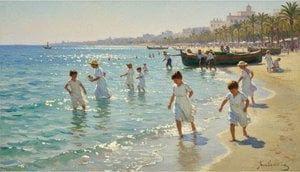
Joaquín Sorolla y Bastida: Meister des Lichts – Ein spanischer Impressionist im Fokus
Entdecken Sie das faszinierende Werk von Joaquín Sorolla y Bastida, dem Meister des spanischen Impressionismus! Erfahren Sie mehr über seine Technik, sein Leben und seine ikonischen Gemälde. Jetzt lesen!

Echoes of Time: Exploring the Enduring Appeal & Historical Context of Vintage Art Prints
Explore the captivating world of vintage art prints! Discover their history, collecting tips & enduring appeal. Expert insights on chromolithography and building a legacy collection with ArtsDot.

The Enduring Legacy of Fine Art Prints: Technique, History & Aesthetic Impact
Explore the rich history & techniques of fine art prints. Discover investment potential, assess authenticity, and learn how to preserve your collection with expert guidance. Trusted insights for discerning collectors.

Crimson Threads of Narrative: Exploring Symbolism & Representation in Artworks Featuring the Red Dress
Explore the rich symbolism of the red dress in art history! From ancient power displays to iconic portraits like Cézanne’s 'Madame Cezanne', discover the cultural and artistic significance behind this captivating color. Expert analysis & insights.

Giclée-Prints: Hochwertige Kunstreproduktionen mit Archivqualität für Ihr Zuhause
Erfahren Sie alles über die Archivqualität und Technik echter Giclée-Drucke. Jetzt Expertenwissen für Ihre Kunstsammlung entdecken!


