


 In echtem Maßstab anzeigen
 Versenden als Grußkarte
 Teilen
 Details anzeigen
 Leitfaden öffnen

 Herunterladen
 Ähnliche Objekte
 Röntgenaufnahme
 Diashow
 Besucherstatistiken
Forest Landscape
 Etching
- Baroque
 1643
1643- Early Modern
 27.0 x 32.0 cm
 Szépművészeti Múzeum
 Mehr anzeigen
Giclée / Kunstdruck
Giclée- oder Leinwanddruck in Museumsqualität mit schneller Produktion und flexiblen Veredelungsoptionen. ( Handgemalte Reproduktion kaufen Zum digitalen Bild wechseln)




P118B €10

P118H €10

P118W €10

P438Z €10

P508JH €12

P508YH €12

P805H €10

P805Z €10

P919BZ €10

P919G €10

P919XJ €10

P959ZH €10

P968JZ €12

W106C €8

W218G €10

W218JH €8

W218Y €10

W307PJ €10

W316G €10

W316PJ €8

W316Y €10

W398PJ €8

W4111J €10

W500HY €15

W500JH €15

W692G €12

W849H €8

W940BG €15

W953PJ €8




Wählen Sie aus unseren vordefinierten Formaten, die den ursprünglichen Proportionen des Kunstwerks entsprechen.

Geben Sie die Breite und die Höhe an, die Sie benötigen, damit der Druck perfekt in Ihren Rahmen oder an Ihre Wand passt. Ein Druck kann nur beschnitten werden und niemals größer als das Originalbild gemacht werden; daher verliert ein Format mit einer anderen Proportion einen Teil des Bildes. Wir senden Ihnen ein digitales Mockup zur Freigabe, bevor wir den Druck ausführen. Das auf dieser Seite gezeigte Bild zeigt nicht den tatsächlichen Beschnitt – dies ist nur im Mockup ersichtlich.
Weltweiter Versand () innerhalb von 2 Wochen statt der üblichen 4/5 Wochen. (23 Oktober)

Kostenloser weltweiter Expressversand

Hochwertige Leinenleinwand

Vollständiger Versicherungsschutz beim Versand

Zollgebühren-Rückerstattungsgarantie

Garantie für exakte Farbtreue

100-tägiges Rückgaberecht (nur bei Mängeln)

100% Geld-zurück-Garantie

Angebot für Mengenrabatt
 Die Glasoption ist nur für Größen unter 110 cm verfügbar.

Forest Landscape
Giclée / Kunstdruck
Format der Reproduktion
-


Gesamtpreis
€ 54
A Journey into the Italianate Dream
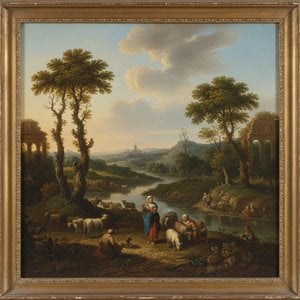
To gaze upon this depiction of a forest landscape is to step across the threshold of time, transported to the sun-dappled, yet subtly shadowed corners of Italia in the early seventeenth century. This piece captures the very essence of the Dutch fascination with the Mediterranean world—a yearning for the classical grandeur and luminous atmosphere that beckoned Northern European artists away from their familiar northern skies. It speaks volumes about the cultural currents of the time, when study trips to Italy were not merely leisure pursuits but vital academic pilgrimages for painters seeking mastery.
The Hand of Jan Both: Mastering Mediterranean Light
Created around 1643 by Jan Both, this work places us squarely within his mature period. Both was a key figure in the "Dutch Italianate" movement, an artistic current defined by its deep absorption of Roman and Venetian landscape ideals. While the subject matter is profoundly natural—a gently sloping hillside descending toward placid waters, framed by dense, brooding foliage—the execution reveals a meticulous technical prowess. The style leans heavily into the detailed realism characteristic of Dutch Golden Age drawing or etching. Notice how the lines themselves become carriers of light and shadow; they are not merely outlines but carefully modulated tonal passages built through expert hatching and cross-hatching.
Technique and Atmosphere: An Etcher's Precision
The physical evidence suggests a technique rooted in drypoint or fine etching upon copper plate. This medium allowed Both to achieve an astonishing level of linear precision, giving the forest its palpable texture. The light is not harsh; rather, it is diffused, suggesting the soft veil of an overcast day or the deep cool shade beneath a canopy. This masterful handling of shadow creates an incredible sense of depth—a visual recession where foreground details give way to atmospheric haze in the distance. The organic shapes of the trees and the water’s edge are rendered with such care that one can almost hear the quiet murmur of the stream.
Symbolism of Solitude and Nature's Embrace
Beyond its technical brilliance, the painting resonates with profound emotional undertones. The subtle inclusion of small figures wandering through the woods transforms the scene from a mere topographical study into a meditation on human experience. These travelers seem absorbed in their own contemplation, dwarfed by the immensity and tranquility of nature. This quietude speaks to an era grappling with both intense artistic patronage (as Both himself experienced) and a growing appreciation for the sublime power of the natural world—a refuge from the bustling life of the city.
Bringing the Italianate Spirit Home
For the collector or designer, this reproduction offers more than just decoration; it offers an atmosphere. It is a window into scholarly aspiration, a celebration of masterful draftsmanship, and an invitation to pause. The deep greens, muted earth tones, and the silvery quality of the water lend themselves beautifully to creating a space that feels both historically rich and serenely contemporary—a perfect anchor for any room seeking the quiet dignity of a classical landscape.
Fragen & Antworten
Was ist die dominierende Farbe von "Forest Landscape" von Jan Both?
Black (#050504) ist die dominierende Farbe von "Forest Landscape" von Jan Both.
Welches Motiv und welche Atmosphäre vereint "Forest Landscape" von Jan Both?
"Forest Landscape" von Jan Both verbindet forest landscape, dutch art, 17th century scene, serene nature, detailed drawing, italian influence, monochromatic tone mit einer Serene Atmosphäre.
Aus welcher Epoche stammt "Forest Landscape" von Jan Both?
Die historische Epoche von "Forest Landscape" von Jan Both ist Early Modern. Diese Klassifizierung ordnet das Werk kunsthistorisch ein.
Ähnliche Kunstwerke


Biografie des Künstlers
Jan Both (1610-1652): Meister des mediterranen Lichts
Jan Dirksz Both war ein niederländischer Maler, Zeichner und Radierer, der als eine der bedeutendsten Figuren der aufstrebenden „italinisierenden“ Landschaftsbewegung während des Goldenen Zeitalters der Niederlande hervorging. Geboren um 1615/16 18 in Utrecht, war er der jüngere Bruder von Andries Both. Ihr Vater, Dirck Both, ein Glasmaler und Glashandwerker, vermittelte ihnen bereits früh eine tiefe Wertschätzung für künstlerisches Handwerk. Obwohl die biografischen Details spärlich geblieben sind, deutet die wissenschaftliche Forschung darauf hin, dass Jans Ausbildung die Lehren von Abraham Bloemaert und Gerrit van Honthorst umfasste, was ihn zu einem der einflussreichen Künstler seiner Zeit machte.- Frühes Leben & Ausbildung: Die prägenden Jahre Boths verbrachte er in Utrecht, wo er seine Fähigkeiten gemeinsam mit seinem Bruder Andries verfeinerte und Techniken aus der Glasmalerei seines Vaters aufnahm – ein Handwerk, das tief in flämischen Traditionen verwurzelt war.
- Römischer Einfluss: Um 1638 begaben sich Jan und Andries auf eine transformative Reise nach Rom über Frankreich. Dort tauchten sie in die künstlerische Leidenschaft des päpstlichen Hofes ein und begegneten Größen wie Bloemaert und Gerrit van Honthorst, was ihre stilistische Sensibilität tiefgreifend prägte.
Der romanische Stil & die Zusammenarbeit mit Lorrain
Rom erwies sich als der entscheidende Schmelztiegel für Boths künstlerische Entwicklung. Während Andries sich auf Genreszenen im Stile von Pieter van Laer konzentrierte, widmete sich Jan primär der Landschaftsmalerei – einem Stil, der Claude Lorrain tief verpflichtet war. Er hielt die ätherische Schönheit der Mittelmeerregion mit einer unvergleichlichen Meisterschaft in Licht und Farbe fest. Besonders bemerkenswert war seine enge Zusammenarbeit mit Herman van Swanevelt an einem monumentalen Projekt für den Palast Buen Retiro in Madrid, was seinen Ehrgeiz und sein künstlerisches Können in den höchsten Kreisen des europäischen Mäzenatentums unter Beweis stellte. Diese Partnerschaft festigte Boths Ruf als führender Innovator der Landschaftsmalerei.Bedeutende Gemälde & künstlerische Merkmale
Das Œuvre von Both zeichnet sich durch weitläufige, fantasievolle Landschaften aus, die in ein leuchtendes, goldenes Licht getaucht sind – ein Markenzeichen des Stils von Lorrain und Ausdruck der breiteren künstlerischen Strömungen, die ganz Europa durchzogen. Sein Meisterwerk „Landschaft mit Banditen, die Gefangene führen“ (Museum of Fine Arts, Boston) verkörpert diese ästhetische Brillanz. Eine diagonale Straße lenkt den Blick des Betrachters in das Bild hinein und stellt realistische Figuren einer Kulisse aus idyllischen Ausblicken gegenüber, die von akribisch ausgearbeiteter Vegetation bevölkert sind. Wiederkehrende Motive sind religiöse oder mythologische Gestalten – wie in „Das Urteil des Paris“ (London, National Gallery) zu sehen –, die oft von Mitstreitern aus Utrecht wie Cornelis van Poelenburch ausgeführt wurden, was Boths Auseinandersetzung mit humanistischen Idealen und künstlerischen Konventionen unterstreicht.Vermächtnis & Einfluss
Jan Boths Bruder Andries erlag tragischerweise während der Rückreise von Rom in Venedz einer Krankheit. Trotz der Kürze seines Lebens etablierte sich Andries als angesehener Künstler, der auf Bauernszenen spezialisiert war – ein Genre, das die sozialen Realitäten jener Zeit widerspiegelte. Das künstlerische Erbe von Jan Both reicht weit über einzelne Gemälde hinaus; er diente als Lehrer für talentierte Schüler wie Barend Bispinck und Willem de Heusch und stellte so sicher, dass seine stilistischen Innovationen Generationen von Künstlern weiterhin inspirieren würden. Sein Werk wird bis heute für seine evokative Atmosphäre, seine meisterhafte Technik und seinen Beitrag zur Entwicklung der niederländischen Landschaftsmalerei gefeiert – ein Zeugnis für Boths dauerhaften Einfluss auf die europäische Kunstgeschichte.Sammlungen
- Fitzwilliam Museum an der University of Cambridge
- Eremitage, St. Petersburg
- Kunsthistorisches Museum, Wien
- Louvre, Paris
- Mauritshuis Königliche Gemäldegalerie

Jan Both
1610 - 1652 , Niederlande
Eckdaten zum Künstler
- Artistic Movement Or Style: Italienische Landschaftsmalerei
- Artists Or Movements Influenced By This Artist: ['Claude Lorrain']
- Artists Who Influenced This Artist:
- Abraham Bloemaert
- Gerrit van Honthorst
- Date Of Birth: Utrecht, Niederlande (1610)
- Date Of Death: 9. August 1652
- Full Name: Jan Dirksz Both
- Nationality: Niederländisch
- Notable Artworks:
- Heilige Anna mit der Jungfrau und dem Kind
- Landschaft mit Banditen, die Gefangene führen
- Das Urteil des Paris
- Place Of Birth: Utrecht
Verwandte Artikel

Die 10 Meisterwerke des Goldenen Zeitalters der niederländischen Malerei |
Entdecken Sie die 10 Meisterwerke des Niederländischen Goldenen Zeitalters! Von Rembrandt bis Vermeer – erleben Sie Kunstgeschichte, Techniken & Emotionen. Hochwertige Gemäldereproduktionen für Ihr Zuhause auf .

Golden Light & Dutch Skies: Bringing the Magic of Dutch Golden Age Landscapes into Your Home
Transform your home with the breathtaking light of Dutch Golden Age landscapes. Discover how hand-painted oil reproductions of masterworks like Ruisdael and Vermeer bring timeless elegance, atmosphere, and soulful texture to modern interiors. Elevate your space with museum-quality art.

Charles Leickert: Capturing the Dutch Golden Age Light – A Comprehensive Study of Technique, Context, and Legacy
Explore the captivating winter landscapes of Charles Leickert, a master of Dutch Golden Age light & atmosphere. Discover his techniques, symbolism, and lasting legacy – a comprehensive study for art enthusiasts and collectors.
Nicolaes Berchem und das Goldene Zeitalter: Pastoralismus, Idealisierung & Künstlerische Innovation
Entdecken Sie die faszinierende Welt von Nicolaes Berchem und das Goldene Zeitalter der niederländischen Landschaftsmalerei. Expertenanalyse, Hintergrundinformationen & künstlerische Innovationen.

Golden Age Reflections: Dutch Baroque Painting & Cultural Innovation
Explore the Dutch Golden Age of painting! Discover key artists like Vermeer & ter Borch, their innovative techniques, and the rich cultural context behind these Baroque masterpieces. Learn about collecting & appreciating this iconic art period.


