


 In echtem Maßstab anzeigen
 Versenden als Grußkarte
 Teilen
 Details anzeigen
 Leitfaden öffnen

 Herunterladen
 Ähnliche Objekte
 Röntgenaufnahme
 Diashow
 Besucherstatistiken
Italian Landscape
 Oil On Canvas
- WallArt
- Romantic Landscape Painting
 1795
1795- Early Modern
 65.0 x 96.0 cm
 Eremitage Museum
 Mehr anzeigen
Handgefertigte Ölreproduktion
Handgemaltes Ölgemälde auf Leinwand in Ihrer Wunschgröße und mit Rahmen, auf Bestellung von unseren Künstlern angefertigt. ( Zum Druck wechseln Zum digitalen Bild wechseln)




P118B €10

P118H €10

P118W €10

P438Z €10

P508JH €12

P508YH €12

P805H €10

P805Z €10

P919BZ €10

P919G €10

P919XJ €10

P959ZH €10

P968JZ €12

W106C €8

W218G €10

W218JH €8

W218Y €10

W307PJ €10

W316G €10

W316PJ €8

W316Y €10

W398PJ €8

W4111J €10

W500HY €15

W500JH €15

W692G €12

W849H €8

W940BG €15

W953PJ €8




Wählen Sie aus unseren vordefinierten Formaten, die den ursprünglichen Proportionen des Kunstwerks entsprechen.

Sie können Ihre eigenen Maße eingeben, um einen bestimmten Rahmen oder Platz auszufüllen. Wenn die gewählte Größe nicht den Proportionen des Originalbildes entspricht, werden wir das Kunstwerk entweder beschneiden oder das Gemälde durch zusätzliche, handgemalte Elemente erweitern. Ein digitales Mockup wird Ihnen zur Genehmigung zugesandt, bevor die Produktion beginnt.
Bitte beachten Sie, dass die Bildschirmvorschau nicht die tatsächliche Beschneidung oder Erweiterung widerspiegelt. Nur das Mockup zeigt die endgültige Komposition exakt an.
Obwohl Sondermaße verfügbar sind, empfehlen wir, eine Größe aus der vordefinierten Liste zu wählen, um die ursprünglichen Proportionen beizubehalten.
Nach der Bestellung wird das ArtsDot.com-Team dem Kunden Anweisungen per E-Mail zusenden und eine Mockup-Vorschau bereitstellen.
Weltweiter Versand () in nur 3 bis 4 Wochen statt der üblichen 5 Wochen. (10 Oktober). Keine Kompromisse bei der Qualität.

Kostenloser weltweiter Expressversand

Hochwertige Leinenleinwand

Vollständiger Versicherungsschutz beim Versand

Zollgebühren-Rückerstattungsgarantie

Garantie für exakte Farbtreue

100-tägiges Rückgaberecht (nur bei Mängeln)

100% Geld-zurück-Garantie

Angebot für Mengenrabatt
 Die Glasoption ist nur für Größen unter 110 cm verfügbar.

Italian Landscape
Reproduktionsmedium
Format der Reproduktion
-


Gesamtpreis
€ 226
A Symphony of Light and Tranquility
In the vast tapestry of the Romantic movement, few works capture the ethereal essence of the Italian countryside as profoundly as Jacob Philippe Hackert’s Italian Landscape. Created in 1795, this oil on canvas masterpiece serves as a window into an idealized Arcadia, where the grandeur of nature and the quietude of pastoral life exist in perfect, undisturbed harmony. As one gazes upon the canvas, there is an immediate sense of being transported to a world far removed from the industrializing tensions of the late 18th century. The painting does not merely represent a location; it evokes a feeling of timelessness, inviting the viewer to linger within its sun-drenched valleys and misty mountain peaks.
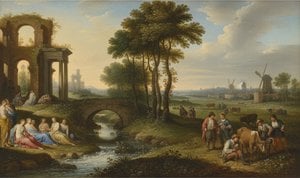
The composition is a masterclass in balanced tension, guiding the eye through a meticulously layered journey. In the foreground, a tranquil river meanders with a gentle grace, its surface acting as a mirror for the clear blue sky and the lush greenery that lines its banks. The presence of grazing cows adds a touch of pastoral intimacy, grounding the epic scale of the landscape in the humble, rhythmic reality of rural life. As the gaze moves toward the middle ground, rolling hills draped in verdant vegetation lead the viewer upward toward a majestic mountain range. These peaks, partially veiled by an atmospheric haze, command the horizon with an imposing power that speaks to the Romantic fascination with the sublime—the awe-inspiring and sometimes overwhelming beauty of the natural world.
The Mastery of Atmosphere and Technique
Hackert’s technical prowess is most evident in his sophisticated use of sfumato, a technique he refined under the influence of his mentor, Claude Joseph Vernet. By subtly blurring the boundaries between distant mountains and the sky, Hackert creates a palpable sense of depth and atmospheric perspective. This soft, smoky transition prevents the landscape from feeling static; instead, it breathes with moisture and light. The artist’s ability to marry minute, realistic details—such as the individual textures of foliage and the rugged contours of rocks—with this expansive, misty atmosphere is what distinguishes this work as a pinnacle of his era.
The color palette is a deliberate study in serenity, dominated by harmonious shades of emerald, forest green, and deep azure. These cool tones are punctuated by the warm, golden light that seems to filter through the clouds, illuminating the classical architecture nestled among the trees. This interplay of light and shadow does more than define form; it establishes a mood of profound peace. For the discerning collector or interior designer, this painting offers a sophisticated focal point that brings a sense of calm and classical elegance to any space, acting as an anchor of tranquility in a modern environment.
Historical Resonance and Lasting Legacy
To understand the Italian Landscape is to understand the heart of a traveling artist. Hackert, born in Germany but deeply enamored with the Mediterranean spirit, spent much of his career capturing the light of Italy. His work reflects the transition from Neoclassical precision toward the more expressive, emotional observations of the Romantic era. The inclusion of classical architectural elements—columns and structures that hint at a storied past—serves as a poignant reminder of humanity's historical connection to the land. These man-made wonders do not intrude upon the scenery but rather blend seamlessly into the natural topography, suggesting a world where civilization and nature exist in a state of grace.
Owning a reproduction of such a significant work allows one to possess a fragment of art history. It is an invitation to daily contemplation, a piece that rewards repeated viewing with new discoveries of light, shadow, and texture. Whether placed in a grand library or a contemporary living suite, Hackert’s vision of the Italian landscape remains a timeless testament to the enduring power of beauty and the quiet majesty of the earth.
Fragen & Antworten
Wie alt war Jakob Philipp Hackert, als „Italian Landscape“ im Jahr 1795 geschaffen wurde?
Jakob Philipp Hackert schuf „Italian Landscape“ im Alter von 58. Der Künstler wurde 1737 geboren, und das Werk datiert auf 1795.
Gibt es für "Italian Landscape" eine Augmented-Reality-Vorschau?
„Italian Landscape“ verfügt über eine Augmented-Reality-Vorschau: Die AR-Vorschau-Seite des Kunstwerks zeigt es auf einem kompatiblen Gerät in Ihrem eigenen Raum.
Wie schafft "Italian Landscape" das Gleichgewicht zwischen Hell und Dunkel?
Die aufgezeichneten Werte für "Italian Landscape" von Jakob Philipp Hackert sind: balanced Helligkeit, Gentle Luminance Luminanz.
In welcher Technik wurde "Italian Landscape" von Jakob Philipp Hackert ausgeführt?
Jakob Philipp Hackert verwendete die Technik der Oil On Canvas für „Italian Landscape“. Die Technik bestimmt die materielle Beschaffenheit des Originalwerks.
In welchem Raum des Zuhauses lässt sich eine Reproduktion von "Italian Landscape" gut platzieren?
Der empfohlene Raum für "Italian Landscape" von Jakob Philipp Hackert ist ein Living Room. Dieser Vorschlag kann natürlich an Ihr Interieur angepasst werden.
Welchem Künstler wird "Italian Landscape" zugeschrieben?
Der Künstler hinter „Italian Landscape“ ist Jakob Philipp Hackert. Das Werk ist unter dem Namen von Jakob Philipp Hackert katalogisiert.
Was ist das Entstehungsdatum von "Italian Landscape" von Jakob Philipp Hackert?
"Italian Landscape" von Jakob Philipp Hackert entstand im Jahr 1795.
Ähnliche Kunstwerke


Biografie des Künstlers
Early Life and Artistic Foundations
Jacob Philipp Hackert wurde im September 1737 in Prenzlau, Brandenburg, geboren – eine Region, die heute Teil Deutschlands ist. Seine Kindheit war von Kunst durchdrungen; sein Vater, Philipp Hackert, praktizierte sowohl als Porträtist als auch als Tierzeichner und legte damit den Grundstein für Jacobs künstlerische Reise. Diese familiäre Einflüsse erstreckten sich auf seinen Onkel, unter dessen Anleitung er seine Fähigkeiten weiter verfeinerte. Eine formale Ausbildung folgte in der renommierten Prussian Academy of Arts in Berlin ab 1758, wo er die technischen Grundlagen entwickelte, die später seinen Stil prägen sollten. Hackerts frühes Berufsleben war jedoch nicht auf Ateliers beschränkt. Seine Reisen führten ihn durch Schwedisch Pommern und schließlich nach Stockholm, wo ihm eine wichtige Bestellung von Baron Adolf Friedrich von Olthof – dekorative Wandmalereien für den Barons Anwesenheit – seinen künstlerischen Horizont erweiterte und ihn mit verschiedenen ästhetischen Einflüssen vertraut machte. Diese prägenden Jahre waren entscheidend für die Formung seines Blickes und bereiteten ihn auf die größeren Bühnen seiner Karriere vor.The Italian Awakening: Paris, Rome, and Naples
Ein einschneidendes Kapitel begann mit Hackerts Umzug nach Paris zwischen 1765 und 1768 zusammen mit dem Schweizer Künstler Balthasar Anton Dunker. Diese Zeit erwies sich als transformativ, indem sie ihn in ein lebendiges künstlerisches Milieu eintauchte. Er ließ sich von Claude Joseph Vernet, dem gefeierten Maler von Landschaften und Seeschiffen, beeinflussen und übernahm Elemente von Vernets dramatische Kompositionen und atmosphärische Effekte in seinen eigenen aufkeimenden Stil. Gleichzeitig trug ein Studium bei dem deutschen Kupferstecher Johann Georg Wille zur Verfeinerung seiner Präzision und Detailgenauigkeit bei. Im Jahr 1768 begab sich Hackert mit seinem Bruder Georg auf eine Reise, die seinen künstlerischen Lauf für immer verändern sollte – er ließ sich hauptsächlich in Rom und Neapel nieder und gründete dort einen außergewöhnlich produktiven Zeitraum, der von zahlreichen Aufträgen für Ansichten des italienischen Landes geprägt war, insbesondere von Sir William Hamilton. Er durchquerte das gesamte Italien, dokumentierte seine Schönheit akribisch und erlangte als Meister des Landschaftsbildnerns Anerkennung. Das Licht, die Farben, die Essenz der italienischen Halbinsel fesselten ihn, wurden zum bestimmenden Merkmal seiner Werke.Patronage, Recognition, and Artistic Flourishing
Hackerts künstlerische Karriere stieg durch Talent und strategische Förderung zu neuen Höhen auf. Seine Fähigkeit, die sublimen Schönheiten Italiens einzufangen, resonierte mit bedeutenden Persönlichkeiten in ganz Europa. Ein Meilensteinauftrag kam von Katharina der Großen aus Russland – ein Zyklus von Gemälden, der den entscheidenden Kampf von Chesma darstellt und seinen Ruf international festigte. Darüber hinaus stärkte eine fruchtbare Beziehung zu Papst Pius VI seine Position durch bedeutende künstlerische Projekte, die seine Vielseitigkeit demonstrierten. Im Jahr 1786 wurde Hackert zum Hofmaler König Ferdinand I. der beiden Sizilien in Neapel ernannt – eine prestigeträchtige Rolle, die über reine Malerei hinausging; er beriet bei der Erstellung eines Malrestaurierungs laboratories im Museo di Capodimonte und beaufsichtigte den Transfer der angesehenen Farnesischen Sammlungen von Rom nach Neapel. Er schuf bemerkenswerte Gemälde, die Caserta und den Königlichen Palast von Caserta darstellten sowie eine Reihe, die die Häfen des Bourbon-Hauses illustrierten. Interessanterweise diente Hackert auch als Geheiminformant für Russland während dieser Zeit – ein Beweis für das komplexe politische Umfeld, in dem er operierte. Eine besonders geschätzte Verbindung entwickelte sich zwischen Hackert und Johann Wolfgang von Goethe während der späteren Besuche des Dichters in Neapel, wodurch eine Freundschaft entstand, die seinen intellektuellen Status weiter erhöhte.Style, Legacy, and Historical Significance
Hackerts künstlerischer Stil stellt eine überzeugende Synthese aus klassischem Landschaftsbildern und einer aufkommenden Romantik dar. Er ist stark von den Werken Claud Lorrain beeinflusst und zeichnet sich durch sorgfältig ausgewogene Anordnungen aus, die beobachtete Realität mit einer idealisierten ästhetischen Vision verbinden. Dennoch unterschied er sich durch ein unerschütterliches Engagement für botanische Genauigkeit und den Wunsch nach erkennbaren Darstellungen von Orten. Seine Gemälde sind durch scharfe Darstellungen natürlicher Details und realistische Darstellungen italienischer Landschaften gekennzeichnet, oft in warmem, goldenem Licht getaucht. Er gilt als einer der größten Interpreten des *Vedutismo*-Genres – Gemälde, die Ansichten von Städten und Landschaften mit topographischer Präzision darstellen. Hackerts historisches Ansehen erstreckt sich über seine künstlerischen Beiträge hinaus; er diente als wichtiger kultureller Botschafter zwischen Deutschland und Italien im späten 18. Jahrhundert und förderte den Austausch zwischen künstlerischen Traditionen. Er starb am 28. April 1807 in San Pietro di Careggi in der Nähe von Florenz und hinterließ ein beträchtliches Werk, das weiterhin Bewunderung und Inspiration für seine Schönheit, sein technisches Können und seine dauerhafte historische Bedeutung hervorruft. *Seine Landschaften sind nicht nur Darstellungen von Landschaftsbildern; sie sind Fenster zu einer Welt, die sowohl klassische Anmut als auch romantische Emotionen vereint.*
Jakob Philipp Hackert
1737 - 1807 , Deutschland
Eckdaten zum Künstler
- Artistic Movement Or Style: Klassizismus, Romantik
- Artists Or Movements Influenced By This Artist: ['Vedutismo']
- Artists Who Influenced This Artist:
- Vernet
- Wille
- Lorrain
- Date Of Birth: 15. September 1737
- Date Of Death: 28. April 1807
- Full Name: Jacob Philipp Hackert
- Nationality: Deutscher
- Notable Artworks:
- Landschaft mit Fluss
- Caserta-Ansicht
- Herbst
- Place Of Birth: Prenzlau, Deutschland
Verwandte Artikel

Evocations of Place: A Historical Journey Through Landscape Art
Explore the rich history of landscape art with ArtsDot. Discover renowned artists, movements like Impressionism & Romanticism, and expert guidance for collecting timeless pieces. Find your perfect serene escape today!

Barock Meisterwerke: Die 10 prägendsten Kunstwerke für Ihr Zuhause |
Entdecken Sie die 10 prägendsten Meisterwerke des Barock! Caravaggio, Rembrandt & Co. – Erfahren Sie die Geschichten hinter ikonischen Gemälde und finden Sie hochwertige Kunst Reproduktionen für Ihr Zuhause auf .

Romantische Landschaften: Die 10 Meisterwerke, die eine Epoche prägten | ArtsDot
Entdecken Sie die 10 Meisterwerke der Romantischen Landschaftsmalerei! Von Caspar David Friedrich bis Turner – erleben Sie die Kunst, Emotion & Natur. Hochwertige Reproduktionen auf ArtsDot.com
Cornelis van Poelenburch: Bridging Mannerism & the Dutch Baroque Landscape
Discover Cornelis van Poelenburch, a pivotal Dutch Baroque landscape painter bridging Mannerism & Italianate styles. Explore his life, key works, and lasting influence on 17th-century art with ArtsDot.

John Constable: Die 25 Meisterwerke des englischen Landschaftsgenies – ArtsDot
Entdecken Sie die 25 Meisterwerke von John Constable! Erleben Sie englische Landschaftsmalerei vom Hay Wain bis zur Stour Valley. Hochwertige Reproduktionen & Kunst für Ihr Zuhause auf ArtsDot.com.
