


 In echtem Maßstab anzeigen
 Versenden als Grußkarte
 Teilen
 Details anzeigen
 Leitfaden

 Herunterladen
 Ähnliche Objekte
 Röntgenaufnahme
 Diashow
 Besucherstatistiken
Haywain (detail)
 Öl auf Tafel
- Early Netherlandish Painting
 1490
1490 66.0 x 147.0 cm
 Mehr anzeigen
Giclée / Kunstdruck
Giclée- oder Leinwanddruck in Museumsqualität mit schneller Produktion und flexiblen Veredelungsoptionen. ( Handgemalte Reproduktion kaufen Zum digitalen Bild wechseln)




P118B $10

P118H $10

P118W $10

P438Z $10

P508JH $12

P508YH $12

P805H $10

P805Z $10

P919BZ $10

P919G $10

P919XJ $10

P959ZH $10

P968JZ $12

W106C $8

W218G $10

W218JH $8

W218Y $10

W307PJ $10

W316G $10

W316PJ $8

W316Y $10

W398PJ $8

W4111J $10

W500HY $15

W500JH $15

W692G $12

W849H $8

W940BG $15

W953PJ $8




Wählen Sie aus unseren vordefinierten Formaten, die den ursprünglichen Proportionen des Kunstwerks entsprechen.

Sie können Ihre eigenen Maße eingeben, um ein bestimmtes Format oder einen speziellen Platz einzupassen. Wenn das von Ihnen gewählte Format nicht den Proportionen des Originalbildes entspricht, werden wir das Kunstwerk entweder beschneiden oder das Bild mit einem gespiegelten oder einfarbigen Rand erweitern. Ein digitaler Entwurf wird Ihnen zur Genehmigung zugesandt, bevor die Produktion beginnt.
Bitte beachten Sie, dass die Vorschau auf dem Bildschirm nicht den tatsächlichen Zuschnitt oder die Erweiterung widerspiegelt. Nur der Entwurf zeigt die endgültige Komposition präzise an.
Obwohl Sondermaße verfügbar sind, empfehlen wir die Auswahl eines Maßes aus der vordefinierten Liste, um die ursprünglichen Proportionen zu bewahren.
Weltweiter Versand () innerhalb von 2 Wochen statt der üblichen 4/5 Wochen. (24 September)

Kostenloser weltweiter Expressversand

Hochwertige Leinenleinwand

Vollständiger Versicherungsschutz beim Versand

Zollgebühren-Rückerstattungsgarantie

Garantie für exakte Farbtreue

100-tägiges Rückgaberecht (nur bei Mängeln)

100% Geld-zurück-Garantie

Angebot für Mengenrabatt
 Die Glasoption ist nur für Größen unter 110 cm verfügbar.

Haywain (detail)
Giclée / Kunstdruck
Format der Reproduktion
-


Gesamtpreis
$ 62
A Window Into a Twisted Paradise: Hieronymus Bosch’s “Haywain” (Detail)
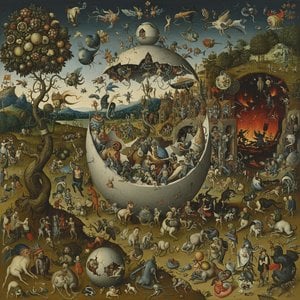
Hieronymus Bosch's "Haywain" – often referred to as “Haywain Detail” when considering this exquisite section of the larger triptych – is not merely a depiction of a rural scene; it’s an immersive descent into a meticulously crafted, profoundly unsettling vision. Painted around 1495-1500 during the height of the Early Netherlandish movement, this work transcends simple representation, offering instead a complex tapestry woven with religious allegory, moral judgment, and a startlingly modern sense of unease. Bosch, a figure shrouded in mystery yet undeniably one of the most influential artists of the Renaissance, created a world where the familiar—a hay wagon, a gathering of people—becomes imbued with layers of symbolic meaning, inviting endless interpretation.
The painting’s immediate impact lies in its sheer density. Thirteen figures populate the scene, each engaged in activities ranging from quiet contemplation to frenzied interaction. Bosch masterfully employs perspective and spatial relationships to draw the viewer into this chaotic tableau. Notice how some individuals are positioned prominently in the foreground, seemingly oblivious to the drama unfolding behind them, while others recede into the distance, suggesting a broader, more ominous context. The artist’s use of color is equally deliberate; earthy tones dominate, punctuated by flashes of vibrant red and unsettling greens – colors often associated with sin and temptation within Bosch's oeuvre.
The Anatomy of Allegory: Decoding Bosch’s Symbolism
Bosch was renowned for his intricate symbolism, a practice deeply rooted in the religious beliefs and anxieties of his time. “Haywain” is no exception; every element contributes to a larger narrative of human fallibility and the perils of earthly desires. The hay wagon itself represents worldly possessions and fleeting pleasures – a tempting trap for the soul. Observe the figures surrounding it: some are engaged in seemingly innocent activities, such as dancing or playing musical instruments, but these actions are subtly corrupted by underlying vices. The presence of a hanged man, a recurring motif in Bosch’s work, serves as a stark reminder of mortality and the consequences of sin.
The details within this section – particularly the figures near the wagon – are laden with symbolic weight. A woman seemingly lost in contemplation, a young man engaged in a furtive exchange, and a group of revelers indulging in sensual pleasures all represent different facets of human temptation. The background landscape, dominated by a fiery sky and ominous clouds, foreshadows impending doom. Bosch’s genius lies not just in depicting these scenes but in suggesting that they are reflections of the inner turmoil within each individual.
Technique and Context: A Masterpiece of Northern Renaissance Art
“Haywain” is executed in oil on panel, a technique favored by Bosch for its ability to capture intricate detail and rich color. The artist’s meticulous brushwork is evident in the rendering of textures – from the rough bark of the trees to the folds of the clothing worn by the figures. Bosch's work belongs firmly within the Early Netherlandish tradition, yet he pushed beyond established conventions, creating a uniquely personal style characterized by fantastical imagery and unsettling psychological depth.
Painted around 1495-1500, “Haywain” is part of a larger triptych – a complex narrative unfolding across three panels. The full triptych, now housed in the Museo del Prado in Madrid, offers further context and expands upon the themes introduced in this detail. It’s important to note that Bosch's work was not always immediately understood; its symbolic complexity often required scholarly interpretation over centuries. This painting reflects a period of growing religious anxiety and social upheaval, mirroring the concerns of a society grappling with questions of morality, faith, and the nature of human existence.
Bringing “Haywain” Home: A Reproduction for Collectors
ArtsDot is proud to offer meticulously hand-painted reproductions of Hieronymus Bosch’s "Haywain (Detail)." Our artists replicate the artist's intricate detail, vibrant colors, and profound symbolism with unparalleled skill. Whether you are an art enthusiast, a collector seeking a unique addition to your collection, or simply someone captivated by this iconic masterpiece, our reproduction provides a stunning window into Bosch’s visionary world. Each reproduction is created on high-quality canvas using archival pigments, ensuring that it will retain its beauty and vibrancy for generations to come. Explore the full artwork at ArtsDot.
Ähnliche Kunstwerke


Biografie des Künstlers
Leben und Karriere
Hieronymus Bosch, ein bedeutender niederländischer/niederländischer Maler aus Brabant, wurde um 1450 in 's-Hertogenbosch, Niederlande, geboren. Sein Leben bleibt einem Mysterium geweiht, mit nur wenigen Aufzeichnungen über seine Existenz. Trotz des Mangels an biografischen Informationen hat sich Boschs Kunst einen tiefgreifenden Einfluss auf die nordeuropäische Kunst erarbeitet, insbesondere im 16. Jahrhundert.Künstlerischer Stil und Einflüsse
Boschs einzigartiger Stil, der durch **surreale und fantasievolle Darstellungen religiöser Themen** gekennzeichnet ist, hat weitreichende Einflüsse ausgeübt. Seine Ölgemälde auf Eichenholz, oft mit **düsteren und traumhaften Visionen der Hölle** ausgestattet, wurden zahlreichen Interpretationen unterzogen. Das Triptychon des letzten Gerichts (ca. 1480-1490) und das Garten der sinnlichen Freuden (ca. 1490-1510) sind zwei seiner bekanntesten Werke, die seine Meisterschaft in der Technik demonstrieren.Bekannte Werke und Sammlungen
* Aufstieg der Seligen (Nordische Renaissance, Öl auf Holzplatte): Ein seltenes Beispiel von Boschs Werk, das eine traumhafte, andereweltliche Szene zeigt. * Epifanie (ca. 1495, Prado Museum, Madrid): Ein Triptychon, das Boschs innovative Verwendung von Öl auf Holz demonstriert. * Kopf eines Halberdiers (Prado Museum, Madrid): Ein feines Beispiel für Boschs Porträtkunst, das seine Detailgenauigkeit zeigt.Museen und Sammlungen mit Boschs Werken
* Das Prado Museum, Madrid: Beherbergt einige seiner berühmtesten Werke, darunter Epifanie und das Triptychon des letzten Gerichts. * Das Philadelphia Museum of Art, Philadelphia: Präsentiert eine Version der Epifanie und bietet so einen einzigartigen Blick auf Boschs künstlerischen Stil.- Erfahren Sie mehr über die Werke von Hieronymus Bosch unter https://ArtsDot.com/@/hieronymus-bosch
- Entdecken Sie die frühe niederländische Kunstbewegung und ihre wichtigsten Figuren, darunter Jan van Eyck und Pieter Bruegel der Ältere, unter https://ArtsDot.com/@@/a@d3cpaf-the-erly-netherlandish-art-movement
- Erfahren Sie mehr über das Leben und Werk von Pieter Bruegel dem Älteren unter https://en.wikipedia.org/wiki/pieter_bruegel_the_elder
Vermächtnis
Hieronymus Boschs rätselhafter Stil hat Kunstliebhaber seit Jahrhunderten in seinen Bann gezogen, und sein Einfluss ist auch heute noch bei zahlreichen Künstlern zu sehen. Seine einzigartige Kombination aus **Surrealismus und tiefgründigen Einsichten in die menschliche Natur** hat seine Position als Meister der niederländischen Malerei gefestigt.
Hieronymus Bosch
1450 - 1516 , Niederlande
Eckdaten zum Künstler
- Beeinflusste Künstler: ['Pieter Bruegel d.Ä.']
- Bemerkenswerte Werke:
- Garten der Lüste
- Letztes Gericht Triptychon
- Aufstieg der Seligen
- Epiphanias
- Geburtsdatum: ca. 1450
- Geburtsort: 's-Hertogenbosch, Niederlande
- Künstlerische Einflüsse:
- Jan van Eyck
- Pieter Bruegel d.Ä.
- Künstlerischer Stil: Frühflämische Malerei
- Nationalität: Niederländisch
- Sterbedatum: 1516
- Vollständiger Name: Hieronymus Bosch
Verwandte Artikel
Hieronymus Bosch: Die 25 Meisterwerke des düsteren Genies – Kunst für Ihr Zuhause | ArtsDot
Entdecken Sie die 25 faszinierendsten Meisterwerke von Hieronymus Bosch! Tauchen Sie ein in die düstere Schönheit niederländischer Malerei, religiöse Symbolik und fantastische Welten. Hochwertige Kunstdrucke & Inspiration für Ihr Zuhause auf ArtsDot.com.

Frühniederländische Meisterwerke: 10 Gemälde, die eine Epoche prägten | ArtsDot
Entdecken Sie die 10 prägendsten Meisterwerke der Frühniederländischen Malerei! Von Jan van Eyck bis Rogier van der Weyden – erleben Sie Kunstgeschichte hautnah. Hochwertige Reproduktionen & Inspiration für Ihr Interieur auf ArtsDot.com.

Hieronymus Bosch: Die Entschlüsselung einer visionären Meisterwerk und seiner tiefgründigen Symbolik
Entdecken Sie die faszinierende Welt des Hieronymus Bosch! Unsere Expertenanalyse enthüllt die tiefgründige Symbolik seiner Meisterwerke, von 'Der Garten der Lüste' bis zum Triptychon des Heiligen Antonius. Erfahren Sie mehr über Leben, Werk und bleibenden Einfluss dieses einzigartigen Künstlers.

The Canvas of Virtue: Exploring Moral Lessons & Narrative Power in Art History
Explore the rich history of moral lessons & symbolism in art! Discover how Renaissance masters like Bosch used allegory to convey virtue & vice. Expert analysis for collectors and enthusiasts.

Museo del Prado: Die 25 Meisterwerke – Kunst für Ihr Zuhause | ArtsDot
Entdecken Sie die 25 Meisterwerke des Museo del Prado! Von Velázquez bis Goya – Kunstgeschichte, Techniken & Geschichten berühmter Gemälde. Finden Sie hochwertige Reproduktionen für Ihr Zuhause auf ArtsDot.com.


