
- Startseite

- Ölgemälde-Reproduktion
- Gustave Caillebotte
- The Pont de Europe
 Druck bestellen Bild kaufen
 Versenden
 Teilen
 Details
 Zu Favoriten hinzufügen

 Herunterladen
 Ähnliche Objekte
 X-Ray
X-Ray
 Diashow anzeigen
The Pont de Europe

Handgefertigte Öl-Reproduktion
Handgemaltes Ölgemälde auf Leinwand in Ihrer Wunschgröße und mit Rahmen, auf Bestellung von unseren Künstlern angefertigt.




P118B $10

P118H $10

P118W $10

P438Z $10

P508JH $12

P508YH $12

P805H $10

P805Z $10

P919BZ $10

P919G $10

P919XJ $10

P959ZH $10

P968JZ $12

W106C $8

W218G $10

W218JH $8

W218Y $10

W307PJ $10

W316G $10

W316PJ $8

W316Y $10

W398PJ $8

W4111J $10

W500HY $15

W500JH $15

W692G $12

W849H $8

W940BG $15

W953PJ $8




 Weiterlesen
Wählen Sie aus unseren vordefinierten Größen, die den ursprünglichen Proportionen des Kunstwerks entsprechen.

Sie können Ihre eigenen Maße eingeben, um einen bestimmten Rahmen oder Platz auszufüllen. Wenn die gewählte Größe nicht den Proportionen des Originalbildes entspricht, werden wir das Kunstwerk entweder beschneiden oder das Gemälde durch zusätzliche, handgemalte Elemente erweitern. Ein digitales Mockup wird Ihnen zur Genehmigung zugesandt, bevor die Produktion beginnt.
Bitte beachten Sie, dass die Bildschirmvorschau nicht die tatsächliche Beschneidung oder Erweiterung widerspiegelt. Nur das Mockup zeigt die endgültige Komposition exakt an.
Obwohl Sondermaße verfügbar sind, empfehlen wir, eine Größe aus der vordefinierten Liste zu wählen, um die ursprünglichen Proportionen beizubehalten.
Nach der Bestellung wird das ArtsDot.com-Team dem Kunden Anweisungen per E-Mail zusenden und eine Mockup-Vorschau bereitstellen.
Weltweiter Versand () in nur 3 bis 4 Wochen statt der üblichen 5 Wochen. (1 Juli). Keine Kompromisse bei der Qualität.

Kostenloser weltweiter Expressversand

Hochwertige Leinenleinwand

Umfassender Versicherungsschutz beim Versand

Zollsteuer-Rückerstattungsgarantie

Garantie für echte Farbtreue

60-Tage-Rückgaberecht (nur bei Mängeln)

100% Geld-zurück-Garantie

Mengenrabatt verfügbar
 Die Glasoption ist nur in Größen unter 110 cm verfügbar.

The Pont de Europe
Art der Reproduktion
Größe der Reproduktion
-


Endpreis aller Optionen
-
Beschreibung des Kunstwerks
A Parisian Moment: Unveiling Gustave Caillebotte’s *The Pont de l'Europe*
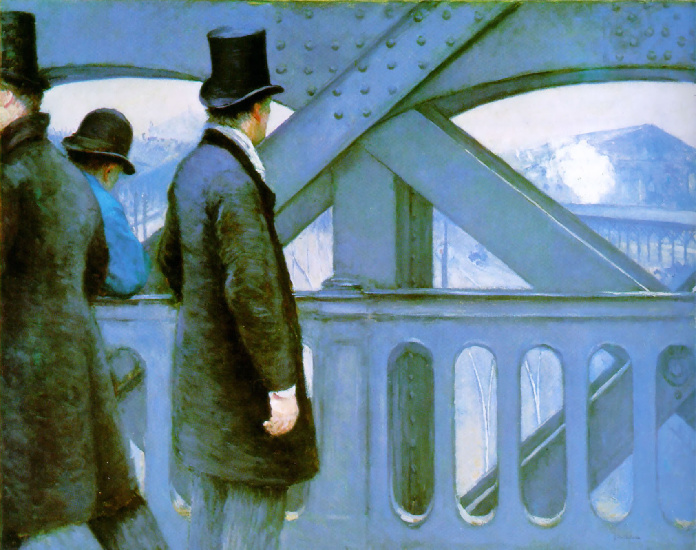
- Subject and Setting: *The Pont de l'Europe* captures a fleeting moment of urban life in 1876 Paris. The scene unfolds on the Place de l'Europe, an impressive bridge constructed over the railway yards of Gare Saint-Lazare. Caillebotte masterfully depicts the bustling intersection of avenues named after European capitals, offering a dynamic snapshot of Haussmann’s rapidly modernizing city. Three figures dominate the foreground – a formally dressed couple and a working-class man – creating a compelling social contrast within the grand architectural setting.
- Impressionist Realism: While associated with the Impressionists, Caillebotte's style diverges from their purely optical explorations. He blends Impressionistic techniques—loose brushwork and an emphasis on light’s effects—with a distinctly realist approach to detail and composition. This unique combination results in a painting that feels both modern and grounded in observable reality. The oblique perspective, influenced by Japanese prints and emerging photography, adds a striking dynamism rarely seen in traditional landscape paintings.
Social Commentary & Symbolism
- Class Dynamics: Caillebotte, himself from an affluent background, subtly explores the social strata of Parisian society. The elegantly attired *flâneur* and his companion stand in stark contrast to the working-class man gazing towards the train station. Some interpretations suggest a complex narrative involving societal observation and even veiled commentary on same-sex desire, with the flâneur’s gaze hinting at hidden desires within the urban landscape.
- The Modern City: The painting is not merely a depiction of a bridge; it's a statement about the changing face of Paris. The Place de l'Europe symbolized progress and connectivity, but also the potential alienation inherent in modern urban life. Caillebotte captures this duality, presenting a scene that is both grand and somewhat isolating.
Technique & Emotional Resonance
- Masterful Composition: The painting’s strength lies in its carefully constructed composition. Caillebotte utilizes strong diagonals, created by the bridge's structure and the figures' placement, to draw the viewer’s eye into the scene. The cool color palette—dominated by blues, greens, and grays—evokes a sense of quiet contemplation and urban melancholy.
- A Moment in Time: *The Pont de l'Europe* isn’t about dramatic action; it’s about capturing an ephemeral moment. The overcast sky and the figures’ subdued expressions contribute to a mood of introspective calm. It invites viewers to pause, observe, and reflect on the rhythms of city life – a quality that continues to resonate with audiences today.
Caillebotte's Legacy & Collecting Considerations
- Gustave Caillebotte was a pivotal figure in the Impressionist movement, not only as an artist but also as a generous patron. His collection formed the cornerstone of Impressionism within French national museums.
- A reproduction of *The Pont de l'Europe* would be a sophisticated addition to any interior, lending a touch of Parisian elegance and intellectual depth. Its cool tones complement modern décor while its subject matter sparks conversation and invites contemplation. Consider pairing it with minimalist furnishings or incorporating it into a gallery wall showcasing 19th-century urban landscapes.
Ähnliche Kunstwerke


Biografie des Künstlers
Frühes Leben und Ausbildung
Gustave Caillebotte, ein französischer Maler, wurde am 19. August 1848 in Paris aus einer wohlhabenden Familie geboren. Sein Vater, Martial Caillebotte, war Erbe der Familienfirma für Militärtuchstoffe und diente auch als Richter am Tribunal de Commerce des Départements Seine. Gustave’s frühes Interesse an Fotografie als Kunstform beeinflusste später seinen Malstil.Künstlerische Karriere
Gustave erwarb 1868 einen Jurabachelor und 1870 eine Zulassung zur Rechtsausübung, doch seine wahre Leidenschaft galt der Kunst. Er begann, das Atelier des Malers Léon Bonnat zu besuchen, wo er ernsthaft Malerei studierte. Caillebotte’s Stil, der durch seinen Realismus gekennzeichnet ist, wurde von seinen impressionistischen Kollegen beeinflusst, darunter Edgar Degas und Giuseppe de Nittis.Bemerkenswerte Werke und Stil
- Les Raboteurs de Parquet (Die Bodenabroller) (1875): Dieses frühe Meisterwerk, das sich heute im Musée d'Orsay befindet, zeigt Caillebotte’s einzigartige Mischung aus Realismus und impressionistischen Einflüssen.
- Vue de toits (Effet de neige) (Aussicht auf Dächer (Schneeeffekt)) (1878): Demonstriert seine Verwendung von erhöhten Perspektiven, eine Technik, die möglicherweise durch japanische Drucke und Fotografie beeinflusst wurde.
Vermächtnis und Einfluss
Caillebotte’s Stil, obwohl Teil der Schule des Realismus, wurde stark von seinen impressionistischen Kollegen beeinflusst. Seine Werke zeichnen sich durch eine präzise Beobachtungsgabe und eine detailgetreue Wiedergabe der Wirklichkeit aus. Er trug dazu bei, die Wahrnehmung des Alltagslebens in der Kunst zu verändern und neue Wege der Darstellung urbaner Szenen aufzuzeigen. Obwohl er zu Lebzeiten nicht immer Anerkennung fand, wird Caillebotte heute als ein bedeutender Vertreter des Impressionismus und Realismus gewürdigt.Weitere Werke
- Mann am Fenster (1875)
- Pink Villas at Trouville (1884)
- Pariser Straße, Regentag

Gustave Caillebotte
1848 - 1894 , Frankreich
Kurzinfos
- Beeinflusste Künstler:
- Edgar Degas
- Giuseppe De Nittis
- Bemerkenswerte Werke:
- Les Raboteurs de Parquet
- Vue de toits (Effet de neige)
- Boulevard vu d'en haut
- Geburtsdatum: 19. August 1848
- Geburtsort: Paris, Frankreich
- Künstlerische Richtung: Realismus, Impressionismus
- Nationalität: Französisch
- Sterbedatum: 1894
- Vollständiger Name: Gustave Caillebotte
Ähnliche Artikel

Impressionistic Realism: Bridging Perception & Representation in 19th-Century Painting
Explore the fascinating intersection of Impressionistic Realism! Discover how 19th-century artists balanced subjective perception with objective representation, revolutionizing art history. Learn about key techniques & masters.


Biedermeier: Art, Society & Intimacy in Restoration Europe
Explore the world of Biedermeier art & culture! Discover the history, aesthetic principles, and lasting influence of this fascinating European movement. Expert insights & beautiful reproductions at ArtsDot.

Concrete Visions: Exploring the Urban Landscape in Painting – From Realism to Contemporary Art
Explore the evolution of cityscape painting from Realism to contemporary art with ArtsDot. Discover key artists & invest in timeless urban visions. Expert guidance, museum-quality reproductions.

Rafael Barradas: Die Synthese europäischer Avantgarde und uruguayischer Moderne – Eine künstlerische Annäherung
Entdecken Sie Rafael Barradas und seine Synthese aus europäischer Avantgarde und uruguayischer Moderne. Expertenanalyse, Sammlerperspektiven & Investitionspotenzial. Jetzt mehr erfahren!

Oscar Bluemner: Bridging European Modernism with American Landscapes
Discover the captivating world of Oscar Bluemner, a key American Modernist bridging European art with uniquely American themes. Explore his vibrant landscapes, bold colors & enduring legacy.



