


 Vorschau anzeigen
 Versenden
 Teilen
 Details anzeigen

 Herunterladen
 Ähnliche Objekte
 Röntgenaufnahme
 Diashow
Metaphysical muse


 Weiterlesen
Handgefertigte Ölreproduktion
Handgemaltes Ölgemälde auf Leinwand in Ihrer Wunschgröße und mit Rahmen, auf Bestellung von unseren Künstlern angefertigt. ( Druck bestellen Bild kaufen)




P118B $10

P118H $10

P118W $10

P438Z $10

P508JH $12

P508YH $12

P805H $10

P805Z $10

P919BZ $10

P919G $10

P919XJ $10

P959ZH $10

P968JZ $12

W106C $8

W218G $10

W218JH $8

W218Y $10

W307PJ $10

W316G $10

W316PJ $8

W316Y $10

W398PJ $8

W4111J $10

W500HY $15

W500JH $15

W692G $12

W849H $8

W940BG $15

W953PJ $8




Wählen Sie aus unseren vordefinierten Formaten, die den ursprünglichen Proportionen des Kunstwerks entsprechen.

Sie können Ihre eigenen Maße eingeben, um einen bestimmten Rahmen oder Platz auszufüllen. Wenn die gewählte Größe nicht den Proportionen des Originalbildes entspricht, werden wir das Kunstwerk entweder beschneiden oder das Gemälde durch zusätzliche, handgemalte Elemente erweitern. Ein digitales Mockup wird Ihnen zur Genehmigung zugesandt, bevor die Produktion beginnt.
Bitte beachten Sie, dass die Bildschirmvorschau nicht die tatsächliche Beschneidung oder Erweiterung widerspiegelt. Nur das Mockup zeigt die endgültige Komposition exakt an.
Obwohl Sondermaße verfügbar sind, empfehlen wir, eine Größe aus der vordefinierten Liste zu wählen, um die ursprünglichen Proportionen beizubehalten.
Nach der Bestellung wird das ArtsDot.com-Team dem Kunden Anweisungen per E-Mail zusenden und eine Mockup-Vorschau bereitstellen.
Weltweiter Versand () in nur 3 bis 4 Wochen statt der üblichen 5 Wochen. (17 August). Keine Kompromisse bei der Qualität.

Kostenloser weltweiter Expressversand

Hochwertige Leinenleinwand

Umfassender Versicherungsschutz beim Versand

Zollgebühren-Rückerstattungsgarantie

Garantie für exakte Farbtreue

60 Tage Rückgaberecht (nur bei Mängeln)

100% Geld-zurück-Garantie

Mengenrabatt verfügbar
 Die Glasoption ist nur für Größen unter 110 cm verfügbar.

Metaphysical muse
Art der Reproduktion
Format der Reproduktion
-


Gesamtpreis
$ 263
Beschreibung des Kunstwerks
A Portrait of Disquiet: De Chirico’s “Metaphysical Muse”
Giorgio de Chirico's "Metaphysical Muse" is not merely a depiction of a woman in a helmet; it’s an immersion into the unsettling logic of the subconscious. Painted around 1917, during his most intensely productive and influential period, this work exemplifies the core tenets of the Metaphysical School – a movement that sought to evoke a sense of dreamlike disorientation through meticulously constructed scenes imbued with symbolic weight. The painting immediately confronts the viewer with an arresting image: a woman’s head, partially obscured by a bizarre, almost alien helmet, dominates the composition. This isn't a portrait in the traditional sense; it’s a carefully orchestrated tableau designed to provoke contemplation and unease.
- The Helmet’s Significance: The helmet itself is arguably the most potent symbol within the piece. Its intricate design – reminiscent of ancient military armor yet undeniably strange – suggests protection, but also confinement and detachment. It could represent a shield against the harsh realities of modern life, or perhaps a barrier erected to guard a vulnerable psyche.
- Architectural Context: The backdrop, featuring a classical building, is crucial to understanding de Chirico’s intent. These architectural elements, often rendered with an unsettling stillness and a sense of isolation, are borrowed from the past – specifically Roman antiquity – but presented in a way that feels utterly detached from time. This juxtaposition creates a profound sense of displacement and timelessness.
- The Smaller Figures: The two smaller figures flanking the central subject further contribute to the painting’s unsettling atmosphere. Their diminished scale emphasizes the woman's dominance, while their presence hints at an audience, or perhaps witnesses to her private torment.
De Chirico and the Metaphysical School
To fully appreciate “Metaphysical Muse,” one must understand the context of de Chirico’s artistic development within the broader movement he spearheaded. Emerging in early 20th-century Italy, the Metaphysical School rejected the Impressionistic focus on fleeting moments and instead sought to capture a deeper, more fundamental reality – one that existed beyond the realm of sensory experience. Influenced by philosophers like Nietzsche and Schopenhauer, de Chirico explored themes of alienation, illusion, and the subjective nature of perception. His work deliberately manipulates perspective, scale, and composition to create an atmosphere of psychological tension and ambiguity. The use of sharp lines, stark contrasts, and unsettling juxtapositions are hallmarks of this style.
- Böcklin’s Influence: De Chirico's early work was profoundly affected by Arnold Böcklin’s symbolic landscapes, particularly “Isle of the Dead.” The mood of melancholy and mystery found in Böcklin’s paintings resonated deeply with de Chirico’s own artistic concerns.
- Munich’s Intellectual Climate: De Chirico's time studying in Munich exposed him to a vibrant intellectual scene, fostering his interest in philosophical ideas that would later inform his art.
Technique and Materiality
De Chirico employed a meticulous technique characterized by precise draftsmanship and a deliberate attention to detail. The painting is executed with oil paints on canvas, utilizing layering and glazing to achieve a remarkable sense of depth and luminosity. Note the careful rendering of the metallic surfaces of the helmet – reflecting light in a way that suggests both hardness and vulnerability. The muted color palette—dominated by browns, grays, and ochres—contributes significantly to the painting’s somber mood. This restrained use of color allows the viewer's eye to focus on the formal elements of composition and the unsettling symbolism within.
Emotional Impact and Legacy
"Metaphysical Muse" continues to captivate viewers with its haunting beauty and profound psychological depth. It is a work that invites introspection, prompting questions about identity, perception, and the nature of reality itself. De Chirico’s ability to evoke such powerful emotions through seemingly simple imagery is a testament to his artistic genius. This painting represents a pivotal moment in 20th-century art, influencing Surrealist artists like René Magritte and Salvador Dalí. A hand-painted reproduction offers an unparalleled opportunity to experience the full impact of this iconic work.
Ähnliche Kunstwerke


Über den Künstler
frühes Leben und Einflüsse
Giorgio de Chirico, ein renommierter italienischer Künstler, wurde am 10. Juli 1888 in Volos, Griechenland, geboren, der Mutter war eine Genueserin und der Vater sizilianisch. Sein frühes Leben war geprägt von der Beschäftigung mit Kunst an der Athener Polytechnik unter der Anleitung griechischer einflussreicher Maler Georgios Roilos und Georgios Jakobides. Diese Grundlage prägte später seinen einzigartigen künstlerischen Stil.Die Metaphysche Kunstbewegung
Im Jahr 1910 gründete de Chirico die Metaphysche Kunstbewegung, die den Surrealisten nachhaltig beeinflusste. Seine Werke aus dieser Zeit, die von unheimlichen Stimmungen und traumhaften Szenarien geprägt sind, werden in Gemälden wie die Verwirrungen des Denkers (verfügbar auf ArtsDot's Plattform) und das Rätsel der Stunde (anschaulich auf ArtsDot) dargestellt. Diese Werke erwecken ein Gefühl von Geheimnis, oft mit scharfen Kontrasten von Licht und Schatten.Postmetaphysche Periode
Nach 1919 verschob sich de Chiricos Interesse hin zu traditionellen Maltechniken und übernahm einen neoklassischen oder neobarocken Stil. Diese Veränderung ist in seinen späteren Werken erkennbar, die zwar nicht die gleiche Kritikerlob wie seine früheren Werke erhielten, aber eine reife Entwicklung in seinem künstlerischen Ansatz demonstrieren.Vermächtnis und Einfluss
De Chiricos Einfluss auf den Surrealismus ist unbestreitbar, wobei Künstler wie André Breton von seinen metaphysischen Gemälden beeinflusst wurden. Obwohl sein späteres Werk nicht so breit gefeiert wurde, bleibt de Chirico eine zentrale Figur in der Geschichte der modernen Kunst. Sein Vermächtnis inspiriert weiterhin, und seine Werke sind in Sammlungen auf der ganzen Welt zu finden, darunter das Museum von Giorgio de Chirico, das sich in der Nähe der Spanischen Treppe in Rom befindet.- Erforsche mehr Werke von Giorgio de Chirico auf ArtsDot
- Entdecke die Metaphysche Kunstbewegung und ihren Einfluss auf Surrealismus durch dieses informative Artikel auf ArtsDot
- Lerne mehr über de Chiricos Leben und Werke auf Wikipedia

Giorgio de Chirico
1888 - 1978 , Griechenland
Kurzinfos
- Beeinflusste Künstler: ['André Breton']
- Bemerkenswerte Werke:
- Die Verwirrungen des Denkers
- Das Rätsel der Stunde
- Das Lied der Liebe
- Geburtsdatum: 10. Juli 1888
- Geburtsort: Volos, Griechenland
- Künstlerische Bewegung: Metaphysische Kunst
- Künstlerische Einflüsse:
- Arnold Böcklin
- Max Klinger
- Friedrich Nietzsche
- Arthur Schopenhauer
- Nationalität: Italienisch
- Vollständiger Name: Giorgio de Chirico
Ähnliche Artikel

Handelsanfragen
APS bietet seit 2004 hochwertige Kunst-Reproduktionen und individuelle Auftragsarbeiten an. Unternehmen, Hotels und ausgewählte Sammler vertrauen auf uns für museumsgerechte Kunstwerke, diskreten Service und umfassende künstlerische Lösungen. Kontaktieren Sie uns für ein individuelles Angebot!

Goya: Die 25 Meisterwerke des spanischen Genies – Kunst für Ihr Zuhause | ArtsDot
Entdecken Sie die 25 Meisterwerke von Francisco Goya! Tauchen Sie ein in die düstere Romantik spanischer Malerei, Porträts & Historienbilder. Hochwertige Kunstdrucke auf ArtsDot.com – für Kunstliebhaber und stilvolles Wohnen.
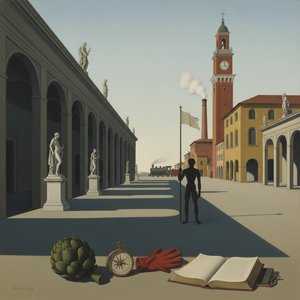
Giorgio de Chirico: Metaphysische Realitäten und die Poetik der Abwesenheit
Entdecken Sie Giorgio de Chiricos revolutionäre Metaphysische Malerei! Analysieren Sie seine Räume, Einflüsse und die Poetik der Abwesenheit. Expertenwissen & tiefe Kunstinterpretation.

Beyond Reality's Veil: Exploring the Enigmatic World of Metaphysical Art
Explore the captivating world of Metaphysical art with ArtsDot. Discover Giorgio de Chirico's iconic paintings, philosophical influences & lasting impact on Surrealism. Expert insights for collectors.

Giclée Prints: Archival Quality & Aesthetic Nuances for the Discerning Collector
Explore the world of giclée prints with ArtsDot. Learn about archival quality, aesthetic nuances & investment potential. Expert guidance for discerning art collectors seeking museum-quality reproductions and lasting value.



