


 In echtem Maßstab anzeigen
 Versenden als Grußkarte
 Teilen
 Details anzeigen
 Leitfaden

 Herunterladen
 Ähnliche Objekte
 Röntgenaufnahme
 Diashow
 Besucherstatistiken
Battle


 Mehr anzeigen
Giclée / Kunstdruck
Giclée- oder Leinwanddruck in Museumsqualität mit schneller Produktion und flexiblen Veredelungsoptionen. ( Handgemalte Reproduktion kaufen Zum digitalen Bild wechseln)




P118B €10

P118H €10

P118W €10

P438Z €10

P508JH €12

P508YH €12

P805H €10

P805Z €10

P919BZ €10

P919G €10

P919XJ €10

P959ZH €10

P968JZ €12

W106C €8

W218G €10

W218JH €8

W218Y €10

W307PJ €10

W316G €10

W316PJ €8

W316Y €10

W398PJ €8

W4111J €10

W500HY €15

W500JH €15

W692G €12

W849H €8

W940BG €15

W953PJ €8




Wählen Sie aus unseren vordefinierten Formaten, die den ursprünglichen Proportionen des Kunstwerks entsprechen.

Sie können Ihre eigenen Maße eingeben, um ein bestimmtes Format oder einen speziellen Platz einzupassen. Wenn das von Ihnen gewählte Format nicht den Proportionen des Originalbildes entspricht, werden wir das Kunstwerk entweder beschneiden oder das Bild mit einem gespiegelten oder einfarbigen Rand erweitern. Ein digitaler Entwurf wird Ihnen zur Genehmigung zugesandt, bevor die Produktion beginnt.
Bitte beachten Sie, dass die Vorschau auf dem Bildschirm nicht den tatsächlichen Zuschnitt oder die Erweiterung widerspiegelt. Nur der Entwurf zeigt die endgültige Komposition präzise an.
Obwohl Sondermaße verfügbar sind, empfehlen wir die Auswahl eines Maßes aus der vordefinierten Liste, um die ursprünglichen Proportionen zu bewahren.
Weltweiter Versand () innerhalb von 2 Wochen statt der üblichen 4/5 Wochen. (22 September)

Kostenloser weltweiter Expressversand

Hochwertige Leinenleinwand

Vollständiger Versicherungsschutz beim Versand

Zollgebühren-Rückerstattungsgarantie

Garantie für exakte Farbtreue

100-tägiges Rückgaberecht (nur bei Mängeln)

100% Geld-zurück-Garantie

Angebot für Mengenrabatt
 Die Glasoption ist nur für Größen unter 110 cm verfügbar.

Battle
Giclée / Kunstdruck
Format der Reproduktion
-


Gesamtpreis
€ 53
A Vision of Conflict: De Chirico’s “Battle” – Exploring Surrealist Landscape
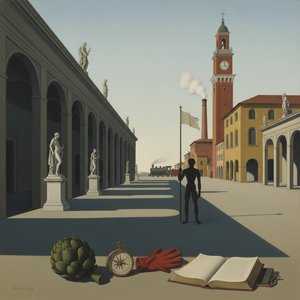
Giorgio de Chirico's "Battle," a painting shrouded in mystery and imbued with unsettling beauty, stands as a cornerstone of Surrealist landscape art. Created around 1920-1921 during his formative years in Munich—a period profoundly influenced by Nietzsche’s existential philosophy—the artwork transcends mere depiction; it delves into the subconscious mind's confrontation with reality. The scene unfolds within an imagined Roman piazza, rendered with meticulous detail yet imbued with a dreamlike quality that defies conventional perspective. This deliberate distortion serves not merely as stylistic flourish but as a crucial element in conveying the painting’s core thematic concerns: disorientation and the fragmentation of experience.- Subject Matter: The composition centers on a chaotic battlefield, populated by figures engaged in violent combat. Despite the grim subject matter, De Chirico employs a strikingly calm palette—primarily ochres, browns, and muted reds—creating a paradoxical juxtaposition that amplifies the emotional impact.
- Style & Technique: Characteristic of De Chirico’s Surrealist style is his masterful use of *Cubism* combined with elements of *Romantic landscape painting*. The figures are rendered in fragmented planes, mirroring the fractured nature of consciousness and challenging viewers to reconstruct a coherent narrative from disjointed visual cues. Impasto technique—thickly applied paint—adds textural richness and contributes to the overall sense of unease.
Historical Context: Nietzsche’s Influence & The Weimar Era
De Chirico's artistic vision was inextricably linked to the intellectual climate of Weimar Germany, where philosophical debates raged concerning morality, faith, and the role of art in confronting existential anxieties. Friedrich Nietzsche’s proclamation that “God is dead” resonated deeply within De Chirico’s psyche, fueling his exploration of irrational forces and questioning established conventions. This preoccupation with nihilism—the belief in the absence of inherent meaning—manifested itself in his artwork through unsettling juxtapositions and dreamlike imagery, mirroring Nietzsche's concept of perspectivism: that truth is subjective and dependent on individual viewpoint. The painting reflects a broader cultural shift away from traditional values toward an embrace of psychological complexity.- Symbolism: The horse—a recurring motif in De Chirico’s oeuvre—represents primal instinct and embodies the destructive potential inherent within human nature. Its positioning at the center of the piazza underscores its dominance over the battlefield, symbolizing both power and vulnerability.
- Emotional Impact: “Battle” evokes a profound sense of melancholy and disorientation. The stillness of the piazza contrasts sharply with the frenetic activity of the combatants, highlighting the inescapable tension between order and chaos—a theme central to De Chirico’s artistic exploration of the human condition.
Comparative Analysis: Echoes of Böcklin & Klinger
De Chirico's aesthetic sensibilities were undeniably shaped by his exposure to the works of Arnold Böcklin and Max Klinger—artists who similarly employed symbolic landscapes to convey psychological states. Like Böcklin’s “Isle of Flowers,” De Chirico’s piazza operates as a stage for confronting anxieties about mortality and transcendence. Furthermore, Klinger's preoccupation with grotesque imagery finds parallels in De Chirico’s unsettling compositions, demonstrating a shared commitment to exploring the darker recesses of human consciousness. The influence of these artists underscores De Chirico’s position at the vanguard of Surrealist art—a movement dedicated to liberating imagination from rational constraints and accessing realms beyond conscious awareness.Conclusion: A Timeless Reflection on Human Experience
“Battle” remains a powerfully evocative artwork, continuing to captivate viewers with its masterful blend of stylistic innovation and psychological depth. De Chirico’s ability to distill existential anxieties into a visually arresting landscape—a testament to his artistic genius—solidifies his legacy as one of the most significant figures in Surrealist art history. Its enduring appeal lies not merely in its aesthetic beauty but in its profound contemplation of the human condition, prompting viewers to confront unsettling truths about our relationship with reality and ourselves.Ähnliche Kunstwerke


Biografie des Künstlers
frühes Leben und Einflüsse
Giorgio de Chirico, ein renommierter italienischer Künstler, wurde am 10. Juli 1888 in Volos, Griechenland, geboren, der Mutter war eine Genueserin und der Vater sizilianisch. Sein frühes Leben war geprägt von der Beschäftigung mit Kunst an der Athener Polytechnik unter der Anleitung griechischer einflussreicher Maler Georgios Roilos und Georgios Jakobides. Diese Grundlage prägte später seinen einzigartigen künstlerischen Stil.Die Metaphysche Kunstbewegung
Im Jahr 1910 gründete de Chirico die Metaphysche Kunstbewegung, die den Surrealisten nachhaltig beeinflusste. Seine Werke aus dieser Zeit, die von unheimlichen Stimmungen und traumhaften Szenarien geprägt sind, werden in Gemälden wie die Verwirrungen des Denkers (verfügbar auf ArtsDot's Plattform) und das Rätsel der Stunde (anschaulich auf ArtsDot) dargestellt. Diese Werke erwecken ein Gefühl von Geheimnis, oft mit scharfen Kontrasten von Licht und Schatten.Postmetaphysche Periode
Nach 1919 verschob sich de Chiricos Interesse hin zu traditionellen Maltechniken und übernahm einen neoklassischen oder neobarocken Stil. Diese Veränderung ist in seinen späteren Werken erkennbar, die zwar nicht die gleiche Kritikerlob wie seine früheren Werke erhielten, aber eine reife Entwicklung in seinem künstlerischen Ansatz demonstrieren.Vermächtnis und Einfluss
De Chiricos Einfluss auf den Surrealismus ist unbestreitbar, wobei Künstler wie André Breton von seinen metaphysischen Gemälden beeinflusst wurden. Obwohl sein späteres Werk nicht so breit gefeiert wurde, bleibt de Chirico eine zentrale Figur in der Geschichte der modernen Kunst. Sein Vermächtnis inspiriert weiterhin, und seine Werke sind in Sammlungen auf der ganzen Welt zu finden, darunter das Museum von Giorgio de Chirico, das sich in der Nähe der Spanischen Treppe in Rom befindet.- Erforsche mehr Werke von Giorgio de Chirico auf ArtsDot
- Entdecke die Metaphysche Kunstbewegung und ihren Einfluss auf Surrealismus durch dieses informative Artikel auf ArtsDot
- Lerne mehr über de Chiricos Leben und Werke auf Wikipedia

Giorgio de Chirico
1888 - 1978 , Griechenland
Eckdaten zum Künstler
- Beeinflusste Künstler: ['André Breton']
- Bemerkenswerte Werke:
- Die Verwirrungen des Denkers
- Das Rätsel der Stunde
- Das Lied der Liebe
- Geburtsdatum: 10. Juli 1888
- Geburtsort: Volos, Griechenland
- Künstlerische Bewegung: Metaphysische Kunst
- Künstlerische Einflüsse:
- Arnold Böcklin
- Max Klinger
- Friedrich Nietzsche
- Arthur Schopenhauer
- Nationalität: Italienisch
- Vollständiger Name: Giorgio de Chirico
Verwandte Artikel

Evocations of Place: A Historical Journey Through Landscape Art
Explore the rich history of landscape art with ArtsDot. Discover renowned artists, movements like Impressionism & Romanticism, and expert guidance for collecting timeless pieces. Find your perfect serene escape today!

Über uns
Entdecken Sie unsere Geschichte! Wir bringen Weltklasse-Kunst in Ihr Leben durch fachkundige Auswahl, individuelle Kreationen und kostenlose Vorschauen. Seit dem Jahr 2000 von Privatpersonen und Unternehmen geschätzt.

Romantische Landschaften: Die 10 Meisterwerke, die eine Epoche prägten | ArtsDot
Entdecken Sie die 10 Meisterwerke der Romantischen Landschaftsmalerei! Von Caspar David Friedrich bis Turner – erleben Sie die Kunst, Emotion & Natur. Hochwertige Reproduktionen auf ArtsDot.com
Giorgio de Chirico: Metaphysische Realitäten und die Poetik der Abwesenheit
Entdecken Sie Giorgio de Chiricos revolutionäre Metaphysische Malerei! Analysieren Sie seine Räume, Einflüsse und die Poetik der Abwesenheit. Expertenwissen & tiefe Kunstinterpretation.

Goya: Die 25 Meisterwerke des spanischen Genies – Kunst für Ihr Zuhause | ArtsDot
Entdecken Sie die 25 Meisterwerke von Francisco Goya! Tauchen Sie ein in die düstere Romantik spanischer Malerei, Porträts & Historienbilder. Hochwertige Kunstdrucke auf ArtsDot.com – für Kunstliebhaber und stilvolles Wohnen.


