

 Vorschau anzeigen
 Versenden
 Teilen
 Details anzeigen
 Leitfaden

 Herunterladen
 Ähnliche Objekte
 Röntgenaufnahme
 Diashow
 Fragen & Antworten
 Statistiken
Archaeologists


 Weiterlesen
Die auf dieser Seite dargestellten Kunstwerke sind urheberrechtlich geschützt, was bedeutet, dass wir keine identische Reproduktion rechtmäßig erstellen oder verkaufen dürfen. Dieser Schutz wird durch internationale Abkommen wie die Berner Übereinkunft und durch nationale Gesetze, einschließlich derer, die von den US-Urheberrecht – Titel 17.
Diese Methode entspricht vollumfänglich den Urheberrechtsbestimmungen, da sie keine Kopie oder Vervielfältigung des geschützten Kunstwerks darstellt. Stattdessen handelt es sich um eine kreative Neuinterpretation – ein neues Gemälde, das vom Original inspiriert, aber nicht identisch mit ihm ist.
Giclée / Kunstdruck
Giclée- oder Leinwanddruck in Museumsqualität mit schneller Produktion und flexiblen Veredelungsoptionen. ( Handgemalte Reproduktion bestellen Zum digitalen Bild wechseln)




P118B €10

P118H €10

P118W €10

P438Z €10

P508JH €12

P508YH €12

P805H €10

P805Z €10

P919BZ €10

P919G €10

P919XJ €10

P959ZH €10

P968JZ €12

W106C €8

W218G €10

W218JH €8

W218Y €10

W307PJ €10

W316G €10

W316PJ €8

W316Y €10

W398PJ €8

W4111J €10

W500HY €15

W500JH €15

W692G €12

W849H €8

W940BG €15

W953PJ €8




Wählen Sie aus unseren vordefinierten Formaten, die den ursprünglichen Proportionen des Kunstwerks entsprechen.

Geben Sie die benötigte Breite und Höhe an, damit der Druck perfekt in Ihren Rahmen oder an Ihre Wand passt. Ein Druck kann nur beschnitten, aber niemals größer als das Originalbild angefertigt werden; daher verliert ein Format mit anderen Proportionen einen Teil des Bildes. Wir senden Ihnen ein digitales Mockup zur Freigabe, bevor wir den Druck ausführen. Das auf dieser Seite gezeigte Bild zeigt nicht den tatsächlichen Beschnitt – dies ist nur im Mockup ersichtlich.
Weltweiter Versand () innerhalb von 2 Wochen statt der üblichen 4/5 Wochen. (4 November)

Kostenloser weltweiter Expressversand

Hochwertige Leinenleinwand

Umfassender Versicherungsschutz beim Versand

Zollgebühren-Rückerstattungsgarantie

Garantie für exakte Farbtreue

100 Tage Rückgaberecht (nur bei Mängeln)

100% Geld-zurück-Garantie

Mengenrabatt verfügbar
 Die Glasoption ist nur für Größen unter 110 cm verfügbar.

Archaeologists
Giclée / Kunstdruck
Format der Reproduktion
-


Endpreis
€ 56
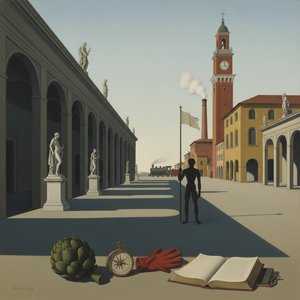
Giorgio De Chirico’s Archaeologists: A Fragmented Dreamscape
- Subject Matter: Giorgio de Chirico's “Archaeologists” presents a striking juxtaposition of figures and architectural elements, capturing a moment suspended between reality and illusion. At the forefront stand two human forms—one holding a book—and another appearing as a statue or sculpture—a deliberate pairing that invites contemplation on knowledge, memory, and permanence.
- Style: The painting firmly establishes itself within De Chirico’s signature metaphysical style, characterized by unsettling stillness and an uncanny sense of disorientation. It embodies the Surrealist movement's fascination with dreamlike imagery and psychological exploration, yet retains a distinctly classical influence evident in its compositional structure.
- Technique: Executed in oil on canvas, “Archaeologists” showcases De Chirico’s meticulous attention to detail—particularly noticeable in the rendering of the statue's surface and the cityscape backdrop. His technique prioritizes tonal gradation and subtle shading to create a palpable atmosphere of melancholy and mystery.
- Historical Context: Created in 1926, “Archaeologists” emerged during a period of profound intellectual upheaval in Europe—the Weimar Republic—marked by anxieties surrounding the decline of traditional values and the rise of psychoanalysis. De Chirico’s work reflects these concerns, delving into themes of isolation, decay, and the subconscious mind.
- Symbolism: The book symbolizes erudition and intellectual pursuit, contrasting with the statue's impassivity—representing timelessness and perhaps hinting at forgotten histories. The cityscape serves as a backdrop for psychological drama, suggesting an urban environment devoid of human warmth or connection. Overall, the painting evokes feelings of unease and contemplation, prompting viewers to confront questions about identity and existence.
This reproduction captures not merely the visual appearance of De Chirico’s masterpiece but also its underlying emotional resonance. Its muted palette and masterful execution translate beautifully into a high-quality print, offering an opportunity to bring this evocative artwork into any interior space—a testament to De Chirico's enduring legacy as one of the most influential artists of the 20th century.
Fragen & Antworten
Gibt es Werke, die "Archaeologists" ähneln?
Ähnliche Werke zu „Archaeologists“ finden Sie auf der Seite Ähnliche Werke des Kunstwerks.
Welche Farbpalette wird in "Archaeologists" von Giorgio de Chirico verwendet?
Die Farben von "Archaeologists" bilden eine Erdig-Palette. Diese Klassifizierung beschreibt die dominierenden Farbfamilien.
Welche emotionale Stimmung prägt den Stil der Surrealist Dreamscape-Epoche in „Archaeologists“?
Innerhalb der Surrealist Dreamscape-Strömung ist „Archaeologists“ mit einem Geheimnisvoll Ton festgehalten.
Ähnliche Kunstwerke


Künstlerbiografie
frühes Leben und Einflüsse
Giorgio de Chirico, ein renommierter italienischer Künstler, wurde am 10. Juli 1888 in Volos, Griechenland, geboren, der Mutter war eine Genueserin und der Vater sizilianisch. Sein frühes Leben war geprägt von der Beschäftigung mit Kunst an der Athener Polytechnik unter der Anleitung griechischer einflussreicher Maler Georgios Roilos und Georgios Jakobides. Diese Grundlage prägte später seinen einzigartigen künstlerischen Stil.Die Metaphysche Kunstbewegung
Im Jahr 1910 gründete de Chirico die Metaphysche Kunstbewegung, die den Surrealisten nachhaltig beeinflusste. Seine Werke aus dieser Zeit, die von unheimlichen Stimmungen und traumhaften Szenarien geprägt sind, werden in Gemälden wie die Verwirrungen des Denkers (verfügbar auf ArtsDot's Plattform) und das Rätsel der Stunde (anschaulich auf ArtsDot) dargestellt. Diese Werke erwecken ein Gefühl von Geheimnis, oft mit scharfen Kontrasten von Licht und Schatten.Postmetaphysche Periode
Nach 1919 verschob sich de Chiricos Interesse hin zu traditionellen Maltechniken und übernahm einen neoklassischen oder neobarocken Stil. Diese Veränderung ist in seinen späteren Werken erkennbar, die zwar nicht die gleiche Kritikerlob wie seine früheren Werke erhielten, aber eine reife Entwicklung in seinem künstlerischen Ansatz demonstrieren.Vermächtnis und Einfluss
De Chiricos Einfluss auf den Surrealismus ist unbestreitbar, wobei Künstler wie André Breton von seinen metaphysischen Gemälden beeinflusst wurden. Obwohl sein späteres Werk nicht so breit gefeiert wurde, bleibt de Chirico eine zentrale Figur in der Geschichte der modernen Kunst. Sein Vermächtnis inspiriert weiterhin, und seine Werke sind in Sammlungen auf der ganzen Welt zu finden, darunter das Museum von Giorgio de Chirico, das sich in der Nähe der Spanischen Treppe in Rom befindet.- Erforsche mehr Werke von Giorgio de Chirico auf ArtsDot
- Entdecke die Metaphysche Kunstbewegung und ihren Einfluss auf Surrealismus durch dieses informative Artikel auf ArtsDot
- Lerne mehr über de Chiricos Leben und Werke auf Wikipedia

Giorgio de Chirico
1888 - 1978 , Griechenland
Kurzinfos
- Beeinflusste Künstler: ['André Breton']
- Bemerkenswerte Werke:
- Die Verwirrungen des Denkers
- Das Rätsel der Stunde
- Das Lied der Liebe
- Geburtsdatum: 10. Juli 1888
- Geburtsort: Volos, Griechenland
- Künstlerische Bewegung: Metaphysische Kunst
- Künstlerische Einflüsse:
- Arnold Böcklin
- Max Klinger
- Friedrich Nietzsche
- Arthur Schopenhauer
- Nationalität: Italienisch
- Vollständiger Name: Giorgio de Chirico
Ähnliche Artikel

Bronze-Meisterwerke: Die 10 Skulpturen, die Kunstgeschichte schrieben | ArtsDot
Entdecken Sie die 10 legendärsten Bronze Skulpturen der Kunstgeschichte! Von Michelangelo bis Rodin – erfahren Sie die Geschichten hinter den Meisterwerken und lassen Sie sich von Wanddeko-Ideen inspirieren. Hochwertige Kunstdrucke auf ArtsDot.com.

Meister der Schatten: Die 25 eindrucksvollsten Kunstwerke von Francisco Goya
Erleben Sie Goyas Meisterwerke von Romantik bis Schatten. Entdecken Sie alle Klassiker auf ArtsDot.com.

Die 10 legendärsten Bronzestatuen: Meisterwerke, die Kunstgeschichte schrieben | ArtsDot
Entdecken Sie die 10 legendärsten Bronzestatuen der Kunstgeschichte! Von Rodin bis Michelangelo – erfahren Sie die Geschichten hinter ikonischen Skulpturen und finden Sie hochwertige Reproduktionen für Ihr Zuhause. Jetzt bei ArtsDot entdecken!
Giorgio de Chirico: Metaphysische Realitäten und die Poetik der Abwesenheit
Entdecken Sie Giorgio de Chiricos revolutionäre Metaphysische Malerei! Analysieren Sie seine Räume, Einflüsse und die Poetik der Abwesenheit. Expertenwissen & tiefe Kunstinterpretation.

The Enduring Form: Exploring Themes & Techniques in Sculpture Across Historical Periods
Explore the rich history of sculpture from ancient masterpieces to contemporary innovations. Discover key techniques, influential artists & investment potential for discerning art collectors.


